The U.S. Food and Drug Administration (FDA) has authorized Neuralink to launch the LINK pivotal trial, which will evaluate its implantable brain-computer interface in people with severe paralysis caused by amyotrophic lateral sclerosis (ALS). The company announced the approval on November 25; the study aims to determine whether participants can operate digital devices with their thoughts and assess the system’s long-term safety.
Neuralink describes it as the first pivotal U.S. trial of an implantable brain-computer interface. The company will evaluate the safety and effectiveness of its system at several clinical sites, focusing on functional outcomes that could help participants gain independence in their daily lives. The trial will also continue to assess the device’s reliability over time.
The authorization enables the study, not general use of the implant. A pivotal trial is usually an advanced phase that precedes an application to market a device; it does not mean the FDA has approved its sale. If the results support the system’s safety and performance, they could help advance it to further evaluation stages.
Who can apply to participate
Enrollment is open to adults with ALS in the United States, according to Neuralink and Digital Trends. The company has not specified the expected number of participants or all the eligibility requirements. Digital Trends reports that interested people can submit a form through Neuralink’s patient registry; the company says it plans to expand access to the study over time.
The trial focuses on people whose severe paralysis is related to ALS. This is a more narrowly defined group than those in some of Neuralink’s earlier studies, which also included people with spinal cord injuries or a brainstem stroke, according to Digital Trends and TNW.
Before receiving the implant, candidates undergo an initial assessment and neuroimaging, according to Digital Trends. The procedure uses Neuralink’s R1 surgical robot. Afterward, participants receive instructions on learning to move a cursor with their thoughts and attend follow-up visits for about 24 months; some may take place remotely.
20minutos details a schedule of checkups at 10 and 45 days, and at 3, 6, 12, and 24 months after surgery, at clinical sites and from home. TNW also reports that follow-up lasts around 24 months and that some visits are remote. The publications describe these checkups as part of monitoring the implant’s performance and safety.
What LINK aims to measure
The trial will test whether participants can control digital devices with their thoughts, with a particular focus on tasks that support everyday independence. Neuralink will also continue to assess long-term safety and reliability at different clinical sites. These reports have not published figures for the number of participants, expected results, or a timeline for completing the study.
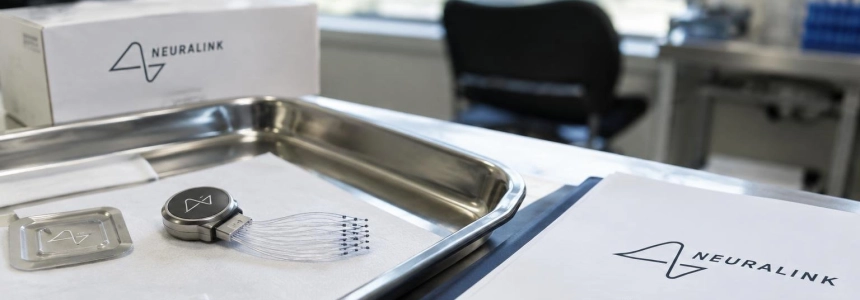
The approach involves translating brain signals associated with movement into digital commands. 20minutos explains that the implant, which it calls Telepathy, records activity in the brain region associated with the hand: the user imagines moving it and learns to convert those attempts into cursor movements. This allows them to use a computer to write, send messages, or play games, according to the publication.
Engadget describes the system as an N1 implant placed in the skull, with flexible electrodes inserted into the brain by the R1 robot. The software interprets neural activity related to movement and transforms it into commands for computers or other digital devices. The stated goal is to enable people with paralysis to interact without relying on keyboards or other physical controls.

More than 30 participants in earlier studies
LINK builds on early feasibility studies conducted in the United States, Canada, and the United Kingdom. Neuralink says more than 30 people have received implants and accumulated thousands of hours of real-world use. The company cites activities such as pursuing education, creative expression, playing video games, and communicating with family members.
The company summarized the progress in an announcement published on November 25: “We’ve received FDA approval to launch LINK, the first pivotal trial for an implantable brain-computer interface in the US. This builds off of our work with 30+ participants with Neuralink to date.”
We’ve received FDA approval to launch LINK, the first pivotal trial for an implantable brain-computer interface in the US. This builds off of our work with 30+ participants with Neuralink to date.
— Neuralink
Those earlier studies were exploratory and are not equivalent to LINK. Digital Trends notes that the FDA also recognized Neuralink’s vision- and speech-related initiatives as breakthrough devices, a fast-track review pathway that does not grant permission to market them. The LINK study therefore marks a more advanced research stage, but it remains a clinical evaluation.
A history of challenges and new competitors
The development comes after technical problems and regulatory scrutiny. The New York Times reported, according to TNW, that Neuralink’s first participant had technical problems with the implant in 2024, although he said he did not regret participating. Reuters reported on a federal investigation into the company’s animal testing in 2022.
Engadget recalls that Neuralink announced the previous year that its first participant with ALS, Bradford Smith, could communicate using brain signals. Smith described the effect on his life at the time in these words: “Neuralink has given me freedom, hope, and faster communication. ... It has improved my life so much. I'm so happy to be involved in something big that will help many people”.
Competition is also heating up. Paradromics implanted its chip in its first patient in June, according to TNW. That same month, China approved a commercial implant and, in July, implanted the device in its first patient, according to the same publication. The South China Morning Post reported that Beijing aims to get ahead of the United States through standards for brain-computer interfaces and wider real-world adoption.
The FDA’s authorization allows Neuralink to begin the study with adults with ALS and continue gathering clinical data. In LINK, the company will have to demonstrate how thought-based control and the system’s safety perform during follow-up; for now, the authorization is limited to conducting the trial.
Sources: TNW | Health-tech, Technology, Digital Trends, Neuralink Updates, Bloomberg Law / Bloomberg News, Engadget