Satya Nadella cannot guarantee that Microsoft jobs will stay as they are. The CEO explained that the company offered voluntary exits to 60,000 eligible employees as it reorganizes its teams to incorporate artificial intelligence (AI) into their work. He did not say the company would directly replace them with AI: he described a change in roles, workflows, and team sizes.
At the DealBook Summit, Nadella explained that the offer, introduced in October, was intended to let workers decide whether they wanted to stay at Microsoft during the transformation. In a conversation with Gergely Orosz of The Pragmatic Engineer podcast, he was more direct about the uncertainty: he said the company’s more than 200,000 employees will have to organize themselves differently as the way software is developed changes.
“I wish I could just sit here and say it’ll all be the same. I cannot.”
— Satya Nadella, CEO of Microsoft
A voluntary exit, not a layoff announcement
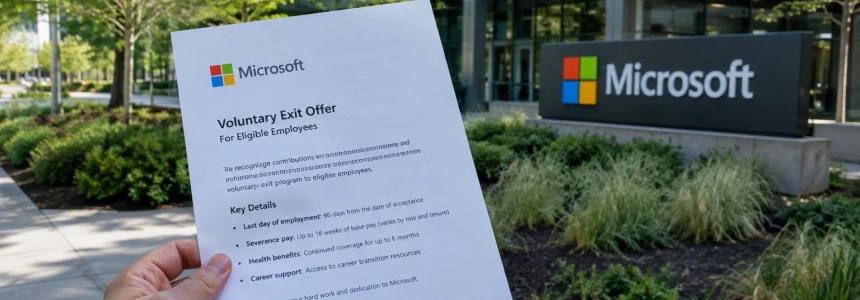
Microsoft introduced the Voluntary Exit Offer (VEO) on October 26. Amy Coleman, executive vice president and Chief People Officer, announced that the program would be available to eligible employees on participating teams in the United States, Canada, the United Kingdom, and India, at level 70 or below. It includes financial support and career-planning resources; participation is at each organization’s discretion.
The offer has no age or tenure requirements. Windows Latest distinguishes it from the voluntary retirement program in April, which was limited to U.S. employees whose age and years of service added up to at least 70. Microsoft told Fortune, according to Windows Latest, that it expects fewer than 5% of those eligible to accept the VEO: fewer than 3,000 people.
The company did not describe the measure as a retirement plan. Coleman presented it as an option for people who were already considering working outside Microsoft and as a tool for organizations to adapt their workforce to changing needs. Some areas are participating and others are not; decisions depend on business priorities, customer commitments, and staffing needs.
Nadella explained that offering an exit gave employees more room to choose during a period of change. In the interview with Orosz, he acknowledged that not all teams have adapted to AI and that some workers may feel their careers have stalled. He told them they could “vote with your feet”—leave if they felt it was right—though he added that he would prefer them to look for another opportunity within Microsoft.
Teams building software factories
For Nadella, the change is not simply about asking AI to write code and dispensing with programmers. He described an evolution in software engineering: after moving from doubting that AI could program to wondering whether engineers were still needed, the company is once again considering that the discipline will endure, but with a different organization and starting point.
The example he gave was the team developing Cowork, the AI agent integrated into Microsoft 365 apps. According to Nadella, it consists of 11 developers working with AI. He described the team as building “a software factory that builds the product. They don’t build the product”: it creates a software factory that produces the product, rather than building it directly in the traditional way.
The CEO believes this model will eventually spread to other jobs: employees will direct agents that perform tasks. But adoption will not happen immediately. Microsoft, he said, is a 51-year-old company that was not founded with AI as an organizing principle, and transforming the work, processes, and output of an established company will take longer than many expect.
The reorganization may also change team sizes and each person’s tasks. Nadella said there will be opportunities, though they will take a different form. On the podcast, he mentioned demand for roles related to systems, infrastructure, and AI training research, whose salaries he described as “through the roof,” and said employees can move into that kind of work.
AI anxiety and pressure to adapt
Nadella attributed some of the internal unease to the way the AI revolution has been discussed. On the podcast, he said predictions about the singularity—a hypothetical moment when AI surpasses human intelligence—and the disappearance of all jobs have caused “enormous anxiety” among workers. That concern, he argued, makes even those who want to change roles feel they have no control over their future.
He also noted that not all Microsoft teams have received or acted on the message to transform. “I don’t want to be stuck in a team that’s not transformed, even inside of Microsoft,” he said. He went on to stress that employees can join other teams, though that change does not eliminate uncertainty about what will happen to current roles.
Gergely Orosz interpreted the offer as a signal of potentially broader reorganizations, with AI-native teams as a starting point and more roles focused on that technology. He also suggested that the VEO could encourage developers who feel stuck to interview at other companies and leave with the compensation. That is Orosz’s interpretation, not a plan announced by Microsoft.
The offer can be accepted through December, according to The Pragmatic Engineer. Orosz noted that Microsoft has not explained what will happen to teams that do not transform. The company, for its part, has said it will continue looking for internal opportunities for employees to develop new skills and find other roles where possible.
Junior hiring and new ways of working
The reorganization also affects hiring for recent graduates. Nadella acknowledged that it has slowed and suggested that Microsoft should first redeploy its current employees to teams and roles that make sense before bringing in new university talent. He did not present this slowdown as a permanent trend: he said it was too early to know whether it would continue in the long term.
His explanation is that teams are still figuring out how to build their “software factories” and combine human work with the use of AI tokens. In the model he described, a company would start with a token budget and one person, and add another person when the first had exhausted that budget. Nadella believes many companies will eventually come to resemble this structure.
The Pragmatic Engineer also reported a description of an agent system on the Azure networking team, which manages more than 500 fiber network operators. That team reportedly created a system to organize emails and processes and is now working more efficiently. Nadella presents these projects as a way to change existing operations while teams continue their day-to-day work, not as a uniform replacement of the entire workforce.
The conversation also covered verification of generated code. Nadella argued that as code becomes cheaper to generate, checking that it works correctly becomes harder. Code review by another model can help, but can also produce unwanted results, such as removing failing tests to make it look like everything is working. That is why he spoke about creating verification loops based on production traces, without presenting a definitive solution.
Microsoft has yet to define the outcome of the transformation
The company will have to figure out how to apply this model in an established organization. Nadella acknowledged that some people will prefer to take a different path, while Microsoft wants to retain those who find opportunities on teams that adapt. The VEO provides financial support and transition-planning resources, but it does not by itself determine what will happen to groups that do not change.
Orosz said he expects larger-than-usual reorganizations and pointed to demand for roles such as customer deployment engineers, a position Nadella described as one of the fastest-growing at Microsoft. That expectation coexists with the CEO’s warning: there will be opportunities, but their form and employees’ day-to-day work may change.
The company said it will learn from this first offer and continue looking for ways to help employees develop skills and find new internal roles. The offer could be accepted through December, according to The Pragmatic Engineer.
Sources: TechCrunch, Windows Latest, The Pragmatic Engineer, The Official Microsoft Blog