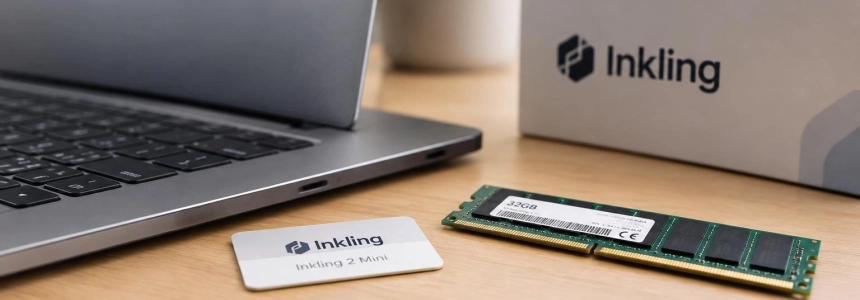
Inkling 2 Mini has 26.4 billion parameters and can run locally on devices with 32 GB of memory, including Macs with Apple Silicon. Thinking Machines Lab introduced it on November 20 as an open-weight model that processes text and images, with a context window of up to one million tokens.
The proposal is not simply about reducing the size compared with larger models. Inkling 2 Mini uses a looping transformer architecture: it runs some of its layers again to add computation per token and, according to Thinking Machines, improve reasoning without lengthening the response with more written steps.
Twelve layers run three times
The model is organized into 24 layers and a Mixture of Experts architecture. The first six and last six run once; the 12 in the middle pass over each token three times. The result is 48 layer applications per token from 24 stored layers, with weights shared across passes.
Thinking Machines' technical report puts the model at 3.4 billion active parameters before accounting for the effect of looping, and at 5.4 billion weight activations per token when loops are included. The company explains that each additional pass through the repeated layers adds around 1 billion effective active parameters. Artificial Analysis, for its part, says the model uses 3.1 billion unique weights per text token: a different measure from the effective count that incorporates loops.
The design separates the size of the stored weights from the work the model does during generation. Instead of producing more text to show each phase of reasoning, it can internally process representations over multiple passes. Thinking Machines says this is especially useful for agentic coding tasks, which require chaining actions and decisions.
The company says repeating the 12 central layers produced better accuracy gains than repeating the last 12 in 27 of 28 evaluations. Its explanation is that the central layers play a greater role in abstract reasoning, while the initial and final blocks handle translation between the input and output representations and the internal ones.
Strong coding results, with differences depending on the test
In evaluations published by Thinking Machines, Inkling 2 Mini scored 48.2% on DeepSWE v1.1 and 77.9% on SWE-bench Pro v2 Hard. The company places it ahead of open-weight models with fewer than 100 billion parameters on those tests. It scored 79.2% on SWE-bench Verified and 46.5% on Vals Index v2.2.
Results are not consistent across all tasks. On Terminal Bench v2.1, it scored 71.6%, below Qwen3.8-27B's 73.0%; on DeepSWE v1.1, however, it outperformed that model's 42.2%. Thinking Machines cautions that evaluation configurations vary between models, so the figures should be considered within the context of each test.
Artificial Analysis gave Inkling 2 Mini 20.1 points on its Intelligence Index, the same score as Qwen3.8-27B. In its comparison, the Thinking Machines model required around 2.8 times less compute per task, but generated approximately 38% more output tokens to reach that score. Artificial Analysis estimates a cost of $0.59 and 9 minutes per task for Inkling 2 Mini, compared with $3.53 and 38.2 minutes for Qwen3.8-27B; the cost estimate uses prices published by Thinking Machines.
The model also scored 85.3% on DeepSearchQA and 82.7% on MCP Atlas, according to Thinking Machines' table. In vision, it achieved 92.8% on OmniDocBench v1.6. These results are consistent with its multimodal nature: it can take images as well as text as input, although its output is text.

A model of around 20 GB for local use
The weight file is around 20 GB, distributed in NVFP4 and MXFP8 precision. Thinking Machines says most of the weights were trained and are deployed in NVFP4, while the last four layers use MXFP8. The company claims that retaining the precision used during training at inference avoids conversion losses associated with subsequent quantization.
The company supports Apple Silicon devices with at least 32 GB of unified memory and NVIDIA's DGX Spark desktop computer. For other GPUs and platforms, it recommends 32 GB or more of VRAM. On Apple Silicon, Hugging Face lists Ollama and Exo Labs among the runtime options; the report also notes compatibility with Hugging Face, SGLang, vLLM, TokenSpeed, NVIDIA Dynamo, Unsloth and, for quantized GGUF versions, llama.cpp.
Thinking Machines showed the model running offline on a MacBook Pro during a flight. In a demonstration, it generated a playable flight simulator in a few minutes. The company also presented Thinkyville, a small pixel-art town where 20 autonomous residents run on a MacBook offline: they plan their days, interact and respond to messages from the player.
Inkling 2 Mini accepts images from 40 to 4,096 pixels per dimension for optimal performance, according to the Hugging Face report. Its context window reaches one million tokens. The Apache 2.0 license allows users to download the weights and use them for research, fine-tuning and integration into third-party products, subject to its terms.
Internal reasoning raises questions about oversight
Because loops allow more computation without each step appearing in a visible chain of reasoning, Thinking Machines examined whether they made oversight more difficult. To compare different loop depths, the company used a research variant with a variable number of passes, which it also released alongside the model.
In that variant, the horizon of tasks solved without a written chain of thought increased from 16 seconds with one pass to 37 seconds with three. Performance on a serial reasoning test continued to improve up to ten loops, twice the number used during training. The company says chains of thought became shorter as the number of passes increased, but remained legible, and that it observed no upward trend in agentic sabotage tests.
Thinking Machines says the behavior remained monitorable in its experiments at this scale. In its safety report, it adds that the model had little control over its chain of thought and could not perform covert tasks in realistic agentic environments. It also concludes that it does not offer capabilities materially beyond those already available in open-weight models.
“Looping allows the model to reason longer without writing its reasoning down.”
— Thinking Machines Lab
Limitations acknowledged by Thinking Machines
The company notes that the model is less reliable in long conversations and when given instructions with many constraints. On ComplexConstraints v1.1, it scored 33.4%, behind Qwen3.8-27B, which reached 35.6%. It also trails larger models on demanding reasoning tests such as CritPt v2 and HLE-Diamond.
The Hugging Face report warns of repetitive reasoning, especially during code debugging, and recommends limiting output tokens and agent turns. It also cautions that when using tools, the model may ignore detailed conventions or delete and overwrite files without asking for confirmation. Quality may decline in languages other than English; in Chinese tests, the company observed truncated sentences and language mixing.
Thinking Machines recommends human oversight for high-impact uses, running agentic tasks in an isolated environment, and requesting confirmation before destructive or irreversible actions. It also advises evaluating the model for each use case, language and population before deployment, and not using it for medical, legal or safety-critical decisions without specific validation and human oversight.
The weights are available on Hugging Face under Apache 2.0; the model can also be accessed through Tinker, Thinking Machines' inference and customization platform. The Ollama page lists the identifier inkling-2-mini and 20 GB variants, while the company presents Tinker Playground as an option for trying it out.
Sources: Wccftech, GitHub, The Decoder, Thinking Machines Lab, Hugging Face, Ollama, Artificial Analysis