GPT-6.2 Sol is now arriving in ChatGPT chat: OpenAI began the global rollout on November 23 for Plus, Pro, Business, and Enterprise accounts. The model is tuned for everyday conversations, with improvements to web searches, instruction following, and image reading, and it can offer to notify users when a product’s price drops.
A version of Sol for everyday use
The update brings a version of GPT-6.2 Sol to the Chat tab, not to every ChatGPT experience. OpenAI describes it as a model for everyday conversations. The company introduced GPT-6.2 Astra and GPT-6.2 Sol in Work and Codex on November 17; this arrival in regular chat expands that rollout but does not change the models powering those two tools.
OpenAI distinguishes between the roles of the two models: Sol is designed for everyday tasks, while Astra is its frontier model for complex work. The version of Sol now appearing in ChatGPT has been tuned to handle requests with detailed instructions, search for information online, and ask follow-up questions when appropriate.
One of OpenAI’s examples is comparing hotels for a weekend getaway. ChatGPT can weigh factors such as price and location and recommend the option that best matches the user’s priorities. If someone asks whether an item is on sale, the system can also offer to notify them when its price drops.
The idea is not just to find an answer and end the conversation: the model can recognize when it makes sense to continue with a follow-up offer. In the case of a purchase, that follow-up would be a price-change alert. OpenAI presents this capability as part of the conversational experience, not as a change to Work or Codex features.
More image detail and better instruction following
OpenAI says GPT-6.2 Sol also interprets images more accurately, particularly small details such as text on a label or symbols on a sign. In internal tests of the Chat tab, it scored 71.7% on image understanding, compared with 47.4% for GPT-6.
The difference also shows up with difficult instructions. GPT-6.2 followed especially demanding instructions 78.1% of the time, compared with 62.5% for GPT-6. The figures are results from OpenAI evaluations; the company does not present them as independent measurements.
| Chat evaluation | GPT-6.2 | GPT-6 |
|---|---|---|
| Image understanding | 71.7% | 47.4% |
| Following difficult instructions | 78.1% | 62.5% |
| Expert-level tasks, lowest reasoning level tested | 65% | 52% |
| BrowseComp, Extra high level | 64.5% | 54.4% |
| Difficult conversations that comply with safety policies | 91–94% | 77–80% |
Web browsing improvements were measured using an internal version of BrowseComp, an OpenAI evaluation that checks how models find answers to difficult questions online. GPT-6.2 outperformed GPT-6 at all four reasoning levels; at Extra high, it scored 64.5%, compared with 54.4% for GPT-6, a difference of about ten percentage points.
In an internal evaluation of expert-level tasks, OpenAI also places GPT-6.2 ahead of GPT-6 at all four reasoning levels. At the lowest level tested, it scored 65%, compared with 52% for GPT-6. The Decoder puts GPT-6.2’s overall range at approximately 65% to just over 71%, and GPT-6’s at around 52% to 66%.
Safety test results also improve
OpenAI reported progress in its evaluations involving teenagers, with notable improvements in conversations about emotional dependence, eating disorders, and dangerous activities. Its difficult-conversation tests also include age-restricted goods and services. In that set, GPT-6.2 complied with the company’s safety policies in 91–94% of cases, compared with 77–80% for GPT-6.
The comparison reflects OpenAI’s internal evaluations and concerns difficult conversations, not every response the system produces. The launch announcement particularly highlights emotional dependence, disordered eating, and dangerous activities; it also mentions age-restricted goods and services. This is not an update to the Work and Codex models: the change described affects chat.
Who can use it and which model appears
The global rollout began on November 23 for Plus, Pro, Business, and Enterprise. Free and Go accounts are not included for now, and OpenAI has not announced a date for adding them. Availability in Enterprise depends on the settings configured by workspace administrators.
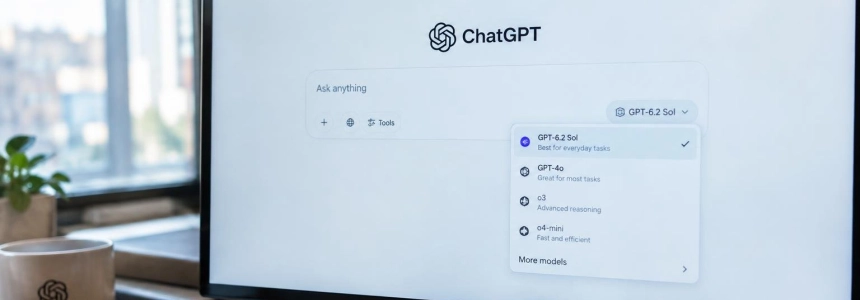
The rollout is gradual, so the model may not appear at the same time in all eligible accounts. When GPT-6.2 appears in the model picker, the “Latest” option uses it in all four reasoning modes: Instant, Medium, High, and Extra High. The Pro level, however, continues to use GPT-6 Pro, because there is not yet a GPT-6.2 Pro option.
For those using Work or Codex, their models are not changing with this launch. GPT-6.2 Sol and GPT-6.2 Astra were already available there in preview from November 17. The November 23 update adapts a version of Sol for ChatGPT’s regular conversation tab.
GPT-5.6 Sol has a retirement date
The transition also sets a date for the end of one of the previous models. GPT-5.6 Sol will be retired from Chat on December 23; until then, those still using it can continue to select it. On the same day, GPT-5.6 Sol and GPT-5.6 Terra will also leave Work and Codex, according to OpenAI’s notes.
The retirement schedule affects those two versions in Work and Codex, but it does not mean that the models in those experiences have already changed with the launch of GPT-6.2 in Chat. OpenAI explicitly separates the two moves: the current rollout applies to the Chat tab; GPT-5.6 is scheduled to leave on December 23.
For now, the practical difference for Free and Go accounts is that they are not part of the announced rollout. For eligible plans, availability may take some time as the rollout is gradually enabled, and in Enterprise the decision also depends on administrator settings. The next milestone already has a date: the retirement of GPT-5.6 on December 23.
Sources: Digital Trends, The Decoder, OpenAI Help Center, MacRumors, 9to5Mac, Notebookcheck