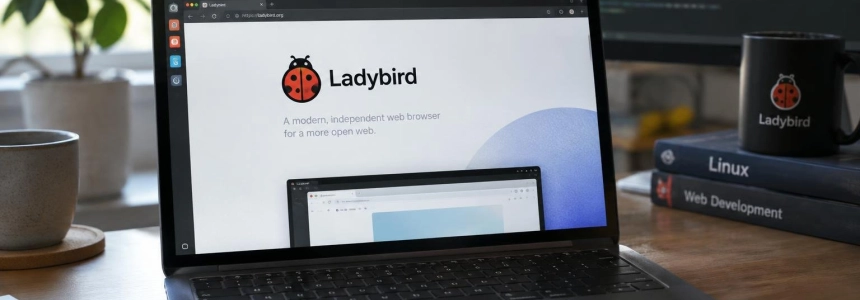
Ladybird now has its first alpha version, available to download for macOS and Linux. The browser comes with its own web engine, built from scratch and not derived from Chromium, WebKit, or Gecko; its developers warn that some pages will not work and that the program may close unexpectedly.
Andreas Kling announced the release on November 23, 2026, on the project’s official website. Until now, anyone who wanted to try the browser had to compile it from source code; with this alpha, Ladybird is offering a direct download and a continuous update channel.
“Ladybird is now in alpha.”
— Andreas Kling
A browser with its own engine
The key difference lies beneath the interface: Ladybird is not an adaptation of another browser or a layer built on top of an existing engine. The team presents its own implementation of HTML, CSS, DOM, page rendering, JavaScript, and WebAssembly. The project description on GitHub adds that the engine is developed independently and follows web standards.
The goal is ambitious, but the team describes the browser surrounding the engine as modest and functional. The alpha does not try to hide that work remains to be done: the release page itself warns that some sites will be incompatible and that crashes may occur. In return, users can install it and try it out without having to build it from source.
Ladybird is being developed as a nonprofit project, funded by sponsors and donors, according to the presentation published on GitHub. The project also says it works openly on that platform, under a permissive license, with development guided by web standards. In his announcement, Kling thanked those who contributed code, tested the browser, reported bugs, and supported the work.
What the engine includes
The repository’s technical description details a multiprocess, site-isolated architecture: documents from different sites run in separate, sandboxed rendering processes. Image decoding and network connections also take place outside the main process, isolated for each site.
The custom JavaScript engine is called LibJS and includes an interpreter and a JIT compiler; for WebAssembly, Ladybird includes LibWasm. The project also notes that its object model uses garbage collection and that the codebase is adopting Rust to improve memory safety. It does not present these features as a security promise for this alpha: it explicitly warns that it cannot yet offer guarantees.
The team says the engine passes a broad and growing portion of the web-platform-tests suite, although it does not provide a specific number of tests passed. It also describes its approach as standards-first: following specifications in the implementation and communicating any gaps or ambiguities it finds to those responsible for them.
For website developers, the alpha includes WebDriver and the Firefox DevTools protocol. The former makes it possible to automate tests; the latter provides access to inspection tools compatible with that protocol. Kling encourages website authors to test their own sites and report what fails.
Expected bugs and security testing
The team’s warning is direct: some websites will not display correctly, and Ladybird may crash. When a page fails, users can report the site from the browser. After an unexpected shutdown, they can review the crash report and decide whether to submit it; the project’s privacy policy explains how these reports are handled.
The team also invites security specialists to look for vulnerabilities. The GitHub page asks users to report findings by following the instructions in SECURITY.md, while Kling explains that testing and attacks are part of the hardening process for a new browser. For now, the official position is unequivocal: there are no security promises for this version.
An alpha channel that updates automatically
Ladybird describes this version as a rolling channel with automatic updates. The team plans to distribute them regularly, so improvements reach users without requiring them to rebuild the project. Kling highlighted this change: before the alpha, keeping up with the browser’s progress meant building it from source code.
The official GitHub release thanks the hundreds of people whose work has contributed to the project and mentions code contributions, bug reports, testing, help with specifications, and funding. Kling, for his part, thanked sponsors, donors, testers, and contributors, and acknowledged that much work remains.
The download is available for macOS and Linux; the announcement does not include a Windows version. The next concrete test for Ladybird will be getting more pages to work reliably as user reports and regular updates come in.
Sources: ladybird.org, TechPowerUp, RuntimeWire, LavX News, Simon Willison’s Weblog, GitHub