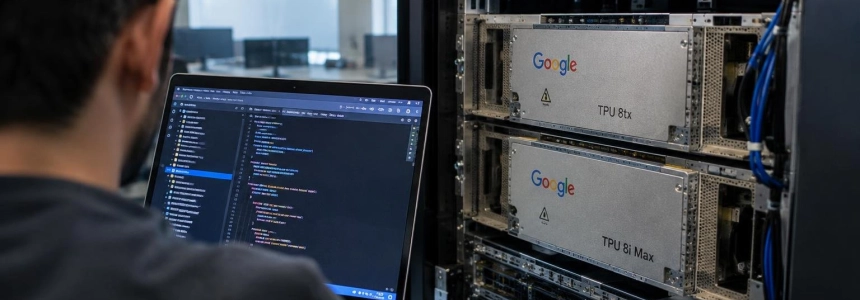
Google introduced two new configurations of its TPU accelerators: the 8tx, focused on confidential computing, and the 8i Max, designed for workloads that need more memory and computing capacity. They are not a new silicon generation: both build on existing processors and expand the eighth generation, which now comprises four systems in a single year for the first time.
The move targets a broader goal than adding models to the catalog. Google is trying to turn its chips, initially designed for its own services, into a platform that external companies can buy and use. Competition with Nvidia thus plays out on two fronts: offering configurations suited to specific workloads and reducing the software barriers that can keep teams in the GPU ecosystem.
Four systems for different stages of AI
According to Google, the family is divided across four use cases: the TPU 8t for large-scale training; the 8i for low-latency reasoning; the 8tx for confidential computing; and the 8i Max for large context windows and greater compute density per rack. The company describes the latter two as new configurations of the previously introduced generation, not as new chips designed from scratch.
flowchart TD
A["TPU 8t: entrenamiento"]
B["TPU 8i: razonamiento"]
C["TPU 8tx: inferencia confidencial"]
D["TPU 8i Max: contexto amplio"]
That distinction matters for understanding the technical strategy. Google separates processor evolution from the configuration of the system around it: packaging, memory, networking, and security. Amin Vahdat, Google’s senior vice president and chief technologist for AI and infrastructure, explains that the company designed its TPUs as modular building blocks so it can adjust these components faster than it takes to manufacture a new silicon generation.
“With computing moving from human to agent scale, businesses are asking for accelerators that can reason across AI models’ massive context windows.”
— Amin Vahdat, SVP and Chief Technologist, AI and Infrastructure
Google says this approach lets it offer specialized systems in months rather than waiting years for a new chip. The 8t and 8i already covered training and reasoning; according to the company, the new variants respond to customer requests involving sensitive data and larger contexts.
The 8tx protects data while it is being processed
The TPU 8tx targets public agencies and companies in regulated industries that want to run models and agents on sensitive information. It addresses a specific problem: data is usually encrypted while stored or traveling over a network, but processing requires the system to be able to use it. Google says that with the 8tx, data and model weights remain protected and isolated during active use as well.
The configuration uses the same silicon as the TPU 8t and, according to Google, is paired with fifth-generation AMD EPYC host processors. It also incorporates hardware-level security and the low-latency Boardfly network, which the company developed for real-time reasoning. Google says the 8tx can reduce latency by up to twice as much compared with the 8t, with an “almost zero” performance penalty.
The combination is designed to run multiple tasks without moving private data between separate clusters. Google lists fine-tuning models on proprietary data, distilling large models into smaller ones, and training agents through reinforcement learning. Reuters also describes the 8tx as an option for regulated companies and public agencies that need to keep information protected during processing.
The feature is not entering a market without competition: The Decoder notes that Nvidia already offers a comparable capability for its GPUs through its confidential computing architecture. Google’s proposal, therefore, is not just about adding encryption, but packaging that protection with its accelerator, low-latency network, and training and inference workloads in a single system.
The 8i Max aims to ease the memory bottleneck
The TPU 8i Max addresses a different constraint. When multiple agents work with large code repositories or extensive video collections, memory access can slow processing. Google combines two TPU 8i chips in a single package to increase available resources without changing the rack form factor.
The company says the 8i Max doubles the compute capacity, SRAM, and HBM memory bandwidth of the 8i. It also says twice as much silicon fits in the same rack footprint, increasing compute capacity per area. According to Reuters, the offering targets applications that need to consult a lot of information in a single interaction, such as coding assistants, mathematical reasoning, and drug discovery.
The trade-off is clear: rather than introducing a completely new architecture, Google concentrates more resources in the same physical form factor. Its usefulness will depend on whether workloads can take advantage of the increased memory and bandwidth; the company presents the configuration as a response to large contexts and jobs that stall when data does not reach the processor quickly enough.
Software will determine how costly it is to switch
For development teams, hardware alone does not solve the cost of adopting a different platform. Google is pairing its TPUs with tools to bring them closer to existing workflows. The company open-sourced TorchTPU and says it allows PyTorch code and Hugging Face models to run on its accelerators without rewrites. It also mentions compatibility with the vLLM and SGLang inference engines.
Google is adding a TPU agent suite, still in preview, that integrates with programming tools such as Claude Code, Cursor, and Google Antigravity to help onboard workloads, diagnose bottlenecks, and tune kernels. For production, it presents XLA Serving Engine as a way to train models in Python and serve them through a low-latency C++ environment on TPU, GPU, and CPU. These components are intended to reduce adaptation work; their existence does not by itself prove that all PyTorch applications will work without adjustments.
The company is also focusing on specific challenges posed by agent-based workloads. Its Agent Compute Engine suspends and resumes idle sessions while they wait for a database query, an external tool, or a human response. TPU Sync, which Google is open-sourcing, organizes accelerator memory, host memory, shared storage, and networking into a hierarchy. Google says it can move KV caches off-chip and reduce cache transfer latency and time to first token by more than 90% in the scenarios it describes.
The company is also announcing Cloud Pathways, now available in Google Kubernetes Engine, to orchestrate distributed TPU systems from a single controller. GKE dynamic slicing, also generally available, makes it possible to reorganize TPU topologies; Google says it reduces job startup times by up to five times and enables failure recovery up to 4.5 times faster. These figures and results were reported by Google, not established through an independent comparison with rival platforms.
Competitive pressure is shifting toward inference
The push to attract external customers marks a shift for a technology Google had mostly used in its own products, such as Search, YouTube, and Gemini. The company says it has nearly 100 external TPU customers, including frontier labs, trading firms, retailers, and universities. Reuters reports that TPU sales contributed significantly to results for the September quarter and puts Google Cloud revenue at $30.71 billion, more than double.
The commercial landscape favors a broader offering: as model use expands, companies need to run inference routinely as well as train models. Google is seeking to meet that demand with specialized systems and cloud services, while Microsoft, Amazon, OpenAI, and Anthropic are also working on their own accelerators, according to The Decoder and TechCrunch.
Nvidia retains a dominant position in the AI chip market and is also strengthening its inference offering; The Decoder mentions its talent acquisition and licensing deal with Groq. Google, therefore, is not competing with just one piece of silicon. Its challenge is to make specialized configurations, security, availability, and development tools an attractive package for customers who can currently choose GPUs or turn to other providers.
The open question is how much of this offering will translate into production workloads outside Google. The company has already reported customers, tools, and performance results, but the new variants expand a platform whose external growth will depend on whether organizations can migrate their models and keep them running while meeting their memory, latency, and confidentiality requirements.
Sources: The Decoder, Reuters (via Euronext), Google, TechCrunch