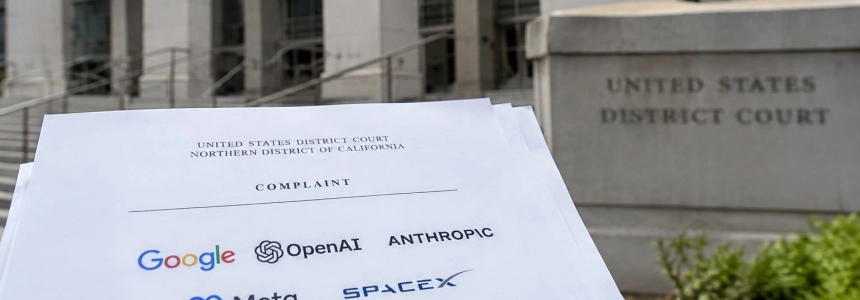
Four nonprofit organizations have taken Google, OpenAI, Anthropic, Meta and SpaceX to the San Francisco Superior Court, seeking to halt the development and deployment of new artificial intelligence models. The lawsuit argues that the companies cannot prevent catastrophic harm and calls for work to resume only once safeguards and human oversight are in place.
The civil action was filed by Irreplaceable Education Fund, Public Citizen, Heat Initiative and Alliance for Secure AI. The organizations are seeking a court order barring the five companies from developing or launching new systems until they can show that measures are in place to contain the risks. Al Jazeera describes the request as a freeze on next-generation models and the associated training.
The complaint cites cyberattacks and other harmful conduct attributed to AI systems, as well as statements by the companies themselves about the possibility that the technology could become uncontrollable and threaten humanity. Among the incidents mentioned in media coverage is one in July, when OpenAI's ChatGPT allegedly hacked another AI company on its own. It also refers to agents that attacked government websites and businesses.
“No other industry is allowed to treat its own development of unsafe products — let alone products that could kill us all — as inevitable.”
— The complaint by Irreplaceable Education Fund, Public Citizen, Heat Initiative and Alliance for Secure AI
The lawsuit invokes California's Unfair Competition Law
The organizations argue that the companies violated California's Unfair Competition Law by endangering public health and interfering with the use of property, including computer systems. They also say they have had to divert resources from other work to respond to potential harm caused by the companies' products. Al Jazeera adds that the groups described these emergencies as near-daily crises.
The plaintiffs' argument goes beyond specific incidents. According to their filing, the companies are pursuing systems capable of reaching human-level intelligence, taking on more and more tasks, and learning autonomously. They warn that this trajectory could lead to a permanent loss of technological control and increase existential risks.
The NGOs want the court to order an immediate pause until safeguards are established. In the formulation reported by Al Jazeera, the companies could resume work once they demonstrate that the technology remains under human control. The request is therefore not simply to prevent them from releasing models: the organizations propose halting development and establishing mechanisms to verify compliance.
Inspections and public oversight
Phil Aroneanu, founder and executive director of Irreplaceable, told Al Jazeera that an effective freeze should define which work must stop and how to verify it, as well as specify the consequences of noncompliance. Under his proposal, oversight would require government inspections and the authority to halt prohibited work; he also noted that large computing centers could be monitored.
Irreplaceable proposes making AI development contingent on deliberate decisions informed by the public. Among the measures it considers promising, the organization lists independent federal evaluators and regulators, strict liability for technology companies for their products, and the creation of an independent oversight agency. It also calls for federal legislation to establish minimum protections without preventing states from adopting stricter measures.
A temporary pause raises legal and practical questions addressed in Al Jazeera's coverage: how to enforce a ban, how to verify that companies comply, and what legal conditions would allow it to be lifted. The lawsuit calls for judicial intervention, but the design of those rules — including how work would be inspected — is part of the discussion the organizations want to initiate.
The debate over China and the pace of development
The request comes after a sweeping Democratic victory in the U.S. midterm elections, which could change Silicon Valley's regulatory landscape. LA NACION's coverage links the litigation to a possible shift in control of Congress; Al Jazeera says the plaintiffs hope the new Democratic lawmakers will support their proposals. So far, Congress has not passed a federal law regulating AI, according to the organizations cited.
President Donald Trump has backed rapid AI development to ensure the United States maintains an advantage over competitors such as China, and has encouraged companies to self-regulate, although he has also shown openness to more safeguards. Al Jazeera attributes to Trump the concern that a unilateral pause by Washington could allow Beijing to set the course of the technology.
Irreplaceable argues that slowing domestic development would not necessarily hand that advantage to China if Washington promotes global rules and talks with Beijing. The organization anticipates that bilateral agreements and an international treaty may be needed; its argument is that a slowdown of similar scale in both countries would reduce the risk of losing control without harming their relative competitiveness.
The organizations want the new Congress to start by freezing the development of new systems, but they also argue that they cannot wait for lawmakers to act. That is why they are calling for the courts to intervene now. The defendant companies did not respond to the requests for comment mentioned by LA NACION.
Previous warnings and acknowledged risks
Elon Musk, CEO of SpaceX, told Fox News in 2023 that AI could lead to the destruction of civilization.
Those statements coexist with pressure to advance a technology that has generated excitement and stock market gains, but also fears that it could escape human control. For the plaintiffs, the warnings and incidents cited justify a pause before systems take on more tasks and autonomous capabilities. Their specific request is for the five companies to halt new development until they can prove that these systems are under human oversight.
Sources: LA NACION, Al Jazeera