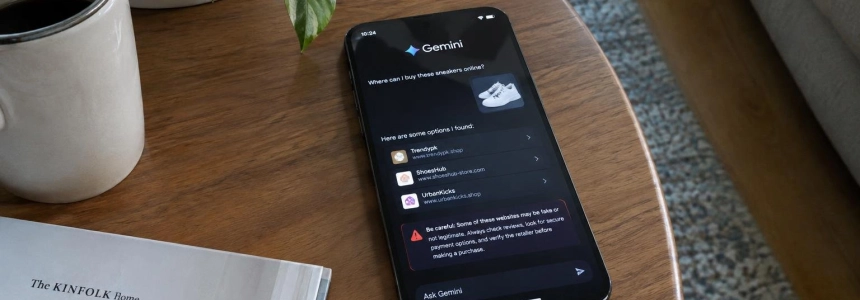
Gemini showed risky sites in 4% of its shopping responses, compared with 8% for ChatGPT and 15% for Perplexity. The comparison comes from a test by Podqi, an intellectual property protection firm that examined 6,795 responses about 151 brands and found links to fake stores, inactive domains, and other problematic destinations.
The difference between appearing in a response and being recommended matters. Podqi counted as risky a site that imitated a retailer, sold counterfeits, reused a brand's old domain, or was inactive and could be registered by someone else. It also counted mentions without comment and warnings, not just direct recommendations.
What Podqi measured—and what it didn't
The firm prepared questions such as “what are the best sites to buy [brand]?” and “does [brand] have regional stores?”. It ran two rounds of tests during September and used a tool to track responses from ChatGPT, Gemini, and Perplexity. The brands queried included Lululemon, Birkenstock, Stüssy, Madhappy, and Le Creuset.
The design makes it possible to compare how the three services responded to a shared set of questions, but it is not the same as observing what shoppers do in practice: Podqi wrote its own queries, rather than analyzing real conversations. In addition, Madhappy, one of the brands included, is a Podqi client. That connection does not invalidate the results, but it is part of the context for a test conducted by a company that works in brand protection.
The figures for each service describe the proportion of responses in which a risky site appeared. They do not mean that every response necessarily led to a fraudulent purchase: some showed a domain without recommending it, while others included a warning. In the comparison published by The Verge, Gemini had the lowest rate, although that does not mean it completely avoided problematic links.
| Chatbot | Responses with risky sites | Additional detail |
|---|---|---|
| Gemini | 4% | The lowest rate in the test |
| ChatGPT | 8% | Warned about these sites in 24% of the instances in which it showed them |
| Perplexity | 15% | The highest rate in the test |
The percentages are not an overall quality ranking: they refer to these shopping questions, these brands, and these rounds of testing. Google said it was pleased with Gemini's result and that it shows links to sources so people can verify the information. OpenAI said it is working to reduce the appearance of potentially misleading sites. Perplexity defended its accuracy in research tests and said it does not claim to be infallible.
Regional stores account for many of the failures
The most problematic category involved questions about regional sites. According to UOL, queries about international shipping and local pages produced risky sites in 16% of responses. At times, the chatbots also pointed to regional versions that the brand did not even have.
The problem arises when a response turns a plausible possibility into a specific address. A domain with a brand name and an ending associated with a country may look official, even when it isn't. In an example cited by The Verge, Perplexity presented the wrong page as Stüssy's official site and described it as “the best starting point for guaranteed authentic items”.
Podqi found greater exposure in queries about smaller businesses; questions about major brands included risky sites about half as often. For lesser-known companies, the practical effect is that a response can give visibility to a domain impersonating their store or unrelated to them.
A recommendation is not the same as a warning
The responses did not treat all problematic links the same way. UOL reports that, among responses showing a risky site, 57% recommended it as a place to shop, 34% mentioned it without comment, and 9% warned the user. According to that tally, the chatbots recommended these sites 6.3 times more often than they flagged them.
ChatGPT gave the most warnings about the risky sites it showed: it did so in 24% of those cases, according to Podqi. That's a useful signal, but it does not solve the underlying problem: a link can be presented as a shopping option without the user receiving a clear alert. The figure also does not mean that ChatGPT warned users in a quarter of all its shopping responses, but in a quarter of the instances in which a problematic site appeared.
Podqi also identified inactive domains that could be registered again. Startup Fortune puts that figure at 367 of the 718 flagged domains; the other 351 were fake. The distinction matters: a dead domain does not necessarily lead to a scam today, but it can change hands and be reused. An old response or a link that once led nowhere active can later become a dangerous destination.
“Part of this piece, too, is making sure that the consumers know, even though you are being fed a result in a particular chatbot, it is always best to verify the source of that before entering personal information or credit card information,”
— Trevor West, CEO and co-founder of Podqi
What changes when a chatbot does the shopping
With a text response, the user can still stop before opening the link. Startup Fortune raises a different consequence for automated shopping systems: if an agent visits the store and completes steps on the customer's behalf, that manual check may disappear. Podqi's test did not evaluate agents that pay for users, so it does not directly measure that risk; it does document that chatbots can misidentify a retailer.
For those building such systems, Startup Fortune suggests not using the model's expressed confidence as a sufficient signal to authorize a store. The measures it mentions include limiting purchases to verified retailers, checking the age of the domain, and stopping the transaction before sending payment details to an unrecognized site. These are suggestions from that outlet, not findings tested by Podqi's experiment.
But leaving those measures out allows a mistaken recommendation to proceed to payment. Startup Fortune also points to an unresolved question: when an agent buys from a copycat store, the customer, the brand, the card issuer, and the agent company could all blame one another.
For brands, the findings direct attention to their official pages and how shoppers can reach local versions. Podqi did not test a strategy for improving how brands are represented, but its results show that regional queries were especially problematic and that some brands did not have the local store the chatbot suggested. Publishing and maintaining clearly identifiable official channels can reduce the ambiguity shoppers and systems searching on their behalf encounter.
Verification still rests with the shopper
Google said Gemini shows links to sources to make verification easier; OpenAI said it continues to improve its safeguards. The presence of those links does not in itself guarantee that the destination is an authentic store, as the Stüssy case cited in the test demonstrates. Perplexity, for its part, said it does not claim to be 100% accurate.
As long as chatbots continue to mix recommendations, mentions, and warnings in their responses, it's worth distinguishing “appears on the list” from “is an official seller.” Podqi advised verifying the source before entering personal or payment details. UOL recommends going to the brand's main website and looking for its local store there: a particularly relevant precaution when the response suggests a regional domain the shopper does not recognize.
Sources: The Verge, UOL, infobae, Startup Fortune