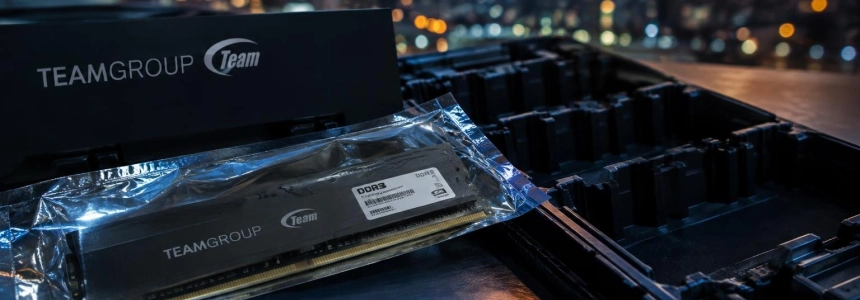
The DRAM memory shortage could reach a point in 2027 where even paying more does not guarantee getting units. Chen Ching-wen, CEO of TeamGroup, expects the most difficult period to run from the fourth quarter of 2026 to the end of the second quarter of 2027, with no significant price drop during the year.
The warning is not just about rising prices. If physical supply is scarce, a buyer may be unable to get memory even if they agree to pay a premium. Chen summed it up at TeamGroup's earnings conference on November 2: «Even money can't buy goods».
Even money can't buy goods.
— Chen Ching-wen (Gerry Chen), CEO of TeamGroup
AI demand is changing how capacity is allocated
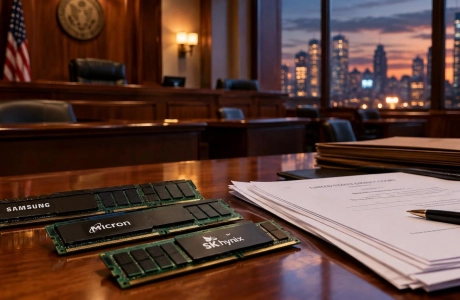
The source of the pressure is the expansion of AI data centers, which need large quantities of high-bandwidth memory (HBM) and DRAM for servers. Wccftech notes that Samsung, SK hynix, and Micron are prioritizing HBM and enterprise memory, higher-margin products, over consumer segments such as DDR, LPDDR, and GDDR.
The effect goes beyond a commercial preference: manufacturing HBM requires more wafer capacity than producing conventional DRAM, according to TrendForce, as cited by Wccftech. With some industrial resources directed toward this demand, less capacity remains to supply other types of memory. In Taiwan, Chen also noted that prioritizing HBM, DDR5, and AI servers is reducing the supply of DDR4 and memory for traditional applications.
TrendForce's demand forecast illustrates the change in scale: in 2027, servers are expected to account for 43.7% of global DRAM demand and 51.1% of NAND Flash demand. These are projections, not production figures, but they point to a market in which infrastructure buyers are competing for a growing share of available resources.
| Indicator | Figure | Source cited |
|---|---|---|
| Share of DRAM demand attributed to servers in 2027 | 43.7% | TrendForce, according to Wccftech |
| Share of NAND Flash demand attributed to servers in 2027 | 51.1% | TrendForce, according to Wccftech |
| Contract price of a 16-gigabit DDR5 chip | From about $8.70 in October 2025 to $48 in September 2026 | Tom's Hardware, cited by Wccftech |
| Spot price of some server memory compared with the contract price | 30% to 50% higher, according to the cited sources | Wccftech and Economic Daily News |
The price comparison refers to individual 16-gigabit DDR5 chips—2 gigabytes—not complete modules sold to the public. Their more-than-fivefold increase helps explain why the problem may stop being a matter of budget and become a matter of availability.
The spot market shows the strain
Spot prices for some server memory already exceed contract prices by 30% to 50%. That gap suggests that obtaining additional units outside regular agreements costs more. Chen said that available market supply would become even scarcer over the three quarters following his statement.
TeamGroup also offers a sign of how the module business is being redirected: B2B sales accounted for 64.6% of its revenue in the first nine months of 2026, up from 24.6% in the same period the previous year. Economic Daily News reports that, starting in November, the company split its B2B and B2C divisions to serve, among others, enterprise demand and high-end brands.
This change in the business mix accompanies the growth of enterprise memory, but it does not show that the entire industry can easily handle new orders. For computer, server, and device manufacturers, the practical consequence is that cost alone may not be enough to secure supply: availability and access to already-committed production also matter.
It will take time for additional capacity to ease the problem
New capacity will not provide an immediate solution. TrendForce expects significant additions to DRAM supply to remain limited until 2028, while TeamGroup expects supply and demand to return to balance no earlier than the second half of 2028. Chen also said he sees no signs of a sharp price drop in the short term.
TeamGroup plans to expand its own production: its new factory in New Taipei is expected to begin operations in the second quarter of 2027 and increase the company's total capacity by around 50%. This is a significant expansion for the company, but it does not amount to a similar increase in global supply. TrendForce's forecast suggests that industry-wide additions will take longer to have an appreciable effect.
TeamGroup's outlook partly aligns with an earlier warning from Kwak Noh-jung, CEO of SK hynix: according to Wccftech, he expects 2027 could be the worst year for memory shortages in history and that demand will exceed his company's production capacity even beyond 2030. This is a forecast attributed to a manufacturer, not a confirmed date for the end of the global shortage.
What this means for businesses and development teams
For a company buying servers, the strain creates a scheduling risk in addition to higher costs: memory supply may limit equipment availability or planned expansion. These forecasts do not provide a figure that would make it possible to calculate the impact on each buyer, but they do identify a clear risk window: according to Chen, the most restrictive period runs from the last quarter of 2026 through the second quarter of 2027.
For teams developing products with integrated memory or defined server configurations, the same pressure may narrow component options. Reduced DDR4 supply and the shift toward HBM and DDR5 make a configuration dependent on a specific type of DRAM more vulnerable to shortages. The planning implication is straightforward: securing supply and considering compatible alternatives become part of product decisions, not just procurement.
That room to maneuver is not free, either. Switching memory may require reviewing the product configuration and its compatibility; keeping the planned specifications, on the other hand, may leave the team competing for more limited supply. The sources do not quantify these costs or specify which products might need to be modified, so the impact will depend on each design and its supply agreements.
For consumers and PC enthusiasts, the signal is less immediate but points in the same direction: TeamGroup anticipates high prices and tight availability throughout 2027, especially during the most severe shortage period. This does not guarantee that all modules will be unavailable or that every category will see the same price increases; it is a forecast shaped by AI demand, consumption by other buyers, and the pace at which new capacity comes online.
The question that will determine whether this scenario comes to pass is whether investment in AI will continue to absorb memory faster than the industry can add production. For now, TeamGroup's forecast puts market balance in the second half of 2028 at the earliest.