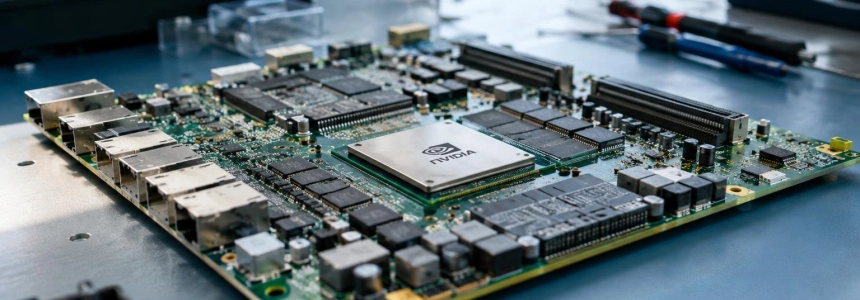
Orders for printed circuit boards (PCB) grew by 56.1% in the first nine months of 2026, while shipments increased by just 13.3%. The Global Electronics Association warns that demand for artificial intelligence servers is absorbing capacity and materials, and that constraints could continue through 2027.
The comparison with the 2021 chip shortage does not mean that the same component is in short supply: the bottleneck is in the boards that connect electronic components. But the potential consequence is similar: a less visible part can slow the manufacture of entire systems, even when investment is being made in chips and final assembly.
More layers, more pressure on materials
The difference lies in the complexity of the boards. A typical PC PCB has around 12 signal layers; those intended for AI servers are moving toward 40–60 layers or more. Each additional layer requires more glass fabric, resin, copper foil, and laminate, so demand drivers do not just occupy more production lines: they also consume more inputs per board.
The association describes a strained supply chain stretching from raw materials to finished boards. Its November note identifies the main constraint upstream, in materials such as glass, resin, and foil, as well as in equipment. Thus, adding PCB manufacturing capacity does not by itself resolve the shortage if the new lines depend on supplies that are also constrained.
| Indicator | Reported figure |
|---|---|
| Layers in a typical PC board | About 12 |
| Layers in boards for AI servers | 40–60 or more |
| Orders in North America, January–September 2026 | +56.1% year over year |
| Shipments in the same period | +13.3% year over year |
| Lead time for multilayer boards | 16–20 weeks or more |
The order and shipment figures show a gap between what buyers request and what reaches the market. For multilayer boards, the association estimates lead times of 16–20 weeks or more. For materials, The Register reports that standard FR-4 laminate now takes six to eight weeks, compared with two or three weeks a year ago; advanced low-loss laminate can require 14 to 18 weeks.
The pressure is already reflected in prices, although the association stresses that availability is the central risk. The Register reports that suppliers raised the cost of laminate by 30% in September and that some types of E-glass fabric rose in price by 300%. It also notes that copper rose by 37% over the past year. Those increases worsen the problem, but a lack of materials can directly prevent a manufacturer from fulfilling an order.
New capacity is not enough
More than 90% of the world’s boards are manufactured in Asia, according to the association. Over the past three years, at least $10 billion has been allocated to new plants in Southeast Asia, and an equal or greater amount to China. However, the expansion is focused especially on serving AI infrastructure and is running up against limits on the inputs it needs.
The association expects standard materials to remain constrained at least through the first half of 2027 and significant relief not to arrive before mid-2028. Capacity is being added gradually, while AI demand absorbs some of it. The result is direct competition: major infrastructure buyers, the hyperscalers, reserve supply, while customers in automotive, industry, medicine, defense, and telecommunications have greater difficulty securing it.
Pressure is not distributed equally across board types, either. Evertiq cites Yole estimates that boards with 18 layers or more will grow by 15.7% annually through 2031, compared with 2.3% for 4–6-layer boards. The same publication attributes to Yole the forecast that AI-grade boards and materials, which account for around 30% of the current market, will exceed half by 2031.
This points to a market increasingly divided between high-complexity products, which AI demands, and conventional boards. That does not mean the latter will disappear, but they will compete for production lines, inputs, and supplier attention in an environment where the former are growing faster. Evertiq also reports that a China-based PCB manufacturer focused on AI told its customers that orders not placed before July 10 could not be delivered before 2028.
“In addition, AI datacenter infrastructure build out is moving capacity support to high-layer count PCBs which increase throughput time and decreases availability of line utilization for more traditional PCB products,”
— Cori Masters, senior research analyst director for Supply Chain Operations at Gartner

The cost of depending on a few links in the chain
Geographic concentration adds another dimension to the risk. While Asia produces more than 90% of PCBs, Europe’s share fell from 13.8% of global production in 2000 to 2.2% in 2023, according to the association. Evertiq reports on closures and difficulties among European manufacturers, although it also mentions plans to produce copper-clad laminate in Ireland for defense electronics.
For companies that manufacture equipment, the practical implication is that a production plan may depend on something other than the processor or accelerator making headlines. If the right board cannot be obtained, investment in semiconductors and final assembly is not enough to complete the system. The association warns that the automotive, industrial, medical, and defense sectors are already being crowded out by AI demand.
For procurement and development teams, this makes demand forecasting and qualifying alternatives production decisions, not administrative tasks. The association recommends sharing realistic forecasts with suppliers and customers, avoiding double booking, and qualifying other sources of laminate, prepreg, and copper foil before supply shortages become critical.
There is a cost to this preparation: validating alternative materials and suppliers takes time, while buying more than needed in advance can worsen the pressure. The Register reports the association’s warning against stockpiling, which fuels advance purchasing. The recommendation is to secure real options without turning forecasting into a race to reserve more capacity than will be used.
Public incentives and the risk of overcapacity
The Global Electronics Association is asking governments to monitor lead times alongside industry, extend tax incentives to equipment for manufacturing PCBs and advanced substrates, and fund research and qualification of alternative materials. It also proposes streamlining permits and prioritizing orders for defense, aerospace, medicine, and critical infrastructure.
Public support requires a balance: accelerate new plants and protect essential programs, but avoid turning subsidies into capacity without demand if advance purchases are canceled and the market corrects in 2027. The association proposes designing loan guarantees and grants to sustain new capacity without ignoring that possibility.
The immediate question for manufacturers is not just how much a board will cost, but whether they can obtain it on time. With long lead times, limited materials, and a forecast that significant relief will not arrive until mid-2028, PCB availability will be a concrete factor in production schedules across very different sectors.
Sources: theregister, Global Electronics Association, Global Electronics Association, Evertiq