Éditions du Boréal will stop printing C’était ça ou mourir and will publish no more books by Thélyson Orélien after finding traces of artificial intelligence markers in the metadata of some working documents. The publisher says it cannot determine how much AI was used; the case sums up the dilemma publishers already face: making decisions without conclusive evidence.
The dispute is not limited to whether a tool classifies a text as AI-generated. It also concerns what evidence publishers accept, who must provide it, and what information the public receives. In practice, checks are shifting toward contracts and publishing processes, while recent cases show that each publisher may respond differently.
Two novels, opposing decisions
In Orélien’s case, Éditions du Boréal explains that the author had assured it several times that he had not used AI to create the novel. The publisher gathered versions of the manuscript and commissioned an external analysis, which found traces of AI markers in the metadata of some documents. Even so, it admits that it does not know to what extent it was used.
The decision had concrete publishing consequences: Boréal canceled a planned reprint and ended its professional relationship with the writer. The publisher also noted that the book had agreements with foreign publishers, meaning its decisions had international reach. In its statement, it called for restraint in the face of personal attacks and said it would not make investigating its authors a standard practice.
Global News reported that Orélien said he began working on the book in 2017, finished a first draft in 2019, and had used AI for research, not to generate sentences in the novel. The writer denied that a machine had written the text and said he had admitted to plagiarism in some early works, following reports of similarities with other texts. The controversy also affected his career: the novel was no longer in the running for the Prix Goncourt.
“We still do not know to what extent AI was used in the creation of ‘C’était ça ou mourir,’ and we will likely never have a definitive answer”
— Les Éditions du Boréal
The episode does not mean Boréal’s decision can be turned into a general rule. In the dispute over Donde el agua trabaja, by David Silva Rojas, Almadía chose to keep the award in place and support the author after conducting checks and consulting specialists, according to Xataka. The publisher maintained that detectors provide information, but their results do not in themselves prove how a text was written.
El Economista reported that Pangram attributed a 99% score for characteristics of AI-generated writing to the novel, prompting Almadía to temporarily suspend events and announce a review. Silva Rojas denied using generative AI at any stage of creation, writing, or revision, and offered to provide drafts, notes, and research documents. The percentage did not settle the dispute: the author asked that it be checked against the writing history.
Detection is not proof
Detection tools analyze linguistic patterns and calculate the probability of AI involvement, but their results are not definitive proof of authorship, according to Xataka. This distinction matters for publishing decisions: an indicator may prompt questions or reviews, but on its own it cannot reconstruct who wrote each part or what role a tool played.
The Boréal case adds another kind of evidence: metadata from working documents. The publisher commissioned an analysis of different versions and found traces of markers, but it was still unable to determine the extent of the use. Therefore, even an investigation that goes beyond running a detector on the text can leave the central question unanswered.
At the other extreme, a high score can also fuel an accusation before the creative process has been examined. In Donde el agua trabaja, the figure attributed to Pangram existed alongside the writer’s denial and his offer of documentation. For publishers, the challenge is not just deciding whether to consult detectors, but establishing how much weight to give them and what additional checks they consider sufficient.
The boundary between different uses is also difficult to define. Xataka distinguishes between using a tool for spelling correction or information searches and using it to develop a structure or entire chapters. A publishing production also involves translation, editing, illustration, design, and promotion: knowing what the author was allowed to do does not automatically clarify what other contributors did.

Contracts, declarations, and labels
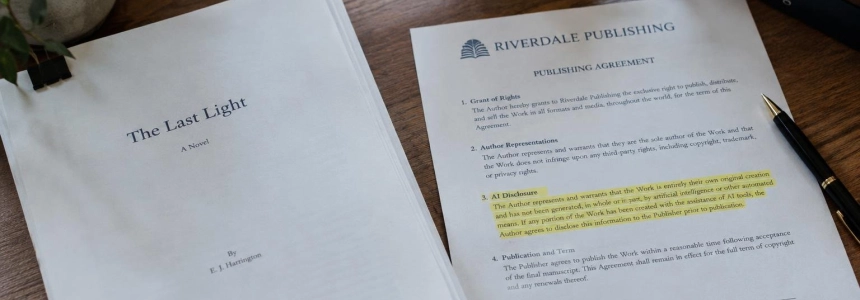
One response several publishers are adopting is contractual. Penguin Random House plans to include a clause requiring authors to declare that their works are original human creations and have not been generated by AI, as explained by Pilar Reyes, editorial director of Alfaguara, Taurus, Debate, Lumen, and the group’s Academic Publications. Reyes suggested that tools could be used in specific cases as support, but not as a substitute for editorial judgment.
Grupo Planeta already includes a declaration in the rules for its awards stating that manuscripts were not created with AI. Although it acknowledges that detection applications are not infallible, it is gradually incorporating them to analyze texts. These measures shift some responsibility to the author: the publisher sets a condition and obtains a declaration, but still needs to decide how to respond when contradictory indications emerge.
Chai Editora, which works with translations of contemporary fiction, bases its process on human translators and joint reviews. Soledad Urquia explains that the publisher includes a request in most of its author contracts not to use AI at any stage of production. But trust does not resolve every assignment: Urquia says she has no way of knowing whether an external designer used a tool.
The gap between a clause and its verification is therefore an operational one. A publisher can specify what it expects from authors and contributors; overseeing every stage also requires access to working materials and a decision about who should review them. Boréal itself said it did not want to become an investigator of its authors, although Orélien’s situation led it to gather documents and request an external analysis.
Transparency for book buyers
Rayo Verde Editorial chose a visible approach for readers: since September, it has been adding a label stating that its books are published without generative AI. The commitment covers authors, translators, illustrators, editors, and contributors. The label’s broad scope is intended to cover precisely the stages that a declaration limited to the manuscript might leave out.
The UNED publications policy, published in March 2026, addresses the issue differently. It allows AI for auxiliary tasks such as language correction, style improvement, or translation, but prohibits it from creating chapters or sections that constitute original scientific contributions. It also requires authors to declare which tool was used and for what purpose. Transparency applies to each use, rather than reducing the policy to a general ban.
This model makes explicit a distinction that also appears in fiction: AI use need not be a single category. A policy can allow assistance with specific tasks and prohibit a tool from producing the central contribution. But the more stages a policy covers, the more important it becomes to define who declares the use and how it is communicated without confusing editing, translation, and content generation.
The lack of a common rule leaves each publisher with its own contracts, labels, and investigation thresholds. Ofelia Grande, director of Siruela, warns, according to Xataka, that filters could become obsolete as technology advances; Anagrama has raised the need for a collective debate. The call also appears in Boréal’s statement, which anticipates consequences for its operations and for the book industry.
Bookstores do not necessarily interpret a publisher’s decision to sever ties as an instruction to remove a title. Floriane Claveau, a spokesperson for Renaud-Bray, told The Canadian Press that the chain would keep a book available as long as copies and demand remained, because it does not consider itself a judge or censor of content. Thus, a decision about future print runs may affect availability over time, but does not in itself determine what retailers do with existing stock.
For authors, translators, illustrators, and designers, the concrete change is that conditions on use can be incorporated into assignments and contracts, while transparency is beginning to extend from the manuscript to the production as a whole. For publishers, the dilemma remains: require declarations they cannot verify, investigate using imperfect evidence, or explicitly communicate which uses they allow. Boréal maintains that it may never be known how much AI influenced Orélien’s novel.
Sources: Xataka, Les Éditions du Boréal, Global News, El Economista