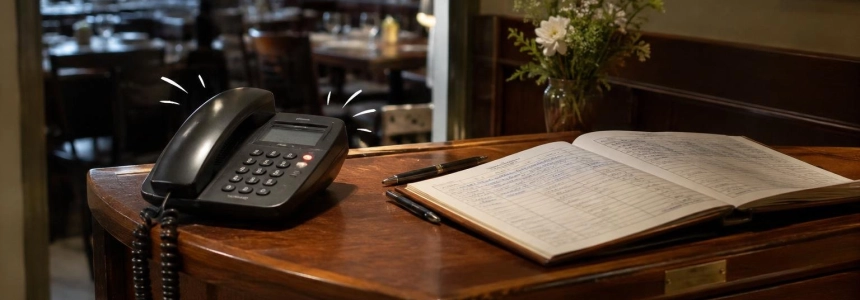
At Bouchon Racine, a London restaurant, Dave Strauss answered a call that sounded human, but not entirely. When he asked whether it was a bot, he heard: “Yes this is an AI booking process”. Strauss, the restaurant’s co-owner, argued with the system and asked it not to call again. Automation is now reaching people by phone, not just through booking platforms.
The episode comes amid the launch of Muse, Meta’s assistant in the UK, which encourages users to delegate tasks such as shopping and booking a table. With permission, it can access a user’s email and make bookings. However, it is unclear which assistant called Bouchon Racine: the timing alone is not enough to attribute that call to Muse.
The friction is not limited to a synthetic voice on the other end of the line. For restaurants, the problem is operational: a booking on the books does not guarantee that there is a customer behind it who will show up.
“Yes this is an AI booking process.”
— Dave Strauss, co-owner of Bouchon Racine
Going back to the phone does not solve the problem
Jeremy King, owner of Simpson’s in the Strand, believes the trend towards depersonalising bookings is pushing his restaurants towards a more analogue response. The phone may become the easiest way to secure a requested table, but Strauss’s experience shows that calls can also be automated.
Kimberley Coke, a concierge, fears that restaurants may not know who is behind a booking made through an app or whether that person will show up. The uncertainty weighs especially heavily when tables are left empty in December, according to Digital Trends. For a business, then, the cost is not just dealing with an annoying call: it may also mean losing a table that an in-person customer would have occupied.
Some establishments are responding by dropping online bookings and returning to phone calls in an effort to restore direct contact. But that alternative depends on the person on the phone actually being the one making the booking. If an agent can call on a user’s behalf, the traditional channel is no longer a reliable filter on its own.
The precedent of online bookings
US restaurants have been facing a different kind of pressure for months. The Guardian reports that Resy banned bots after agents refreshed pages thousands of times to secure tables. One of the venues reportedly frequently targeted was 4 Charles Prime Rib in New York.
In September, Resy temporarily suspended a venture capitalist’s account after his Instinct agent contacted the platform about 200 times an hour looking for a table at the restaurant. Resy data cited by The Guardian indicate that bots and intermediaries are four times more likely than regular users not to show up.
That figure helps explain why an automated booking is not necessarily a useful one. An agent can complete the task delegated by its user; the restaurant, by contrast, needs the table to be occupied. The no-show rate turns automation into an inventory risk for the venue, not just an annoyance for whoever manages the booking system.
Two kinds of automation, with different effects
It is worth distinguishing bots that pursue tables on booking websites from assistants that call to make a reservation. In the first case, the system can overwhelm a platform with repeated queries, as happened with Instinct and Resy. In the second, the agent tries to carry out a task on someone’s behalf, but the call may be unwanted or difficult to distinguish from a human conversation.
Digital Trends says Meta enabled Muse’s calling feature for paying subscribers in the US “earlier this month”. The outlet notes that some test calls were answered by human contractors, and that it is unknown which assistant contacted Bouchon Racine. That distinction matters: a seemingly human voice does not identify who initiated the interaction, and the restaurant may have no context about the agent or the user it represents.
For those developing these products, the case points to a concrete requirement arising from restaurants’ experience: automated calls must be identifiable as such and respect a request not to call again. Strauss had to ask whether he was speaking to a bot and then argue with it. The episode shows an interaction gone wrong, although the sources do not detail what controls Muse offers for managing calls or bookings.
The cost of shifting convenience
Assistants promise to save users the effort of making calls or completing bookings. But the task does not disappear: it changes hands. The agent contacts a business that has to handle the call, interpret the request and bear the consequences if the customer does not show up. User convenience can shift work and uncertainty onto the restaurant.
This also affects companies that offer booking platforms. Resy responded by banning bots, while the restaurants described by The Guardian are looking for alternatives such as the phone. These are different responses to the same mismatch: the platform wants to limit automated use that harms it, and the venue is trying to avoid bookings that do not turn into visits. The figures cited by Resy provide a practical reason for that control, but do not describe how phone agents will behave.
Meta has British partners such as Marks & Spencer, Currys, Sainsbury’s and easyJet. In the UK, the ICO—the data protection authority—said Meta agreed to a voluntary monitoring and reporting system; the CMA, the competition and markets authority, said discussions had led to fairer terms for the app. Meta had not commented on the report cited by Digital Trends.
A tension that extends beyond restaurants
The clash between agents and third-party services is already appearing on commerce platforms too. Digital Trends reports that Amazon blocked Meta’s AI on its platform in September, although recent discussions between the two companies could lead to that decision being reversed. It is another sign that delegating actions to an assistant does not guarantee that the service it accesses will accept that automation.
For restaurants, the immediate test is both simpler and harder: ensuring that a booking represents a customer who can be contacted, and that the call does not add an unnecessary burden. Going back to the phone may change the channel, but it does not eliminate the question that concerns Kimberley Coke: who is really behind each booking.
Sources: Digital Trends, PrivacySignal, Upcoming World TV