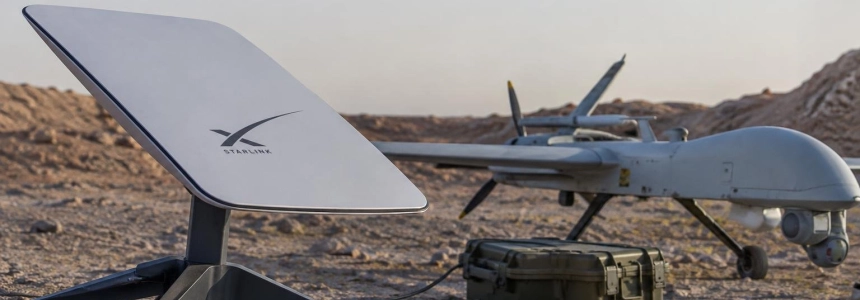
Iran reportedly turned to Starlink to coordinate military operations and monitor drones against U.S. forces during the first days of the war, according to a classified update on the conflict described by The Washington Post. SpaceX’s satellite internet service reportedly offered Tehran an alternative communications channel after the United States attacked more traditional communications systems.
The Washington Post reported that the update was delivered over the summer to Defense Secretary Pete Hegseth. The outlet cited four people familiar with the operations; one of them said the document described Starlink’s use for command and control, as well as monitoring attack drone operations. TimesNow attributed the assessment to U.S. Central Command (CENTCOM), while the Pentagon said it was unaware of a CENTCOM report on the matter.
An alternative network after attacks on communications
Starlink’s use was reportedly detected in early March, after the United States and Israel began attacks on Iran and Tehran retaliated against U.S. bases in the region, according to The Washington Post. SpaceX’s network reportedly helped maintain military communications when more conventional systems were under attack by the United States. Public details about Iranian operations are limited: media outlets have described the contents of a classified report, not a document released in full.
The information coincides with the Iranian drone attack that killed six U.S. service members at Port Shuaiba, a military facility in Kuwait, on March 1. But The Washington Post did not determine whether Starlink was used in that action. The Pentagon had also not made public the results of its investigation into the attack, according to the newspaper; therefore, there is no basis for linking the satellite network to that specific incident.
Pentagon spokesperson Kingsley Wilson said the department was unaware of a CENTCOM report sent to the secretary’s office on the subject. Wilson declined to comment on whether Iran had used Starlink in military operations. TechCrunch reported similar wording: a spokesperson said they were unaware of any report on the matter.
“The dilemma they have is that they either shut the service down completely in the country, which means even dissidents can’t use it. Or they leave the service open to the country, which means the [Iranian Islamic Revolutionary Guard] could potentially use it in its weapons systems.”
— A satellite industry executive, quoted by The Washington Post
The U.S. military’s use of Starshield
The Iran case was not the only source of frustration for Elon Musk. The Washington Post reported that the SpaceX founder was also upset to learn that the U.S. military was using Starshield with LUCAS attack drones under a subscription intended for ground operations. Starshield is SpaceX’s military satellite service, distinct from its commercial Starlink offering.
According to a person familiar with internal discussions cited by TimesNow, the military was paying for a ground plan rather than the more expensive aerial plan to operate LUCAS drones, an acronym for Low-cost Uncrewed Combat Attack System. That person said the aerial option cost five times as much. The Jerusalem Post also noted that Starshield was used under a subscription designed for ground use, though it did not give that multiplier.
On March 1, Musk responded on X to a post about Russian claims that the U.S. military was using Starlink on LUCAS drones. He wrote: “Violation of commercial Starlink terms of service to use the terminal for weapons systems. This applies to all users and is shut down when discovered”. In May, the disagreement became public when Musk accused the Pentagon of making an “improper use of the Starlink civilian system for military purposes”, according to TimesNow.
The dispute also involved the price of an upgrade to the Starshield subscription. Reuters had reported that SpaceX was seeking to raise the monthly cost from $5,000 to $25,000 to allow use with LUCAS drones, according to TimesNow. A person familiar with the negotiations said some military personnel felt that SpaceX had them “held hostage”.
| Plan or measure cited | Detail |
|---|---|
| Monthly Starshield upgrade to guide LUCAS drones | SpaceX reportedly sought to raise the price from $5,000 to $25,000 |
| Aerial plan versus ground plan | The aerial plan cost five times as much, according to a person cited by TimesNow |
| Speed controls in Ukraine | Restriction for terminals traveling faster than 70 km/h, according to TimesNow |
| Aircraft terminal verification | Identification requirement for terminals traveling faster than 100 mph, according to TimesNow |
At least two SpaceX executives were fired at the end of that week over the two incidents, according to a person cited by The Washington Post and reported by The Jerusalem Post and TimesNow. The sources did not identify them. Musk and SpaceX did not respond to the newspaper’s requests for comment, according to The Jerusalem Post.
SpaceX tightened controls but did not shut down the network
After the incidents, SpaceX strengthened checks on customers buying Starlink through resellers. TechCrunch added that the company suspended its Indirect Reseller Program. TimesNow also reported that, in the hours after the March 1 attack in Kuwait, SpaceX introduced identity verification requirements for aircraft using Starlink terminals at more than 100 miles per hour, citing pilots and customer notices reviewed by The Washington Post.
Restricting access in Iran presents a different challenge from military use: shutting down Starlink would also affect civilians and dissidents who rely on the connection to get around internet blackouts. The Jerusalem Post noted that shutting down the service entirely could disconnect people who use it during outages imposed by the Iranian government.
TimesNow reported that Starlink offered free service in Iran in January, after the government imposed a communications blackout during a violent crackdown on anti-government protests, according to The New York Times. The satellite connection became a way for dissidents and citizens to share information. At the same time, analysts cited by TimesNow warned that Iranian military authorities could exploit the same technology if they gained access to the terminals.
Holly Dagres, a senior fellow at the Washington Institute think tank, told The Washington Post that internet access and social media were essential for Iranians to communicate what was happening inside the country. According to Dagres, information posted on social and messaging platforms also helped people understand the situation on the ground, at a time when the United States has no embassy in Tehran and journalists cannot report freely inside Iran.
Ukraine had already prompted SpaceX to limit terminals
The debate over Starlink’s military use had already involved Russia and Ukraine. TimesNow reported that, in January, Ukrainian officials contacted SpaceX after obtaining videos and physical debris from a Russian long-range Italmas drone fitted with a Starlink terminal on one of its wings. A former Ukrainian official familiar with the discussions said Kyiv asked the company to restrict the use of those terminals.
SpaceX later limited the operation in Ukraine of terminals traveling faster than 70 kilometers per hour and worked with the Ukrainian military on a whitelist of authorized antennas exempt from that limit. According to TimesNow, the measures were intended to prevent Russian drones from using the civilian network: those weapons needed to exceed the set speed to stay airborne. Serhil Sternenko, an adviser to then-Ukrainian Defense Minister Mykhailo Fedorov, said the restrictions technically prevented Russian drones from using the service.
In February, Ukrainian defense officials gave SpaceX registration data for terminals authorized in the country; those not on the list lost access, according to TimesNow. The Ukrainian Center for Cooperation and Security, an independent pro-Ukraine analytical organization, told the newspaper that Russia was still trying to gain access to registered terminals by recruiting Ukrainian citizens with Starlink accounts.
SpaceX’s ability to apply geographic and speed limits does not, by itself, resolve the Iran case. Unlike Ukraine, Iran has no trusted authority with which the company can agree on a whitelist of authorized terminals, according to TimesNow. The same outlet reported that, in October, Musk abruptly reduced Ukraine’s access to Starlink, raising concerns about Kyiv’s ability to defend itself against Russian attacks.
A decision between military use and civilian connectivity
The dilemma for SpaceX is whether it can prevent Iranian forces from using Starlink without cutting off people who rely on the network to communicate during blackouts. A total restriction could cut off dissidents’ communications; keeping the service open could allow the Revolutionary Guard to use it in weapons systems, according to the satellite executive quoted by The Washington Post.
For now, the measures confirmed in media reports concern checks on customers and resellers, restrictions applied in Ukraine, and verification requirements for terminals on aircraft. The report on Iran remains a classified update described by people familiar with the operations, and no connection has been established between Starlink and the Kuwait attack that killed six U.S. service members.
Sources: TechCrunch, The Jerusalem Post | JPost.com, TimesNow