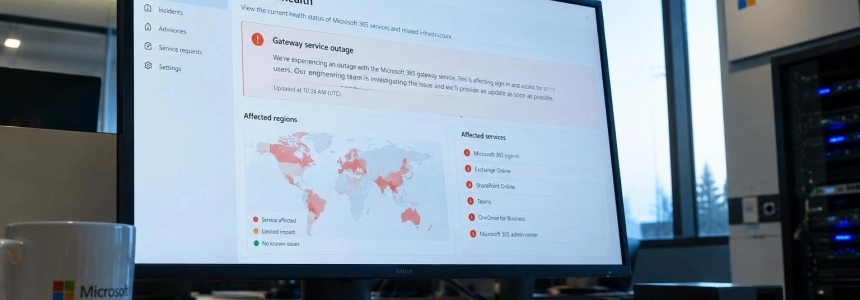
More than 80% of the affected network servers stopped responding during the global Microsoft 365 outage on November 12 and 13. Microsoft attributes the incident, which lasted nearly 24 hours, to a Windows defect introduced in a July update for its own gateways, compounded by increased load and a temporary reduction in capacity.
The greatest impact was concentrated in Exchange Online: many users could not access their mailboxes, and email sending and receiving were delayed. Teams, Copilot, SharePoint, and OneDrive also experienced failures in features that depend on Exchange. The disruption varied by region, time, and connection method.
A latent defect dating back to July
Microsoft's preliminary report, dated November 15, points to three factors that coincided. The first was a defect introduced when a July update was deployed to Microsoft 365 network gateway servers. The company says the change was gradually rolled out worldwide and operated for more than three months without any visible incidents.
The failure occurred under certain loads. Competition between tasks for a shared lock within an internal Windows process—a problem known as lock contention—could exhaust CPU and memory resources and leave the machine unresponsive. The issue was more likely on modern hardware with more cores, but Microsoft's load tests focused on less powerful machines with fewer cores.
The update was specifically prepared for Microsoft 365 network servers. Microsoft clarified that it does not affect other Windows installations. This distinction sets the incident apart from a general Windows Server defect: the problem was tied to the code path used by Microsoft 365 gateways, not to all servers running Windows.
Additional traffic triggered the cascading failure
The second factor was a traffic routing change. About 15 hours before the outage, Teams traffic automatically shifted from an alternative gateway to the primary one, which also serves Exchange Online. Microsoft described the change as a normal operation, but it increased the load on the affected infrastructure.
In addition, nearly 14% of the gateway servers' capacity was out of service because of a separate issue that occurred the previous day. Capacity was expected to be restored through routine tasks; separately, Microsoft considered the system to still have sufficient headroom. The increased load and reduced capacity, when combined, pushed the servers into conditions that triggered the defect.
When a machine became unresponsive, automated systems redirected requests to servers that were still operational. But those servers received more traffic and could fail due to the same issue. In less than two hours, the anomaly had spread throughout the infrastructure: at the worst point, more than 80% of servers were unresponsive.
The safeguards intended to keep the impact within components or regions did not prevent it from spreading globally. The preliminary report identifies a separate problem that affected those protections, although it does not fully detail what caused it. Differences between services also affected how long the disruption lasted: Teams, OneDrive, SharePoint, and Office applications could move off the defective infrastructure; Exchange Online could not, for reasons of scale.
Why recovery took so long
Restarting servers was not enough. When they received the accumulated traffic again, some machines became stuck once more. The usual automated processes were not designed to recover from an outage of this scale, and standard rollback options could not quickly remove a change that had been deployed for months.
Microsoft identified connection negotiation as the main bottleneck between 00:30 and 01:00 UTC on November 13. At 07:20 UTC, it applied a mitigation: an update that returned the connection management path to a code state that had already worked. Teams then took servers offline in groups, applied the change, restarted them, and gradually returned them to service.
The company also rerouted traffic through alternative paths, added capacity, and extended email delivery times to prevent queued messages from being returned as undeliverable. Recovery progressed by region: Asia-Pacific began to partially recover at around 11:00 UTC, and Europe at 11:35. Global webmail availability returned to expected levels at 14:17.
Microsoft declared the active impact over at 16:10 UTC on November 13, although it continued monitoring the service and clearing the email queue. It issued its final customer updates at 04:15 UTC on the 14th. Its preliminary report states that the accumulated messages were processed.
Microsoft rules out an attack and prepares further measures
The company described the incident as a technical failure, with no indication of malicious activity. It also denied that the outage was related to the layoffs announced the previous month or to replacing employees with AI systems.
Charles Lamanna, Microsoft's head of Copilot, Agents, and Platform, acknowledged the scale of the failure in statements shared on X.
“In less than two hours, the previously unknown defect was encountered across our fleet and rendered them unresponsive. At its lowest, more than 80% of servers were unresponsive.”
— Charles Lamanna, Microsoft's head of Copilot, Agents, and Platform
Microsoft says it has added capacity, expanded monitoring of traffic and connection management, and introduced limits to reduce the risk of traffic redistribution causing another cascading outage. It also extended email delivery times and confirmed that queued messages were processed.
The investigation is ongoing. Microsoft expects to publish the final report on November 20, 2026, with a complete list of corrective measures. That document should provide more details about the causes and the safeguards that failed to contain the spread.
Sources: Wccftech, 9to5Mac, XDA, theregister, The Stack, 365Fanatic