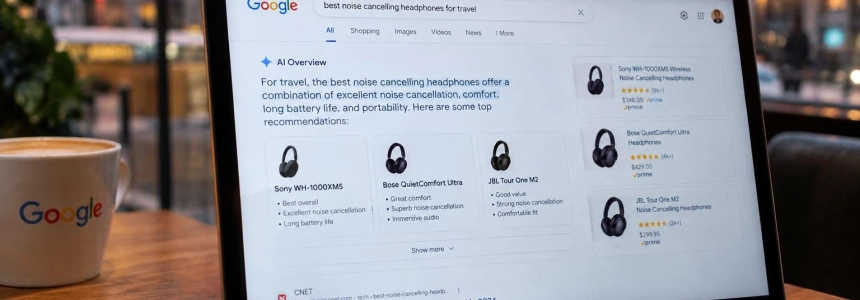
AI Overviews appeared in 88% of 400 commercial searches analyzed by Semrush in the United States over one year. The panel tracked queries in banking, e-commerce, and software, from brand comparisons and reviews to price searches. By August 2026, Google-generated answers already occupied a large share of results for users who might have been considering a purchase.
The change is not just that AI is answering more general questions. The study's queries are closer to concrete decisions: which product to choose, how much it costs, what alternatives are available, or how one brand compares with another. Google can present a summary and its sources before users reach the traditional organic results.
This changes the space in which retailers, brands, and specialist sites compete. But coverage measurements alone do not show that they have lost traffic or sales: Semrush recorded whether an AI Overview appeared, not how users responded.
From informational queries to purchase consideration
The analysis tracked a fixed set of 400 U.S. desktop keywords from September 2025 to August 2026. The queries were divided among three sectors—banking, e-commerce, and software—and five commercial modifiers: alternatives, brand comparisons, “best X for Y,” price or cost, and reviews.
Across the full panel, AI Overview coverage rose from 45.75% to 88%. This figure describes the proportion of keywords that triggered a response at each point in time; it does not mean that 88% of all Google commercial searches received one. The study's scope is limited to the keywords, sectors, device type, and market that were monitored.
The breakdown by intent shows expansion in every group. Review queries started at 30.14% and ended at 89.04%, the largest increase. “Best X for Y” searches rose from 42.72% to 96.12%, the highest level at the end of the period. Alternatives reached 82.81%, price and cost 82.05%, and brand comparisons 86.59%.
“all modifier groups reached coverage above 80%. In September 2025, coverage ranged from 30.14% for ‘reviews’ to 63.41% for ‘brand comparisons.’ In August 2026, the range was between 82.05% and 96.12%.”
— Semrush study authors
Coverage weighted by estimated search volume was even higher: Semrush calculated coverage of 97.08% in August 2026. According to the analysis, keywords without an AI Overview accounted for less than 3% of the panel's estimated volume. This weighting helps explain why the phenomenon may be significant even if some specific queries still do not trigger generated answers.
E-commerce closes the gap
The expansion also narrowed the gap between sectors. In September 2025, AI Overviews appeared for 68% of software keywords and 32.62% of e-commerce keywords. A year later, coverage had reached 91% in software, 89% in banking, and 85.11% in e-commerce.
E-commerce recorded the largest sectoral increase, rising from 32.62% to 85.11%. This increase matters because it puts product and price searches in the same type of answer interface that had already become widespread in software. By the end of the period, the gap between the most and least covered sectors was under six percentage points.
Coverage was not uniform across every sector-and-intent combination. Banking alternatives reached 65%; price and cost searches in e-commerce, 71.43%; and software reviews, 75%. At the other end, three combinations reached 100% within the panel: “best X for Y” in banking, alternatives in software, and “best X for Y” in software. These are results from the observed set, not guarantees for every query in those categories.
Generated answers become another visibility surface
For a brand, appearing in an organic position no longer fully describes its presence on the search results page. A company may have a page that ranks, be cited as a source within an answer, be mentioned without a visible citation, or be left out of the summary. These are distinct situations, and keyword tracking alone does not reveal them all.
TechWyse's analysis notes that Google does not require special markup or a specific file to appear in AI Overviews or AI Mode. The page must be indexed and eligible to show a snippet in Search; practices such as providing crawlable content, maintaining accurate structured data, internal linking, and optimizing the page experience remain relevant. This does not guarantee that Google will select a URL: it establishes eligibility conditions, not a promise of inclusion.
Operationally, Semrush recommends monitoring which brands appear in answers, which sources are cited, and how products are presented. For SEO and content teams, this means looking beyond organic rankings: they also need to check comparisons, product pages, prices, buying guides, and reviews in the answers users see.
The presence of external sources adds another dimension. TechWyse says AI Overviews can draw on review platforms, videos, community discussions, and independent comparisons, as well as brands' own websites. As a result, a company's visibility may depend on how it is described on pages it does not directly control. Marketing4eCommerce's advice to keep product pages, comparisons, and guides up to date, and to strengthen a presence in media and review platforms, addresses this scenario.
More coverage does not prove less traffic
The study's main limitation lies in what it measured: the appearance of an AI Overview. It did not measure click-through rates, conversions, revenue, or user interaction with the answers. Its figures therefore document a change in the composition of search results, but do not allow a drop in visits to be attributed to it or an effect on sales to be calculated.
There is also a difference between an answer appearing and it completely displacing further browsing. A summary may resolve part of a query, but it can include sources users want to consult; the Semrush panel does not establish how many people click or which sites receive those visits. For businesses, coverage is a sign that generated answers are part of more consideration-stage searches, not a direct measure of commercial performance.
TechWyse adds that a Google AI Search update, published in October 2026, introduced more visible inline links, more context about sources, and new features to make it easier to explore supporting pages. That update came after Semrush's tracking ended in August, so its effects are not reflected in the panel's results.
The practical question for teams is not only whether a keyword retains its position, but whether the brand and its pages appear in the answer shown before the click. For now, Semrush provides a clear measure of the expansion—from 45.75% to 88% in its panel—while the impact on clicks, conversions, and sales remains unquantified.
Sources: Marketing4eCommerce, https://www.techwyse.com