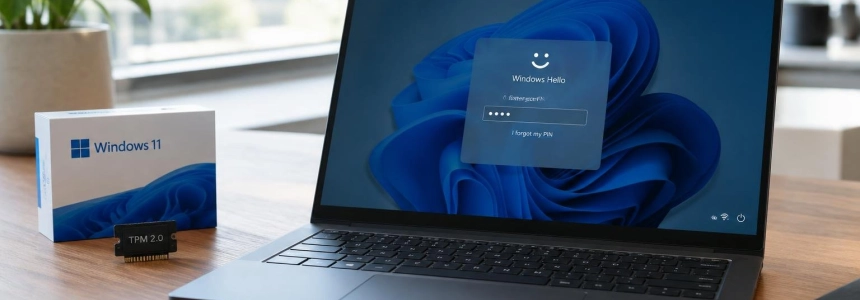
Researchers at Technische Universität Berlin found a way to reset the TPM lockout on some AMD PCs and some Intel systems: the attacker needs physical access and must open the computer. In laboratory tests, they managed to guess a four-digit Windows Hello PIN in 57 minutes and a six-digit BitLocker PIN in less than seven minutes, after 236 attempts in each case.
The issue is not that the PIN can be guessed this way remotely: the method described requires physical intervention on the device. The researchers demonstrated the attack on an HP OmniBook 3 with AMD Ryzen AI 5 330 and a Framework Laptop 13 with Intel Core Ultra 5 125H. This does not mean that all AMD or Intel PCs are exposed; firmware and the flash memory chip are factors.
First, check which PIN you are protecting
The practical recommendation is to review the two cases separately. For Windows Hello, increase the minimum sign-in PIN length. For BitLocker, check that the drive uses TPM+PIN protection and increase the minimum startup PIN length. The research concerns these mechanisms, not every PIN used in Windows.
The figures in the table are worst-case estimates calculated from the speed measured on one laptop for each test. They are not a promise of how long an attack against any given device would take.
| PIN | With documented lockout | Tested Hello attack | Tested BitLocker attack |
|---|---|---|---|
| 4 digits | 69 days | 40 hours | 5 hours* |
| 6 digits | 19 years | 168 days | 20 days |
| 8 digits | 1,903 years | 46 years | 6 years |
*BitLocker accepts a four-digit PIN only if an administrator lowers the default minimum of six. In the tests, the researchers rebooted the computer to regain attempts: Windows continued to force a reboot every five errors on the Hello laptop, but no longer applied the lockout delay.
Steps to reduce exposure
Lengthen the Hello PIN. If you manage Windows Hello for Business, configure the Minimum PIN length policy at
Computer Configuration > Administrative Templates > System > PIN Complexity. The PIN policy settings page displays it in the PIN settings tab. If it is not configured, Windows requires six digits; the policy allows as few as four. Choose a length above the minimum of six when your organization’s policy allows it: the researchers recommend adding at least two digits.Increase the BitLocker PIN length. Configure the Configure minimum PIN length for startup policy. It allows between four and twenty digits and requires six by default. The researchers recommend adding at least two digits here as well. On older hardware, the BitLocker PIN guide recommends enabling Allow enhanced PINs for startup, which allows letters and symbols.
Confirm that BitLocker uses a PIN. In May, Microsoft recommended switching from TPM-only protection to TPM+PIN as a mitigation for YellowKey. The same TPM lockout protection controls this PIN, so verify that your device’s configuration or your organization’s policy includes the startup PIN; do not assume that disk encryption implies it.
On AMD systems, look for the manufacturer’s mitigation. AMD identifies the flaw as CVE-2026-43613 and has announced firmware updates for affected products. The dates are release targets and vary by processor family: some are planned for November 2026 and others for December 2026 or February 2027. Check your PC manufacturer’s update and make sure it applies to your model before installing it; the announced dates do not mean that the firmware is already available.
Physically protect the device while you wait. AMD recommends maintaining physical control of systems and watching for signs of tampering until updated firmware is available. This is especially relevant if the device could be left out of your reach: the attack described requires opening it and connecting hardware to the flash memory.
If you manage AMD systems and know how to use Linux, check RPMC. The researchers published a check that can be run, for example, from a live Linux USB drive:
grep . /sys/bus/pci/drivers/ccp/*/rpmc_*The output indicates whether RPMC flash memory is present and enabled, which helps determine which of the methods described might apply. The absence of files does not prove that the device lacks RPMC. For Intel, the researchers know of no equivalent software check; identifying the specified Winbond chip would require opening the PC, which should not be done without technical expertise and authorization.
«RPMC is intended to stop this type of interposer attack.»
— AMD
What is known about the affected systems
On AMD PCs with RPMC flash, the method described by the researchers blocks counter updates using an interposer board; AMD confirmed a related firmware flaw and is preparing mitigations. On two AMD desktops without RPMC flash, the researchers reset the counter by writing an old copy of the data. They cautioned that two systems are not enough to represent all AMD systems.
The other method affects, according to the researchers, systems that rely on Winbond RPMC flash: a brief change in power can reveal the key used to sign counters. In their test with Intel, the chip allowed the key to be reused after a reboot. Intel said the research did not demonstrate a vulnerability in an Intel component; the test depended on the weakness of the Winbond chip. The memory company was investigating the issue, but had not committed to a fix or a date.
The researchers also claim that a recovered Hello PIN could provide access to device-bound keys and enterprise single sign-on based on Hello; in addition, in some configurations, it could bypass a multifactor check. These additional consequences were not tested in the described experiments. AMD expects its firmware flaw to also affect some systems that use Microsoft Pluton as a TPM, but did not demonstrate this either.
Mistakes to avoid
Do not interpret the risk as remote. The published attack requires physical access, opening the computer, and manipulating the connection to the flash memory. Nor should you generalize from the two laboratory laptops to all devices with AMD or Intel processors.
Do not mistake a target date for an installed patch. AMD is distributing mitigations planned for different dates and processor families. Check availability with the device manufacturer, and do not assume that an operating system update replaces the affected firmware.
Do not treat the RPMC check as a definitive verdict. Missing files do not prove that RPMC is absent. And do not open a laptop to look for a Winbond chip just because of this news: the research requires specialized physical intervention, while increasing PIN lengths and keeping the device under your control are measures you can take without disassembling it.
Sources: The Hacker News, arXiv, AMD, BIFOLD, Technische Universität Berlin, CERT Intelligence