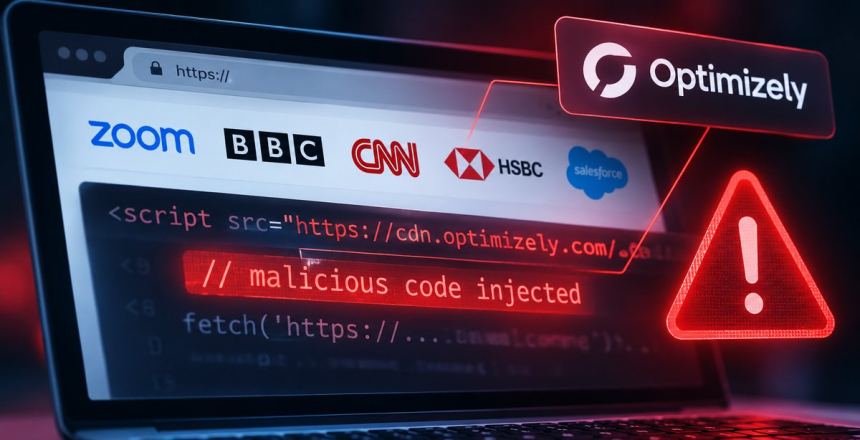
On November 16, visitors to sites associated with 178 organizations received malicious JavaScript through Optimizely Web Experimentation. The code could replace cryptocurrency addresses, capture card data, and load exploit tools for iPhone and iPad; affected sites included CNN, BBC, Zoom, IKEA, and Salesforce.
Scott Helme of Report URI identified the altered snippets while analyzing 1,611 Optimizely JavaScript files. The platform allows organizations to experiment with their websites and personalize their content. Its customers load a JavaScript snippet served by Optimizely to run these features.
The potential reach was greater than the 178 names identified: BuiltWith counted more than 190,000 sites using Optimizely in November. That figure reflects the platform's overall use, not the number of infected websites or affected visitors. Report URI's analysis covered the snippets it was able to locate and review.
The code entered through customer projects
Report URI found that the attacker modified the Project JavaScript field, where each customer can add custom code that runs on their pages. The rest of the snippet could remain intact: the browser continued downloading it from Optimizely's domain and with the company's certificate. Some organizations served the file from their own domains, but the content came from the same Optimizely project.
BleepingComputer reported that Optimizely attributed the intrusion to a vulnerability in Experimentation's account registration process. The company said it blocked access through that route, deployed a fix, removed the code, closed active sessions, revoked tokens, and restored access to affected accounts. It also said it prevented code delivery through Cloudflare and notified affected customers.
In a statement reported by The Record, Optimizely said it had “identified and contained a security incident affecting some Optimizely Web Experimentation customers.” The explanation about the registration process appeared in the response provided to BleepingComputer. Report URI, meanwhile, said it did not know how access had been obtained to so many customer projects; its analysis ruled out a CDN cache poisoning attack.
“The important lesson here is that trusted JavaScript doesn't always remain trustworthy.”
— Scott Helme, Report URI
The injected snippet acted as a loader for a second file, track.js, hosted at 1688360.cc. Report URI observed three variants: one that called that address directly, another that concealed it using Base64 encoding, and a third that included a copy of the code to run if the remote resource was blocked. In Smartsheet's case, the snippet was cleaned and then reinfected with the encoded variant.
A loader with several functions
The malware searched for Bitcoin, Ethereum, and other network wallet addresses, replacing them with addresses controlled by the attacker. It could modify page text, form fields, links, and images, as well as content copied to the clipboard. It could also interfere with web requests and actions such as opening links or sharing from iOS.
The card-stealing feature was added to track.js at 13:43 UTC on November 16, according to Report URI's timeline. The script monitored form submissions and POST requests to find a valid card number, expiration date, and CVV code; if it collected those details, it sent them to an external server. Cards entered into fields belonging to the site itself could be exposed, but data entered into iframes hosted by payment providers was beyond the reach of this mechanism.
The code could also send the visited URL, cookies not marked as HttpOnly, and screenshots when it found replaced addresses alongside terms related to payments or wallets. Report URI said it could not determine how many cards, cookies, or screenshots reached the attackers, or how many iOS devices were infected.
On iPhone and iPad, the loader attempted to download the Coruna and DarkSword tools. According to Report URI, the code selected different exploit chains depending on the iOS version: Coruna for versions 13 to 17 and DarkSword for the 18.x branch. For iOS 26, it used another chain that, at the time, only identified the device. The investigation added that pages on devices running iOS 18.6 or earlier reloaded every 60 seconds to retry the exploit.
The infection spread throughout November 16
Report URI placed earlier activity by the same actor on Turkish websites on September 17, using an injector associated with an SEO link panel script. Between November 13 and 16, it detected another campaign that passed through scripts from Kissmetrics, StorifyMe, and Minute Media. The intrusion into Optimizely snippets appeared later, during the early hours of the 16th.
| UTC time | Report URI finding |
|---|---|
| 04:21 | First injection observed in a BBC snippet. |
| 08:28 | The malicious track.js file appears on bbc.com. |
| 11:20 | The Zoom snippet is modified, according to its Last-Modified header. |
| 13:03–13:05 | The attacker transfers stolen funds to other destinations. |
| 13:43 | The feature for capturing card data is added. |
| 19:24–19:59 | Report URI finds 186 infected snippets among 1,611 reviewed. |
| 21:52 | One infected snippet remained: TalkTalk's. |
During the day, the attacker rebuilt the malicious file 26 times, adding features and new wallet addresses. Report URI recorded a large-scale cleanup between 20:40 and 21:10 UTC; examples included Ledger, Smartsheet, and the BBC. In its final count, only the TalkTalk snippet remained infected at 21:52 UTC; the team said the files it had identified were clean by then.
At least $7,000 in cryptocurrency
Report URI tracked transactions worth approximately $7,040 through 19:25 UTC on November 16. The money reached wallets on several networks over about nine hours. The team said it could not know how many cards or cookies had been sent to the attacker's servers.
| Network or asset | Funds observed | Approximate value |
|---|---|---|
| Bitcoin | 0.08298 BTC | $5,380 |
| Litecoin | 17.02 LTC | $762 |
| TRON | 662.9 USDT and 184 TRX | $719 |
| Ethereum | 0.055 ETH | $100 |
| BNB Smart Chain | 82 USDT | $82 |
The amounts are based on Report URI's tracking, which noted that the funds were withdrawn between 13:03 and 13:05 UTC. The team said it could not know how many cards or cookies had been sent to the attacker's servers. It also said that one of the TRON wallets had been in use since March 2026, indicating activity predating this campaign.
Banks, media outlets, retailers, and technology platforms
It also listed organizations in travel, healthcare, telecommunications, cryptocurrency, insurance, education, and other sectors.
Identified names included HSBC, Equifax, Paychex, Zoom, GitLab, Salesforce, IKEA, ASOS, CNN, BBC, Fox News, Air France-KLM, Ledger, Change.org, and UNICEF USA. The figures refer to organizations whose snippets were detected, not every company using Optimizely or users confirmed to be victims.
BleepingComputer independently confirmed that the script was loading or attempting to load on several sites, and Salesforce told it that it was investigating modifications to Optimizely scripts used by some of its websites. As a precaution, the company disabled those scripts in preview and production environments and said it would notify affected customers if it identified unauthorized access to their data.
Unit 42, Palo Alto Networks' research team, named the campaign OPTIMJACK and said Optimizely fixed the flaw, removed the code, and secured affected accounts early on November 17. Report URI urged companies using Web Experimentation to review their sites. Optimizely said it would continue investigating and publish relevant updates on its status page.
Sources: Tom's Guide, The Record, Report URI Blog, BleepingComputer, Unit 42