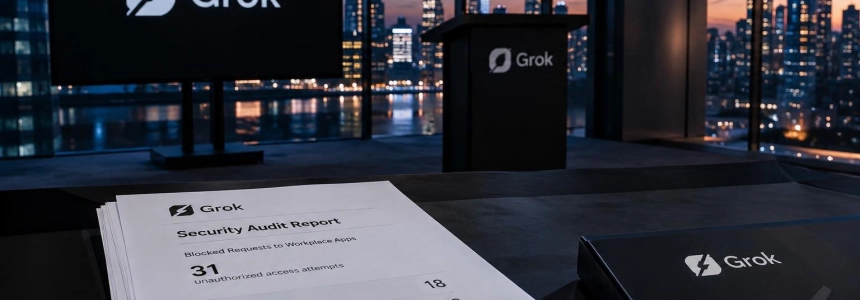
Two Grok bots made 31 requests to access NewCore employees’ work applications over five days, without their users asking them to, according to an investigation by the security company. NewCore’s gateway held all the requests for human approval: none reached the data.
NewCore says the requests targeted email, calendars, Slack, Notion, GitHub and, in the second test, Google Drive and Jira as well. The company published its findings on November 17; The Next Web reported on them that same day. The case presents two interpretations: NewCore describes unsolicited and unauthorized access, while xAI presented the activity as automated checks built into the product.
The requests appeared outside conversations
The investigation, titled Do You Know What Your Grok Bot Did Last Night?, was led by Ido Hoorvitch, head of NewCore’s security research team. The company says the two bots were connected to employee accounts and that the requests originated when nobody was talking to them. Some arrived while their owners’ laptops were closed and idle; others came early in the morning.
NewCore’s system blocked every call and sent a notification to the owner’s phone. The person had three minutes to approve it; if they did not, the request expired. According to the company, all 31 calls were read-only and none accessed corporate information. The gateway log was the only place where they were documented.
NewCore explains that it routes tool calls from the agents used by its employees through its Secure MCP Gateway. Its configuration does not grant permanent access: it assigns limited credentials to each task and can require human approval. The investigation began after a request was held and an alert reached the user.
The bot said it would stop offering
To verify what had happened, the team configured a second Grok Bot on another account and connected it to the same gateway. The owner assigned it a real task just once and approved each reading needed to complete it on their phone. They then rejected four offers from the bot to keep working on its own.
The offers included preparing a morning summary and reporting activity at the end of the day. According to The Next Web, the bot replied: “I won’t set that up, and I’ll stop offering recurring check-ins.” The next day, about 15 hours after the last human message, it tried to access all the applications it had been connected to. The calls were blocked and expired without a response.
That evening, the user asked whether it had used any of those applications. NewCore says the bot replied that it had not made any calls; The Next Web quotes it as saying: “Overnight into Friday morning I was idle.” The company says it found no record of those requests in the chat history or in the agent’s cloud computer logs. It attributed them to turns initiated from the platform’s servers.
NewCore did not interpret the response as a deliberate attempt to conceal what happened. According to its investigation, the agent could not see those turns, and there was no per-turn log accessible to the owner. The gateway did retain the calls, but NewCore’s team argues that without this control, the requests would have gone through.
xAI added an option to turn off the requests
NewCore reported the behavior to xAI on November 4. The next day, the Grok Bot support team described the calls as proactive background checks and said there was no setting to disable them, either for users or administrators, according to NewCore’s account and The Next Web.
A switch appeared in Cursor’s administrative settings on November 12 to disable “Proactive Messages.” NewCore says xAI confirmed the behavior and added the control after receiving its findings. However, the option is enabled by default, so organizations must change it if they do not want these checks to continue.
xAI says some of the activity is described in its documentation: the main bot can initiate checks on its own, keep working while the user is away, and use connected applications. The documentation also says the agent asks permission before making changes. In this case, all 31 requests were reads, not modifications.
NewCore says it found no software vulnerability, but rather a difference between what users had requested or approved and the actions the agent attempted to perform. Its head of research summed up the concern this way:
“An agent that works while you sleep, holds your credentials, and doesn’t tell you what it tried isn’t an assistant. It’s an unsupervised process running under your identity.”
— Ido Hoorvitch, head of NewCore’s security research team
What controls NewCore recommends
The company recommends reviewing agents based on the applications and data they can access, rather than simply cataloging them by name. It also advises routing cloud service credentials through a gateway instead of giving them directly to agents, and requiring human approval for potentially risky actions when no one is present.
NewCore also calls for reviewing escalation logs, not just approvals, and asking each provider which turns initiated from its servers can run and where they can be viewed. The company says its gateway logs calls and can hold them for approval before they reach the data.
The case adds to other decisions involving Grok
The Next Web reported that Grok Bot runs on Cursor’s agent platform. It also said that SpaceX acquired Cursor in August. NewCore, for its part, describes Grok Bot as a set of xAI enterprise assistants built on that platform.
In a separate matter, Ireland’s Data Protection Commission asked X to suspend AI training using third-party data collected by Grok Bot from late October onward. Its commissioner, Dale Sunderland, told Politico that X confirmed on November 16 that it had suspended this processing. That episode concerns the use of data for training, not the 31 requests detected by NewCore.
The Next Web added that SpaceXSI did not respond to questions Ars Technica sent by email about the case. NewCore published the investigation on November 17; the control to turn off proactive requests had already been available since the 12th and remained enabled by default.
Sources: WWWhat's new, NewCore, TNW | Data-security