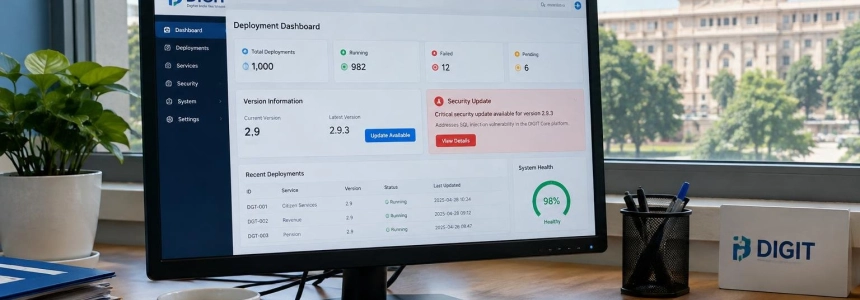
DIGIT Core 2.9 has an SQL injection vulnerability that could allow a remote unauthenticated attacker to run queries against the database. CERT-In, India's computer incident response team, advises updating to version 2.9.3; the alert affects those who administer DIGIT deployments, not users of public services who simply use them.
DIGIT is an open-source platform from eGov Foundation that governments and local authorities use for services such as birth and death certificates, revenue collection, water, and health. The Register reports more than 1,000 active deployments in cities and other entities, in addition to large state and national installations; the platform is also used in other countries.
Who should check
CERT-In's specific reference is DIGIT Core version 2.9. MediaNama notes that it is not known how many deployments run this version, and there has been no confirmation that a system based on DIGIT has been compromised. The vulnerability affects components of the User and Access Control service.
Therefore, the check should be carried out by the teams that maintain the platform: system administrators, deployment managers, and providers that manage instances for governments or other entities. If an organization provides services on DIGIT, it should confirm with the team operating that instance which version of DIGIT Core is installed; it is not enough to know that the public portal works or that the application has a different name.
The risk described is that specially crafted input could reach an affected API endpoint and allow SQL queries to be run without logging in. According to CERT-In, exploitation could cause disclosure, modification, or deletion of data. This does not prove that it has happened in any particular installation: the agency has not said whether the vulnerability has been exploited.
Steps to review and fix the deployment
Locate every DIGIT instance. Review your organization's application and service inventory, including systems managed by integrators or providers. The Register describes deployments across different cities and entities, as well as larger-scale implementations; check every environment you administer, not just the main portal.
Confirm the DIGIT Core version. Check the deployed version against the installation, configuration, or handover records maintained by the responsible team. If the instance is outsourced, ask the provider to explicitly confirm the Core version in use. The version that matters for this alert is DIGIT Core, not a general label for the municipal service.
Prioritize installations running 2.9. If the deployment uses DIGIT Core 2.9, treat it as affected by the alert and plan to update without delay. CERT-In has indicated that you should update to version 2.9.3. If you cannot determine which version is running, ask the technical lead to check rather than assuming the system is up to date.
Apply the fix in a controlled manner. Follow the installation's own update procedure and use the fixed version indicated by CERT-In. The Cyber Express reports that eGov Foundation published the fix in DIGIT Core v2.9.3. Coordinate the change with whoever maintains customizations or added modules to ensure the update reaches the affected instance.
Verify the result in every environment. After the change, confirm with the operations team that DIGIT Core is running v2.9.3 and that the update was applied to every identified instance. If several municipalities or services depend on a shared platform, record which ones have been updated and which are still pending; do not assume deployments are fixed just because a central environment was updated.
Escalate any indication of unauthorized access. If you find suspicious activity or unexplained changes to data during the review, activate your organization's incident response procedure and notify the responsible operator. The alert warns of possible unauthorized queries and the alteration or deletion of information, but does not confirm any attacks: treat indicators as something to investigate, not as automatic proof of exploitation.
Mistakes to avoid
Do not confuse an available fix with an applied update. eGov Foundation publishing fixed code does not, by itself, change instances that are already running. You need to verify the version in each deployment and confirm the result with whoever administers it.
It is also unwise to limit the review to systems that carry the DIGIT brand publicly. The platform supports third-party modules and sector-specific services built on its shared components; check the technical inventory and ask providers which underlying platform each service uses.
Finally, do not claim that a database was stolen or altered without evidence. CERT-In describes what exploitation could allow, while MediaNama notes that no affected system has been confirmed. The first task is to identify the installations and fix those running the vulnerable version.
Sources: theregister, MEDIANAMA, The Cyber Express, India Today