usb-rea generates PyUSB drivers from the traffic exchanged between a manufacturer's application and a USB peripheral. The tool, created by Emir Mrkaljevic, aims to help users access features in Linux that some accessories reserve for their Windows software; the project is still in alpha and does not guarantee that every device will be compatible.
From USB packets to a driver
The problem it addresses arises with accessories that connect and work in Linux but lose advanced options because the manufacturer only offers its configuration application for Windows. Examples include RGB controllers, mice, and displays integrated into PC cases, as well as smart lamps and cooling systems.
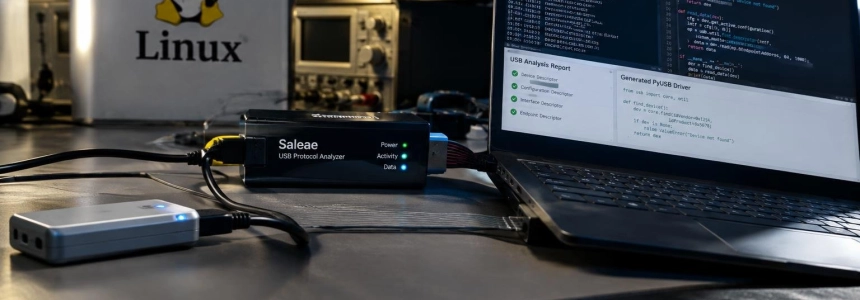
usb-rea tries to infer how a device is controlled by observing communication between the peripheral and its official software. The capture can be made with USBPcap on Windows or usbmon on Linux. While traffic is being recorded, the user marks the actions performed in the application—for example, changing a speed or a lighting setting—so they can be matched to the messages received by the accessory.
The program then looks for patterns in the packets: constant fields, counters, values, lookup tables, and checksums. Based on these deductions, it prepares a Markdown protocol report and a standalone driver for Linux built with PyUSB. The goal is to reduce the manual work of reconstructing protocols that the manufacturer has not documented, not to eliminate the need to observe and interpret communications.
The analysis can be run on Windows, Linux, or macOS, according to CNX Software. To capture traffic from a Windows application, the user needs that application and a capture of the USB exchange; it can then be analyzed on another system. MakeUseOf also suggests using a Windows virtual machine from Linux, provided it has access to the USB device.
Two tests with known protocols
Mrkaljevic compared usb-rea's deductions with protocols already implemented for two peripherals: the NZXT Kraken X liquid cooling system and the SteelSeries Rival 100 mouse. For the Kraken X, the tool reconstructed the command that controls the fan, and the result matched the one used by liquidctl byte for byte.
CNX Software adds that the generated driver produced correct packets for values that did not appear in the captures used for the analysis. This check is relevant for assessing whether the program has found a useful relationship between configuration changes and USB messages, although it does not prove that the same method will work with every accessory.
For the Rival 100, the protocol was checked against information from rivalcfg, which already makes it possible to control the mouse in Linux. How-To Geek cites settings for DPI, polling rate, and RGB lighting among the aspects compared. In both cases, existing tools made it easier to verify the findings; these were not devices without prior support.
The tool also includes a USB identifier lookup to find out whether support already exists. CNX Software gives the example of VID 0x0416 and PID 0x7395, corresponding to a 2.88-inch USB IPS LCD display that is already supported by liquidctl. If the lookup finds a compatible driver, the reverse-engineering process can be avoided.
An experimental tool, not a magic button
Version 0.7.14 is listed as alpha in the GitHub repository, according to How-To Geek. The project is also described as MIT-licensed software, and CNX Software says it can be installed using pip. Its early stage matters: the generated code is a starting point, not a promise that all of the device's features will become available.
The quality of the capture and the interpretation of the protocol affect the result. In addition, two units with matching vendor and product identifiers do not necessarily communicate in the same way. Therefore, a matching VID:PID does not prove full compatibility, and a capture that does not include the relevant actions may omit necessary commands.
To experiment without connecting hardware, usb-rea offers a demo with an emulated fan, also described as adaptable to other emulated devices. CNX Software notes that it generates three files: report.md, fan_driver.py, and fan.lua. The first documents the protocol inferred from a demonstration capture, the second contains a PyUSB driver, and the third is a Wireshark dissector.
The program can also run as an MCP server, allowing an AI programming assistant to direct the analysis. This is an additional way to use it, not a guarantee that the protocol will be reconstructed without intervention: the described workflow still starts with capturing traffic and identifying the user's actions.
The community will decide which peripherals can benefit
The practical value of usb-rea will depend on whether its reports and drivers can serve as a basis for expanding community support. An accessory may work in Linux for basic tasks and still lack options that the manufacturer only exposes through Windows. The project is aimed precisely at these features: fan settings, lighting, and device controls.
CNX Software puts the tool in context with an earlier reverse-engineering experience: its author had to capture packets from a USB video capture card and manually replay URB requests using libusb, paying attention to timing. It notes that a tool like usb-rea would have been useful at the time. This comparison illustrates the work the project is trying to automate, but it is not additional proof of compatibility.
So far, the method has been tested against two protocols that already had implementations in liquidctl and rivalcfg. How-To Geek suggests that the real test will be whether the community can apply it to accessories that are not yet supported by Linux tools. The list of compatible devices will depend on future captures, verifications, and contributions.
Sources: IlSoftware.it, CNX Software - Embedded Systems News, How-To Geek, MakeUseOf