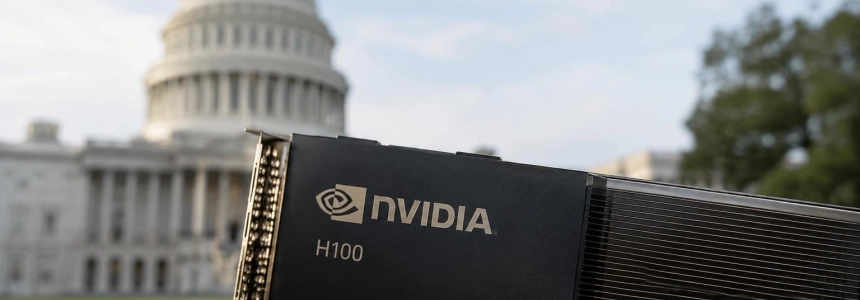
The U.S. Congress is again pushing to limit China’s access to advanced artificial intelligence chips, following a scandal involving Jensen Huang, described by The Verge as Nvidia’s former CEO, and a person suspected of being a Chinese spy. Lawmakers from both parties support stricter measures and are calling for Huang and other Nvidia executives to testify before Congress.
Political pressure is not limited to a single initiative. Senate Minority Leader Chuck Schumer said that Huang and the Trump administration should answer to Congress. Tim Scott, chair of the Senate Banking Committee, sent letters to both Huang and Commerce Secretary Howard Lutnick, asking them to testify publicly before the committee.
The focus is on tightening the rules governing AI chip exports and limiting China’s access to these components. However, the legislative debate described so far does not amount to a new ban already in effect: the initiatives mentioned are still making their way through the political process.
A proposal that advanced in the House
The Remote Access Security Act is one of the measures that has regained attention. The Verge reports that the bill was first introduced in the House of Representatives in April 2025 and later stalled in the Senate. The article does not say that it will become law; rather, it presents renewed interest in the bill as part of a broader discussion about controlling chips.
The House’s official record adds a concrete step: the bill, identified as H. R. 2683, was put to a vote on January 12, 2026, and passed with amendments under a motion to suspend the rules. The result was 369 votes in favor and 22 against; 39 representatives did not vote, and none were recorded as present.
| Voting detail | Result |
|---|---|
| Bill | H. R. 2683, Remote Access Security Act |
| Date | January 12, 2026 |
| In favor | 369 |
| Against | 22 |
| Present | 0 |
| Did not vote | 39 |
Support crossed party lines. A total of 202 Democrats and 167 Republicans voted in favor; all 22 votes against came from Republicans. Another 11 Democrats and 28 Republicans did not participate in the vote, according to the House tally.
Remote access at the center of the debate
One of the initiatives receiving renewed attention is the Remote Access Security Act. The available information does not detail what mechanisms it would establish or which services, equipment, or companies would be subject to its provisions. Nor does it specify how the current rules would change if it passed.
For that reason, the House’s action does not yet resolve the scope of any potential restriction. The Verge cautions that the specific law may not pass, although the debate over limiting exports to China is gaining new momentum. The distinction between a bill passed by one chamber and a rule in force is crucial: the bill still has to go through the Senate.
The January vote, officially recorded as a passage, and The Verge’s description of the bill as stalled in the Senate are not incompatible: the House approved it, but the process did not culminate in full legislative approval. The November report presents the proposal as one of the options being discussed again, not as a regulation that has already taken effect.
Support for new restrictions, but doubts about the bill
House Speaker Mike Johnson said there is growing support among lawmakers for limiting chip exports to China. Reuters, as cited by The Verge, reported his statement. Johnson also expressed personal support for efforts to restrict China’s access to powerful AI chips from companies such as Nvidia.
“growing consensus in Congress on limiting chip exports to China”
— Mike Johnson, Speaker of the House of Representatives, according to Reuters
The statement points to political convergence around the general goal, but does not identify a single legislative solution or guarantee that any specific bill will clear the Senate. The Verge reports that both Democrats and Republicans have expressed support for various measures and bills, while calling for Nvidia executives to testify before Congress.
The episode that has reignited pressure is described in limited terms: The Verge links it to Huang, described as Nvidia’s former CEO, and a person suspected of being a Chinese spy. It provides no details about that person’s identity, the circumstances of the case, or the evidence supporting the suspicion. Schumer has called for Huang and the Trump administration to answer to Congress, while Scott has requested public testimony from Huang and Lutnick before the Senate Banking Committee.
The Senate is the next outstanding step
The next political question is whether the Senate takes up the Remote Access Security Act again or whether the consensus Johnson described leads to other measures. The proposal was introduced in the House in April 2025, received 369 votes in favor in January 2026, and, according to The Verge, remains stalled in the Senate. No date has been given for another vote, nor is there a schedule for the requested testimonies.
It also remains unclear what specific measures could emerge from the debate over AI chip exports to China. For now, lawmakers are seeking answers and exploring restrictions, but no new approved rule that changes the rules has been described. The Senate still has to decide what to do with H. R. 2683.
Sources: The Verge, Office of the Clerk, U.S. House of Representatives