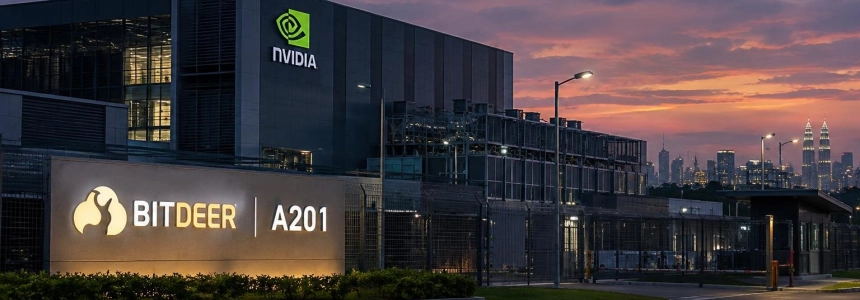
Howard Lutnick wants to limit the scope of new U.S. controls on data centers outside China that provide computing capacity to Chinese customers. The debate directly involves A201, a data center Bitdeer is preparing in Malaysia, which is scheduled to come online next year.
The Malaysian project would bring together hundreds of millions of dollars’ worth of Nvidia servers and supply that computing power to a Chinese tech giant. The arrangement is legal under the rules described by The New York Times: the U.S. ban covers the direct sale of the most advanced chips to Chinese companies, but does not prevent them from renting computing capacity at facilities located in other countries.
The Malaysian data center at the center of the dispute
A201 is a Bitdeer facility in Johor, in southern Malaysia. The company expects it to generate $1.7 billion in revenue over five years, according to a corporate filing cited by The Philadelphia Inquirer. A person familiar with the deal told the newspaper that it will likely serve Tencent, the Chinese internet giant.
Bitdeer is part of Nvidia’s partner network, made up of companies that work closely with the manufacturer. It also operates a Chinese-language website that lets customers rent AI chips and access Chinese open-source models from data centers in Malaysia, Canada, and elsewhere. The Johor facility would be one of five the company plans to open in Malaysia over the next few years, according to filings with the U.S. Securities and Exchange Commission.
The business model takes advantage of the difference between buying chips and renting their capacity. The United States began banning direct exports of advanced Nvidia chips to China in late 2022, out of concern that they could help Beijing crack U.S. encryption and develop new weapons. Chinese companies, however, can turn to data centers located in countries such as Malaysia, Indonesia, or Thailand.
A narrower rule than global coverage
The Trump administration has spent much of the past two years debating how far to extend restrictions to these facilities. Supporters of tougher measures see them as a way for Beijing to get around the ban; other officials, including Lutnick, fear overly limiting Nvidia’s and other U.S. companies’ ability to sell in Asia.
According to people familiar with the discussions cited by The Philadelphia Inquirer, the Department of Commerce has advocated a proposal that would cover seven countries instead of the entire world. Other administration officials wanted global coverage. The department’s proposal would also distinguish between new facilities and those already equipped with U.S. technology.
| Aspect of Commerce proposal | Reported details |
|---|---|
| Countries included | Singapore, Malaysia, Thailand, Indonesia, Brazil, South Africa, and Norway |
| Existing facilities | Would be exempt; controls would apply to future shipments of advanced chips |
| Use by Chinese customers | Companies would notify the government if Chinese customers train AI models |
| Licenses | Notification would not automatically mean applying for a license |
| Computing threshold | Commerce proposed triggering it at a higher level of computing capacity |
That last threshold would reduce the activities subject to regulation, according to the newspaper’s report. The narrower version could leave Chinese companies room to rent capacity in countries excluded from the list. Chris McGuire, a senior fellow at the Council on Foreign Relations and a former Biden administration official, warned: “China will simply rent from data centers outside those countries” if the restrictions cover only some territories.
“If remote access to data centers in only certain countries is restricted, China will simply rent from data centers outside those countries.”
— Chris McGuire, senior fellow at the Council on Foreign Relations and former Biden administration official
Cantor Fitzgerald’s ties
The controversy also puts the spotlight on Cantor Fitzgerald, the financial services firm Lutnick led for decades before joining the administration. Bitdeer is a Cantor client: this year, the firm acted as the designated sales agent for a stock offering of up to $1 billion. The relationship dates back at least to 2024, when Cantor helped arrange an offering of up to $250 million.
Cantor also has a stake in Bitdeer through its investment in Tether, a cryptocurrency company, and has financial ties to other data center businesses. These include Gorilla Technology, which is building facilities in Thailand and Indonesia; Singapore-based Freyr AI, with which it has an AI capacity contract and which, according to corporate filings and job listings, has ties to China; Australian company IREN; and Texas developer Lancium.
The Inquirer noted that these businesses make up a small part of Cantor’s operations, which span investment banking, trading, and real estate. Other financial firms have similar arrangements, and the newspaper said there was no evidence that Cantor’s investments influenced Lutnick’s deliberations. Bain Capital, Citadel, and Blackstone have also invested in AI computing groups in the region.
Nvidia was among Cantor’s largest stock holdings early last year, but the firm began steadily selling shares last fall. Cantor held those shares on behalf of its clients, not as part of its own portfolio. Even so, it has helped finance sectors—from data centers to cryptocurrency—whose activity depends on the supply of Nvidia-based computing capacity.
Lutnick’s conduct and the criticism
Lutnick’s position has been described as a brake on rules that could restrict Nvidia sales to data centers serving Chinese customers. The Department of Commerce has also faced criticism in recent months for giving Nvidia unusual access to rulemaking and investigations, and for blocking sanctions against the company’s customers.
Lutnick stepped down as head of Cantor when he joined the Trump administration and transferred control to his children. In October 2025, he transferred his remaining stake to his family, according to the Inquirer. The Department of Commerce says he is complying with ethics agreements and that Lutnick does not discuss department matters with his children, nor do they discuss Cantor’s business with him.
Before completing the transfer, the White House had granted him a “limited waiver” to participate in certain decisions with a direct and predictable effect on Cantor Fitzgerald. That authorization exempted him from fully recusing himself under a federal criminal law. After transferring his stake, he remained subject to the ethics rule prohibiting federal employees from using their position for the benefit of themselves or their family and friends.
The overlap between his previous interests and his public responsibilities had already drawn political scrutiny. The New York Times reported last year that Lutnick was promoting data center projects linked to family businesses; Senator Elizabeth Warren and 24 other Democratic lawmakers called for an investigation. The Department of Commerce says its decisions are made in the interest of the United States. Cantor Fitzgerald declined to comment, and Bitdeer did not respond to a request for comment.
A revoked precedent and an interim rule
In recent weeks, the debate has drawn attention because of the case of Alice Huang, who ran Megaspeed, a company that installed data centers in Southeast Asia for Chinese companies. The U.S. government considered her a Chinese intelligence asset and is investigating Megaspeed for illegally smuggling chips into China, according to the Inquirer. The article also links the case to Nvidia CEO Jensen Huang.
In the final weeks of the Biden administration, global rules were approved to limit Chinese companies’ remote access to U.S. chips. Trump revoked them upon taking office, arguing that they harmed business and innovation. His administration said it would prepare a replacement rule, but disagreements over its scope delayed the decision.
On November 16, the Bureau of Industry and Security (BIS), part of the U.S. Department of Commerce, announced an interim rule on remote access to advanced “superintelligence” chips and servers. The announcement says the rule was drafted by the Department of the Treasury and the National Security Council, and aims to prevent existing controls from being circumvented through remote computing agreements at data centers in third countries.
The announcement of the rule does not specify which countries it will cover, what thresholds it will apply, or how it will resolve the internal disagreements described over licenses and already-equipped data centers.
Sources: The New York Times, U.S. Department of Commerce, Bureau of Industry and Security, The Philadelphia Inquirer