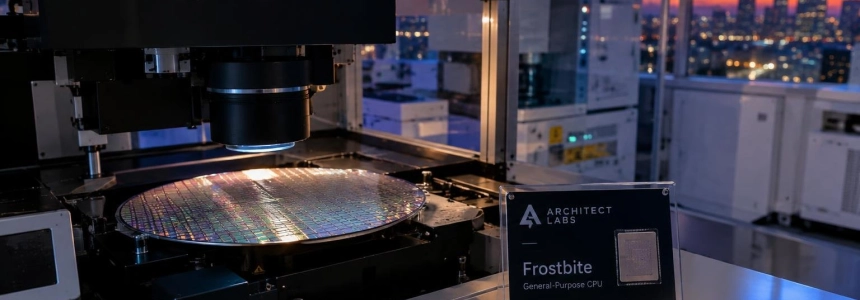
Frostbite delivers 4.59 times the performance per watt of a conventional CPU core, according to Architect Labs, the startup that says it designed and verified this architecture with artificial intelligence systems. The figure comes from pre-silicon simulations: the design has not yet been produced as a chip.
The headline result is for a cluster of four tiles compared with a dual-issue, in-order core described as tested in silicon. Architect Labs does not identify the reference processor; Tom’s Hardware reports that the company says it cannot name it for legal reasons. The test is based on a simulated 7 nm design, not measurements from a manufactured chip.
| Metric | Reported result |
|---|---|
| Workloads evaluated | 25 total |
| Workloads held back for the final evaluation | 15 |
| Performance per watt versus the reference core | 4.59 times across the set of 25 workloads |
| Performance per watt across the 15 held-back workloads | 3.83 times |
| Simulated process | 7 nm |
A CPU that aims to avoid dependency discovery
The proposal departs from the way processors typically execute programs. Architect Labs argues that conventional CPUs must infer at runtime which instructions depend on one another. In multicore systems, they must also keep the shared-memory view coherent, using cache hierarchies and protocols that consume area and energy.
Frostbite is based on interaction nets, a representation in which a program is a graph of nodes and computation happens by rewriting connected pairs. The company describes each step as local and each value as belonging to a single node. Under these rules, it says, the hardware can expose parallel work without reconstructing dependencies through out-of-order execution mechanisms.
Architect Labs presents this approach as “multithreading for free”: parallelism follows from the program’s structure, without the design relying on threads, locks, or race conditions. In its example of five queens on a five-by-five board, the version represented as a net performs 3,183 interactions with a critical path of 262 steps. The company calculates that, on average, about twelve interactions are ready to execute at each step.
The organization also affects memory. Because each value has a single owner and work is performed locally, Architect Labs proposes using small memories next to the compute units, rather than devoting as much area and power to large shared-cache systems. Tom’s Hardware describes each tile as an identical processing unit with local memory, connected to the others through an on-chip network.
Design tuned with 25 workloads
The test selection aimed to cover different ways a program can expose work: independent pieces, rounds of parallel tasks, long sequential chains, data-dependent branches, and recursion. Architect Labs separated search workloads, used during tuning, from others held back until the final evaluation, intending to test whether Frostbite also worked on programs it had not been directly optimized for.
The cited workloads include FFT, radixsort, and LU, whose kernels follow implementations from the SPLASH-2 benchmark at a scale 64 times smaller. Later, the company added five practical tests to the held-back group: a Kalman filter, PCA, finite element analysis, an LU solve, and LZ4 decompression. Tom’s Hardware notes that the advantage across the 15 workloads not used for tuning was 3.83 times, below the aggregate result of 4.59.
Before moving on to detailed design, the agents synthesized research papers and existing benchmarks, and built Python models to compare architectural concepts. This process produced a 141-page document covering the programming model, runtime, and main chip blocks. Architect Labs says it discarded the document after the first generation of RTL, because several initial estimates did not match what was physically possible.
Formal contracts to coordinate the agents
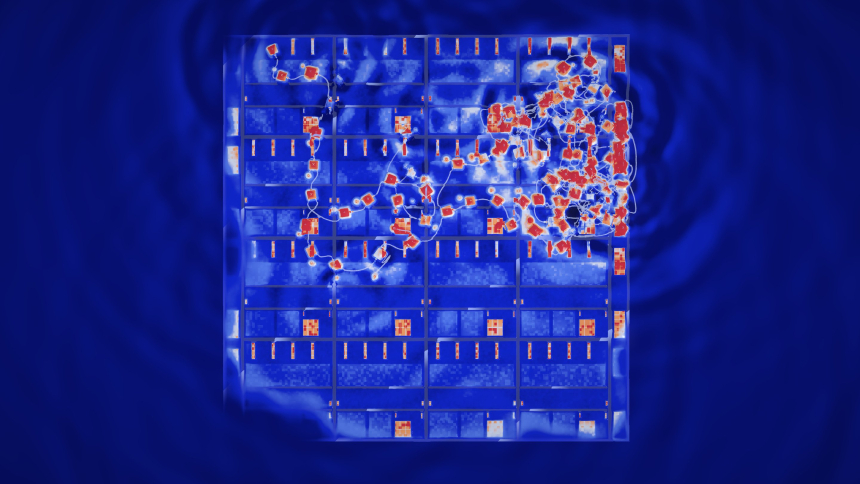
The company created an internal specification language called ASL and used it to write Arcmodel, Frostbite’s system model. ASL allows translations between the model, RTL, UVM, and SVA, among other elements, to be expressed and checked. Architect Labs attributes power and performance estimates accurate to within 1% to 5% to the model, and says it runs about 200 times faster than an RTL simulation.
ASL is also translated into Lean, which the company uses to prove theorems and check AI results in RTL, UVM, C, and SVA. By the end of the project, the Frostbite specification had been converted into more than 800,000 lines of Lean. Architect Labs says the formal contracts served as a shared reference that allowed agents to modify the ISA, model, design, and verification in a coordinated way.
The abstract model alone did not capture all physical effects. Before continuing with automated exploration, a system compared Arcmodel with the RTL and adjusted its power estimates. According to Architect Labs, the initial discrepancy could approach 250%; autonomous tuning tracked power-consumption points such as SRAM reads and writes, operations, flit traffic, and frame misses until the estimates matched within a 5% margin.
With the model aligned, full Arcmodel simulations were 660 times faster than RTL simulations, according to the company. This made it possible to test changes involving both the hardware and the runtime software. Architect Labs cites fine-grained clock-gating adjustments, accompanied by runtime changes, as an example of work its systems completed in a matter of hours.
Of 58 ideas, 37 made it into the design
Once the model and RTL matched, Architect Labs discarded the initial architecture document and original Python models. From that point on, the ASL contracts, Arcmodel, RTL, and power measurements advanced together. Agents proposed revisions on parallel branches; each proposal was verified, modeled, implemented, and evaluated before a decision was made about whether to keep it.
Across four search rounds and a final ablation phase, the system tested 58 ideas and kept 37. The company mentions adding clock gates to an active tile, smaller L3 tables, and a shared expander among the changes. The article does not specify how much each decision contributed to the total improvement.
The software design complements the architecture. Programs are written in Vine, a language with Rust-like syntax, and compiled to Ivy, an intermediate representation that encodes the interaction net. Optimization aims to reduce the graph before execution, but Architect Labs explains that the remaining parallelism must be derived dynamically from the state and distributed spatially across the chip.
Instead of a central scheduler, tiles apply local rules to distribute work. They execute their own tasks first; if they have none, they take work from a neighboring tile that has some available. When they cannot find available work, they can become idle to save energy. The company describes these mechanisms as properties that emerged during the agents’ exploration.
Comparison with more powerful CPUs is still pending
The context of the figure is important: the result comes from a pre-silicon simulation and is compared with a dual-issue, in-order core, not a modern, wider CPU with out-of-order execution. In addition, the cluster used in the comparison contains four tiles and four L3 nodes, while the full design described by Tom’s Hardware has 16 tiles.
Architect Labs says it plans to compare the design with larger, wider processors in the coming months, using well-known suites such as SPEC and PARSEC. Those tests would help determine how Frostbite performs against a broader range of CPUs and workloads. The company has not yet published those results.
The architecture therefore still needs to demonstrate its figures in silicon and pass additional tests against higher-capacity processors. For now, its top result remains 4.59 times more performance per watt across 25 simulated workloads, with a 3.83-times advantage across the held-back set.
Sources: Architect Labs, Tom's Hardware