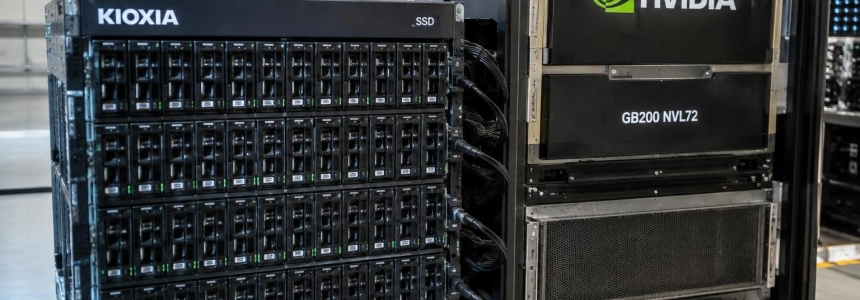
Kioxia and NVIDIA presented a proof of concept with 144 SSDs and about 1.1 petabytes of raw capacity to explore how to expand the effective memory accessible to a GPU. The demonstration showed the potential to process a database of two trillion vectors in an NVIDIA GB200 NVL72 system; the cited capacity refers to flash storage, not HBM installed in the GPU.
The demonstration is part of Storage-Next, an NVIDIA initiative, and combines the company's software technologies with Kioxia NVMe SSDs. According to the announcement released on November 26, the goal is to keep datasets too large to fit in high-bandwidth memory—HBM—accessible during AI processing.
An SSD-based extension, not more physical HBM
The distinction matters: the 1.1 PB refers to the system's raw SSD capacity. The demonstration aims to extend the effective memory capacity available to GPU workloads; it does not claim that the GB200 NVL72 includes that amount of HBM or that the SSDs match its performance.
The announcement explains that the growth of AI datasets is putting pressure on the memory available in GPUs, which is typically HBM. When working with only this memory, some workloads may have to be divided into smaller segments and data moved repeatedly between memory and slower storage systems.
Kioxia and NVIDIA's proposal combines Scaled Accelerated Data Access (SCADA) and Storage-Next software technologies with high-performance NVMe drives. Kioxia describes SCADA as a software library designed to expand effective GPU memory using NVMe SSDs, including through fine-grained access with small blocks.
In the test, the architecture supported 512-byte accesses. According to the announcement, this configuration has the potential to support two trillion 512-byte vectors across the system. This figure describes the potential indicated for the architecture, not an independent measurement of its performance in any application.
18 nodes and eight drives per node
The equipment used was a rack-scale NVIDIA GB200 NVL72, comprising 18 server nodes. In total, it housed 144 KIOXIA XD8 Series drives, each with 7.68 terabytes of capacity and an E1.S NVMe form factor.
| Component | Test configuration |
|---|---|
| System | NVIDIA GB200 NVL72 |
| Server nodes | 18 |
| SSDs per node | 8 |
| SSDs installed | 144 KIOXIA XD8 Series |
| Capacity per SSD | 7.68 TB |
| Total raw SSD capacity | Approximately 1.1 PB |
| Extended flash memory per node | Nearly 60 TB |
| Access and vectors | 512-byte accesses; potential to support two trillion vectors of that size |
Each node supports eight SSDs and provides nearly 60 TB of extended flash memory, according to the companies. Kioxia defines a terabyte as 1,000,000,000,000 bytes and a petabyte as 1 billion megabytes; therefore, the capacity shown by an operating system may be lower when calculated using powers of two. Formatted capacity may also vary.
Kioxia and NVIDIA conducted the test through November 25, 2026, according to Kioxia's statement. The public announcement of the collaboration came the following day. The materials do not detail latency, measured bandwidth, comparative results, or the time required to process the vector database.
Planned applications and pending evaluation
The companies cite large-scale vector databases and processing extensive datasets for graph neural networks (GNNs) as potential use cases. The demonstration shows that this data can be handled beyond HBM's capacity limit, although it does not provide production results or a performance evaluation for each type of workload.
Jason Hardy, NVIDIA's vice president of Storage Technology, linked access to more data with the development of AI agents: “The intelligence of AI agents will increasingly depend on the knowledge they can access, not just the compute power they consume”. Hardy added that SCADA and Storage-Next aim to improve memory efficiency and expand its effective capacity.
The intelligence of AI agents will increasingly depend on the knowledge they can access, not just the compute power they consume.
— Jason Hardy, NVIDIA vice president of Storage Technology
Neville Ichhaporia, senior vice president and general manager of KIOXIA America's SSD business unit, said the collaboration shows how flash storage can contribute to new ways of scaling AI data processing. No commercial product, price, or availability date for the configuration was announced.
Kioxia also mentioned its XD8 Series and GP Series Super High IOPS drives as part of its SSD development for AI and high-performance computing. For now, both companies say they are continuing to evaluate the technical feasibility and performance of NVIDIA SCADA and the Storage-Next architecture for processing large datasets more efficiently.
Sources: BERNAMA, Yahoo Finance