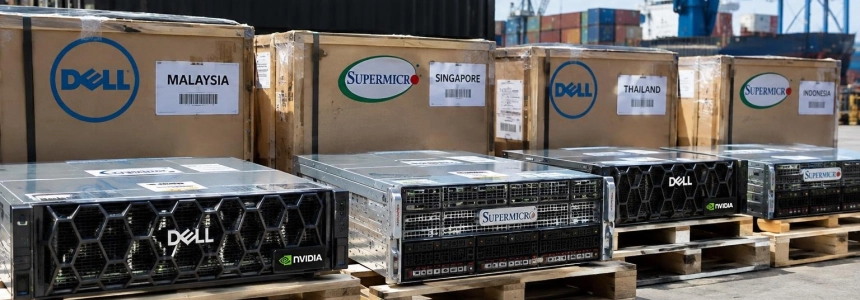
Nvidia has asked Dell, Supermicro, and other partners to halt server shipments to Malaysia, Singapore, Thailand, and Indonesia while it reviews whether its regional partners comply with new U.S. export rules. The duration of the pause is unclear; buyers in those countries have reportedly already been notified that their orders cannot be shipped.
The measure affects servers containing Nvidia processors, not just direct GPU sales. According to the Financial Times, as cited by Channel NewsAsia (CNA) and Engadget, manufacturers told local customers that Nvidia had not authorized the shipment of their orders. TechCrunch attributes the report to the Wall Street Journal and says the company is assessing whether its regional partners are complying with U.S. requirements.
The four destinations are Malaysia, Singapore, Thailand, and Indonesia. Nvidia has not clarified how long the suspension will last. CNA reports that the company and its partners are trying to determine how to comply with the new restrictions; for now, the practical issue for buyers is that the servers they ordered are not being shipped.
Remote access at the center of the new rules
In recent years, Chinese AI labs and companies have turned to cloud computing providers in Southeast Asia to use Nvidia chips. Instead of importing the processors directly, they rented computing capacity in data centers in the region whose servers contained those GPUs. This allowed them to access equipment subject to U.S. restrictions from facilities located in third countries.
The U.S. Department of Commerce published an interim final rule on November 16, 2026, on remote access to advanced chips and servers. The Bureau of Industry and Security (BIS), part of the department, explained that the rule is intended to prevent existing restrictions from being circumvented through remote computing agreements at data centers outside restricted countries. CNA and Engadget describe the measures as an attempt to close off this route to access.
The rule also sets a deadline for data centers that were already providing large amounts of computing capacity to Chinese companies or other affected entities: according to Engadget, they have 90 days from November 19 to obtain a license if they want to continue providing the service. CNA says they must demonstrate that their end users are not restricted entities.
The licensing requirement has left operators uncertain about the process. A cloud provider executive summed up the problem to the Financial Times: “There's this new rule but no guidance on execution. No one knows how to apply for this license while the 90-day clock is ticking. It's causing sheer chaos in the region.”
“There's this new rule but no guidance on execution. No one knows how to apply for this license while the 90-day clock is ticking. It's causing sheer chaos in the region.”
— Cloud provider executive
Nvidia's pause comes as manufacturers and cloud services try to determine which operations can continue under the new conditions. TechCrunch says the company is checking whether its regional partners are complying; CNA describes the halt as part of efforts to adapt to Washington's controls.
Regional projects under pressure
The surge in Chinese demand had driven the construction of data centers in Southeast Asia, especially in Malaysia and Indonesia. CNA reports that billions of dollars have been allocated to AI infrastructure in those countries. U.S. restrictions put some of those investments at risk by complicating access to the chips needed to equip the facilities.
One affected project is reportedly Aolani, a Singapore-based cloud company that planned to offer advanced computing capacity to ByteDance, the Chinese company that owns TikTok, through rental agreements. Two people familiar with the matter told CNA that some bankers who had agreed to finance the project stopped extending credit for around $500 million. ByteDance could abandon the agreement.
The scale of the halt is also reflected in Nvidia's accounts. The company recorded $104 billion in revenue through its Singapore subsidiary in 2025, up 72% from the previous year, according to CNA and Engadget. CNA cautions that the entity also records some of Nvidia's revenue from Taiwan and China, so the figure does not correspond exclusively to sales in the four affected countries.
TechCrunch cites an estimate from the Institute for Progress think tank that remote data centers of this kind provide around 24% of China's AI computing capacity. The figure helps convey the significance of the channel Washington is trying to close, although it does not indicate what share of that capacity depends on each country or provider.
The Megaspeed case and pressure on Nvidia
The new rules came after the United States stepped up scrutiny of Chinese customers' use of Nvidia chips. Engadget reports that the Department of Commerce added Megaspeed to its Entity List on Wednesday, a list of entities subject to export controls. Companies, including Nvidia, need a U.S. license to ship goods covered by those rules to Megaspeed.
Megaspeed had rented access to Nvidia chips to Chinese companies, according to Engadget. The Department of Justice is investigating whether the company violated export rules. CNA also links the controversy to a cloud provider under investigation for alleged involvement in smuggling, although it does not identify the provider in that passage. The reports agree that renting computing capacity has drawn the attention of authorities, but do not detail the outcome of the investigation.
The episode also intersects with Jensen Huang's situation. Engadget says he had stepped down as CEO on November 12, following reports of extramarital relationships, and that Nvidia reinstated him a few days before the news broke. CNA describes his departure as brief and also mentions reports of a relationship with a woman linked to a cloud provider that rented access to Chinese companies.
Engadget identifies the woman as Alice Huang, a former Megaspeed executive, and says some U.S. officials suspect she was a Chinese intelligence asset. That suspicion has not been presented as a proven fact. CNA, for its part, refers to a woman linked to a cloud provider and an investigation into alleged smuggling. Reports about Huang's personal life and suspicions about the former executive do not in themselves establish an export violation.
The controversy has complicated Huang's public position. According to CNA, he had argued that the United States should continue selling Nvidia chips to Chinese companies to increase their dependence on U.S. technology. Some expected his return to the helm to ease enforcement of the new rules; people interviewed by the outlet saw no signs that Nvidia would stop enforcing them.
Licensing will determine the next steps
For cloud providers, the 90-day deadline makes interpreting the rule an immediate concern: they need to figure out how to apply for a license and verify who their end users are. BIS presents the rule as an extension of existing controls on the physical shipment of sensitive technology to remote access to advanced computing capacity.
It also remains to be seen how long the shipping freeze will last and which orders can resume once Nvidia and its partners determine how to meet the requirements. Nvidia declined to comment to CNA; Dell, Supermicro, ByteDance, and Aolani also did not respond to the outlet's requests. Meanwhile, the roughly $500 million in financing tied to the Aolani project remains in doubt, and ByteDance could withdraw from the agreement.
Sources: TechCrunch, Engadget, Punto Informatico, CNA, U.S. Department of Commerce, Bureau of Industry and Security