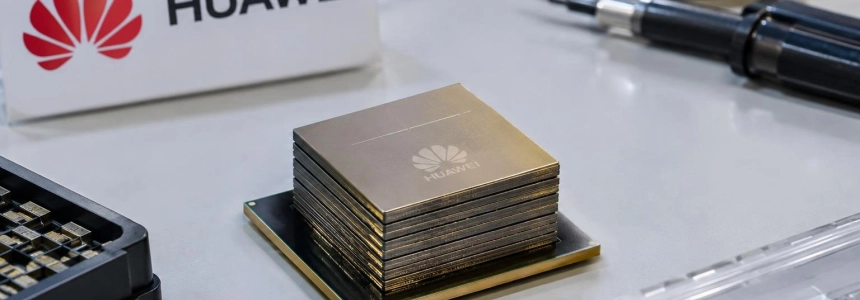
Huawei plans to present an HBM memory design in San Francisco in February 2027 with twice the data pin density of the products Samsung and SK hynix manufacture at scale. The architecture could increase the bandwidth available to artificial intelligence processors, but it is unclear how far the company has progressed or whether it can produce the memory at scale.
The figure comes from the title of a research paper Huawei plans to present at the conference. HBM—high-bandwidth memory—feeds data to AI accelerators. Greater pin density would theoretically allow more information to move between memory and processors; the announcement provides no bandwidth figures or specifications for a commercial product.
The news puts Huawei up against Samsung Electronics, SK hynix, and Micron, companies that dominate this memory market. The opportunity for the Chinese company is not just to challenge them in a hardware segment: manufacturing HBM in China would reduce a dependency that affects the availability of components for its own AI chips.
An announced design, not a ready product
The project’s practical status remains unknown. Presenting a design at a conference can be a way to share ideas and promote research; on its own, it does not prove that a finished, validated, or production-ready chip exists. Huawei did not immediately respond to requests for comment cited by Bloomberg.
Therefore, the claim of twice the pin density is a feature attributed to the design described in the paper’s title, not a published measurement of an available component. No dates for commercial samples, production volumes, prices, or customers have been announced either. The difference between a research architecture and memory manufactured at scale is central to this case.
If the interface works as the design proposes, it could increase the amount of data reaching processors. That improvement would be relevant for AI workloads, but the published materials do not detail how the architecture would be implemented, what performance it would achieve in tests, or what manufacturing challenges Huawei would face.
HBM shortage weighs on China
Samsung, SK hynix, and Micron are prohibited from supplying HBM to Chinese customers, according to Bloomberg. At the same time, China’s stocks of foreign HBM memory are dwindling. In this context, a locally produced alternative would ease a bottleneck in China’s drive for semiconductor autonomy.
Huawei has already told some customers, according to information reported by TNW, that its next Ascend accelerator will rely mainly on Korean HBM brought in through smuggling. The company has not confirmed this in the cited materials. The report illustrates the pressure caused by the lack of legal supply, but does not clarify how much inventory Huawei has or how it plans to supply its future chips.
Huawei’s Ascend accelerators have become the most widely used AI chips made in China since the United States restricted shipments of Nvidia’s most advanced semiconductors. Huawei plans to launch at least one new AI chip every year through 2029, in response to demand for computing capacity and efforts by Chinese labs such as DeepSeek and Moonshot to compete with Anthropic and OpenAI.
The obstacle is not limited to obtaining memory. Chinese companies also lack access to the extreme ultraviolet lithography, or EUV, machines needed to manufacture advanced AI and HBM chips. Bloomberg adds that the U.S. government has taken steps to close routes that allowed Chinese companies to access advanced Nvidia chips remotely from data centers in Southeast Asia.
LogicFolding and the 2031 goal
The HBM push adds to Huawei’s other attempts to circumvent restrictions through design changes. The company began mass-producing smartphone chips this year that use a technique called LogicFolding, and has set a goal of manufacturing semiconductors with performance comparable to 1.4-nanometer chips by 2031.
That goal does not mean Huawei will use a 1.4 nm manufacturing process. Reports describe a target of comparable performance and an alternative technical approach to integrating more transistors and speeding up data transfer. Available information does not establish that LogicFolding will be used in the new HBM, although Wccftech presents this possibility as its own expectation.
Huawei is not the only Chinese company seeking to narrow the gap with foreign memory manufacturers. CXMT, a Chinese memory semiconductor manufacturer, is also working on new architectures. In October, it announced progress on a design called 4F² and said it would apply it to an upcoming server memory product.
CXMT’s initiative and Huawei’s design are separate projects. No data has been provided to compare their performance, manufacturing schedules, or ability to compete with products from Samsung, SK hynix, and Micron. For Huawei, the February presentation will be the announced opportunity to learn more technical details about the HBM design.
Stock market reaction and the next signal
After the news broke, shares of Samsung, SK hynix, and Micron saw movements that Bloomberg described as a jolt to their stock prices. The reaction reflects some investors’ concern that Chinese advances could erode the major memory manufacturers’ position over the long term; it does not prove that Huawei is already a commercial competitor.
Micron, for its part, had recorded an approximately fourfold increase in quarterly revenue earlier this year, driven by demand for AI memory, according to TNW. The figure helps explain the segment’s economic appeal, although the sources provide no estimate of the market Huawei could capture or the cost of developing its design.
The next specific date is the paper’s presentation in San Francisco in February 2027. Until then, questions remain about the project’s progress and industrial viability: Huawei has not yet announced HBM that is ready for production.
Sources: TNW | Artificial-intelligence, Wccftech, TBS CROSS DIG with Bloomberg, CHOSUNBIZ, Bloomberg Línea