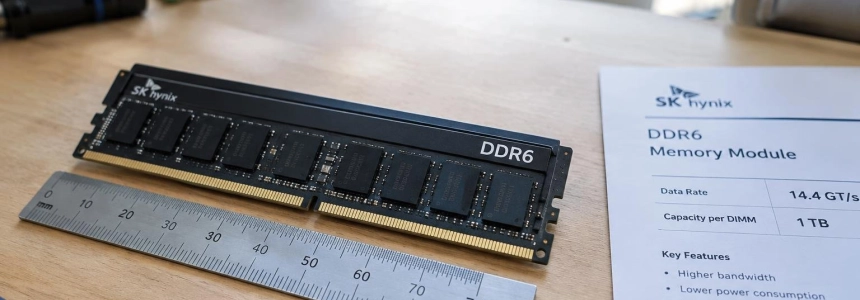
JEDEC has previewed DDR6 with an initial rate of 12.8 GT/s and a roadmap up to 14.4 GT/s. The standard is still in development, but its design also calls for a 96 DQ bus, DRAM dies of up to 128 Gb, and 74 mm modules, compared with the 133 mm specified for DDR5.
A specification preview, not a product ready to ship
The organization published the preview on November 19, 2026. DDR6 is designed as the next generation of main memory and is intended for artificial intelligence workloads, cloud computing, data centers, servers, and client systems. JEDEC says the technology is still under development within the organization.
This caveat applies to all the figures: the details reflect current plans and may change during the drafting and approval process. JEDEC also notes that its standards can be modified during development and may even be rejected by its board of directors. The preview therefore describes a technical direction, not a firm promise for commercial modules.
Wccftech places this announcement six years after JEDEC presented the first DDR5 specifications in 2020. That generation started at rates of 4800 MT/s, according to the outlet; the comparison illustrates how the standard evolves, but it does not make the DDR6 figures guaranteed speeds for every module or system.
More data per second and a wider bus
The forecast for DDR6 RDIMM modules is to start at 12.8 GT/s and scale up to 14.4 GT/s, with a roadmap that could go further. JEDEC compares the new starting point with DDR5 RDIMM's 9.2 GT/s. Wccftech also cites an initial bandwidth increase of more than 50%, combining higher rates with a wider bus.
The planned data width increases from 64 to 96 DQ, a 50% increase. JEDEC expressly cautions that its bandwidth target does not mean applications will see an identical performance improvement. The figure describes memory transfer capacity, not how much faster any program will run.
| Feature | DDR5 | DDR6 plan |
|---|---|---|
| RDIMM data rate | Up to 9.2 GT/s | Starting at 12.8 GT/s; roadmap up to 14.4 GT/s and beyond |
| Data bus | 64 DQ | 96 DQ |
| Maximum DRAM die density | 64 Gb | Up to 128 Gb |
| Cited module length | 133 mm | 74 mm |
The density and length comparison appears in the published details about the proposal: up to 128 Gb per DRAM die, compared with 64 Gb for DDR5, and a 74 mm length for the DDR6 module versus 133 mm. The capacity of up to 1 TB per slot highlighted by Tom’s Hardware refers to the potential configuration of modules, not a capacity that JEDEC presents as a guaranteed feature of every system.
Pseudo-channels and more banks
The planned architecture would organize memory access using pseudo-channels, with the aim of increasing bandwidth per DRAM package. JEDEC also says this approach would provide greater flexibility in configuring system reliability and moving data more efficiently.
The plan calls for doubling bank availability and improving memory refresh. According to JEDEC, both changes would help make better use of the bus and support systems with higher speeds and capacities. These are design elements still in development, not results from testing final products.
Higher density would also depend on optimizations for stacking dies inside packages. This technique would make it possible to fit more capacity into a package footprint, while the shorter module is intended to enable greater memory density in the system. JEDEC's announcement does not provide a specific commercial configuration combining these elements.
Capacity, power consumption, and reliability
In addition to the maximum 128 Gb per die, the proposal defines support for high-capacity modules, especially in systems that need memory close to the processor. JEDEC cites general-purpose computing, AI inference, and agentic AI workloads as design targets for this data-center-oriented interface.
The organization expects several implementations of error-correcting codes, or ECC, so system designers can balance cost, power consumption, and reliability. The preview does not detail a single mandatory ECC configuration: the proposal supports different system-level implementations.
In terms of energy efficiency, DDR6 aims to improve performance per watt over DDR5 by switching to VSS-terminated inputs and outputs and low-power modes focused on data centers. JEDEC does not quantify this improvement. The announcement presents it as a design goal, without a percentage or comparable measurement.
“As AI and data-intensive workloads continue to raise system requirements, DDR6 is being designed to deliver significant advances in memory bandwidth, capacity, and reliability.”
— Christopher Cox, chair of the JC-42 Solid State Memories Committee
Cox added that collaboration among JEDEC member companies aims to create a standard that balances performance, energy efficiency, and scalability across different types of computing. Meanwhile, Mian Quddus, chair of the JEDEC Board of Directors, said members can access proposals before publication and active projects such as DDR6 in advance. He also invited companies around the world to participate in the organization.
RDIMM, UDIMM, and CAMM are still under consideration
JEDEC is defining DDR6 for several form factors, with RDIMM, UDIMM, and CAMM among the potential options. The organization does not present the list as final: it refers to form factors that could be part of the standard to serve different applications and balance reliability, performance, power consumption, and cost.
The stated goal covers everything from servers and data centers to client systems. The focus on AI workloads and high-capacity modules is explicit in the announcement, but JEDEC has not set availability dates or detailed which type of system will adopt DDR6 first. It has also not provided prices or commercial module specifications.
Tom’s Hardware notes that 74 mm represents a 44% reduction compared with DDR5's 133 mm. Wccftech and JEDEC's announcement express the difference using the specific lengths. In any case, the announced size is part of a plan that may still change, and it is not enough to conclude which form factors will ultimately reach each class of computer.
The next step is for JEDEC to continue the development and approval process. Until the specification is finalized, the rates, dimensions, architecture, capacity, and form factors remain provisional DDR6 features; the organization has not announced a commercial launch date in this preview.
Sources: Tom's Hardware, Wccftech, JEDEC / Design-Reuse, TechPowerUp