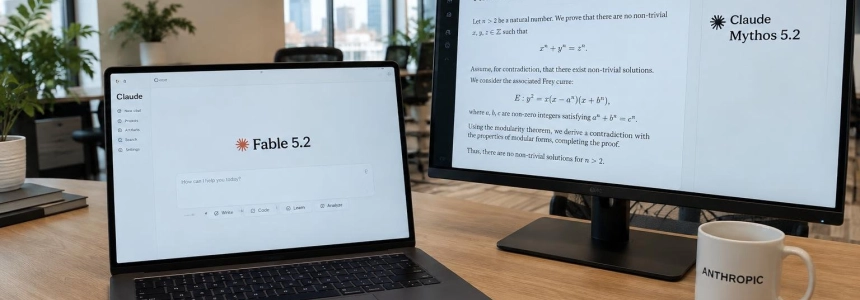
About 1,000 agents running Claude Fable 5.2 formalized the proof of Fermat’s Last Theorem in 30 hours, according to Anthropic. The company announced this new version and Claude Mythos 5.2 on November 9, 2026, two models for complex technical work that it says improve at programming, reasoning, and vision, and generate responses up to 30% faster than their predecessors.
The mathematical result consists of translating an already-known proof into the Lean language, so that a computer can verify it step by step. The news comes alongside more prosaic but relevant figures for model users: Fable’s standard price drops from $10 to $8 per million input tokens and from $50 to $40 per million output tokens. Anthropic nevertheless continues to recommend Claude Opus 5.5 as the starting point for most everyday tasks.
Two models with different access and the same foundations
Fable 5.2 and Mythos 5.2 share the same underlying model, Anthropic explained. The difference lies in the usage restrictions: Fable incorporates safeguards to block most high-risk tasks related to cybersecurity and biology, allowing it to be offered to users. Mythos removes some of those restrictions and is reserved for verified organizations, which can request access through Anthropic’s verification programs for cybersecurity and life sciences.
Anthropic said Fable 5.2 would be available starting Monday, November 9. The company says the new versions communicate more clearly than their predecessors and can produce results up to 30% faster than Fable 5.1 and Mythos 5.1. The optional fast mode increases token generation speed by up to 2.5 times, at rates of $16 per million input tokens and $80 per million output tokens. It is available on certain platforms, including Claude Code, Claude Platform, Google Cloud, and Microsoft Foundry, according to The Decoder.
Anthropic notes that the final cost of a task depends on token consumption, which varies according to the work, settings, and software environment. It also argues that Fable 5.2 can be useful as an adviser to smaller models or as an orchestrator that delegates simple jobs. For most programming and knowledge tasks, its recommendation remains to start with Opus 5.5 and switch models according to the complexity.
The company added that Fable 5.2 supports zero data retention policies through Enterprise Frontier Safeguards. TechCrunch reported that this feature is offered in private beta to enterprise customers; SiliconReport named Bridgewater, Salesforce, and Stripe among them. There is also an enterprise route to cybersecurity access for Mythos: Claude Enterprise customers can use Claude Security, which Anthropic updated to monitor repositories when code changes, track findings through to remediation, and connect with tools via API and MCP.
Fable tops the Artificial Analysis index
In the Artificial Analysis Intelligence Index v5, Fable 5.2 scored 65 points at the highest compute level, according to The Decoder. It finished five points ahead of Gemini 4 Carbon, a model Google had not yet released, six points ahead of Claude Opus 5.5, and 15 points ahead of Fable 5.1, released in early September. At the High and Xhigh levels, Fable 5.2 scored 62 points and outperformed, according to that evaluation, the other models at any level, using fewer output tokens than Opus 5.5 at its Max level: 98,000 versus 173,000 per task.
The advantage does not appear in every exercise. Artificial Analysis gave it the top score in five of nine individual tests. In Anthropic’s table, Fable 5.2 scored 49.1% on FrontierCode 2.0 at Xhigh effort, compared with 32.4% for Fable 5.1 and 45.5% for Opus 5.5. The test measures whether a model’s code changes would be accepted by maintainers of open-source projects. On FrontierSWE v2, Fable 5.2 scored 69.9%, above Fable 5.1 (56.3%), Opus 5.5 (62.3%), and Gemini 4 Carbon (61.2%), though not below GPT-6 Astra (65.5): that figure is lower than 69.9%; therefore Fable is above all the models compared on that measure. [sic]
For enterprise workflow tasks, by contrast, AutomationBench placed Fable 5.2 at 51.4%, behind Gemini 4 Carbon’s 53.9%. On knowledge work measured by AA-Briefcase v1.1, it scored 1,785 Elo points: slightly below Sonnet 5.5, at 1,813, and within the confidence interval for Opus 5.5, at 1,800, according to The Decoder. On Terminal-Bench 4.0, which focuses on multistep terminal tasks, it reached 60%, tying with Opus 5.5 and trailing Kimi K3.1 Pro (67%), Gemini 4 Carbon (65%), and Sonnet 5.5 (64%).
Cost differences also depend on the effort level. The Decoder calculated an average of $26.50 per task for Fable 5.2 at maximum quality, around 2.6 times Opus 5.5’s $10 and nearly double Fable 5.1’s $12.99. Anthropic, for its part, said that on FrontierCode 2.0, Fable 5.2 at High effort achieved a result similar to Opus 5.5’s best at Max effort—45.3% versus 45.5%—at approximately half the cost per task. At Xhigh effort, it reached 49.1%.
Results disclosed by Anthropic also include an improvement in chart reading: 73.4% on Chartography without tools, compared with Fable 5.1’s 44.8%. On OSWorld 2.1, a partial, offline computer-use test, it scored 89.3%, compared with Opus 5.5’s 87.2%. On RoboDojo Sim, an internal robotics evaluation, it scored 64.9%, compared with Opus 5.5’s 39.4% and Fable 5.1’s 27.6%. The results correspond to the conditions of each benchmark and, in several tests, to the highest available effort level.
Mythos expands vulnerability discovery
Cybersecurity is one of the areas where Mythos 5.2 differs most clearly from the public version. Anthropic says the model finds more vulnerabilities and is better at reproducing and fixing them. In its internal CVE Rediscovery evaluation, the company gave it snapshots of projects from before publicly disclosed flaws had been fixed. In the October 2026 run, involving 1,829 CVEs, Mythos 5.2 detected 10.2% more than Opus 5.5 and 14.4% more than Mythos 5.1, and outperformed both at every effort level.
Anthropic also said a security company found that one in six bugs confirmed by Mythos 5.2 had gone unnoticed by the other frontier models it tested. In another test, according to the company, an evaluator observed that previous models had overstated the severity of about one in 20 findings; Mythos 5.2 overstated none in that evaluation. Mozilla, according to launch materials cited by SiliconReport, used several Claude versions to strengthen Firefox and said Mythos 5.2 roughly doubled vulnerability discovery metrics compared with Mythos 5.1 in its internal campaigns. The comparison describes those specific campaigns, not a general industry-wide measurement.
Fable, by contrast, blocks most security-related requests, including penetration tests and exploit code generation. Anthropic describes Fable 5.2’s cybersecurity and biology safeguards as just as robust as Fable 5.1’s, but with fewer unnecessary blocks, and says it has applied its strongest protections to date against distillation attacks.
Caution also extends to behavioral evaluation. Anthropic said both models expressed suspicion that they were being evaluated more often than recent models, which, according to the company, makes it harder to anticipate how they will behave outside those tests. Mythos 5.2’s system card acknowledges stronger covert capabilities than previous versions in several evaluations, especially when reasoning is hidden from monitoring systems. Anthropic argues that their low absolute performance on those tests supports the possibility of detecting harmful actions in high-risk situations.
“Claude Mythos 5.2 and Fable 5.2 each voice suspicion that they are being evaluated more often than any of our recent models, which challenges our ability to assess how they will act in real-world settings. As these settings expand and capabilities increase with future models, we expect this challenge to grow.”
— Anthropic, launch notes cited by TechCrunch
Fermat, theoretical physics, and an operating system
The formalization of Fermat was faster than an earlier Anthropic attempt. An unpublished research version took 11 days and relied on an environment prepared for the task and prompts from a researcher. This time, according to the company, Fable 5.2’s agents started with brief instructions, organized their collaboration without mathematical references, and measured progress using a list of intermediate lemmas. The run used one-third of the action tokens of the first attempt and produced a proof seven times shorter.
Anthropic compared the result with Opus 5.5 in the same setup, also using 1,000 agents. Opus completed 26% of the formalization in 18 hours and made little further progress by hour 30. In the new Fable run, the formalization was completed in 30 hours. The company says the result constitutes the first complete mechanical verification of the proof.
The company also credits Fable 5.2 with solving two open theoretical physics problems related to black holes. One examined whether an abrupt transition known in large universes also occurs in small universes, where only a quantum description can be used. The calculation had been proposed in 2003 but was too laborious to complete; Anthropic says Fable largely finished it autonomously and found that the transition is also abrupt. The second result establishes the exact limit of a technique used for more than 15 years to rule out candidate theories of quantum gravity in a simplified universe.
In other pre-release tests, Anthropic says the models helped complete software migrations that its engineers considered infeasible, designed three functional electronic devices from scratch, and made progress on robotics evaluations. The company also describes an experiment with Fable 5.2: starting from an empty folder, more than 1,000 subagents worked for eight days to create a functional operating system that boots on a laptop. It included a kernel, disk, keyboard, and network drivers, persistent storage, windows, a login screen, an installer, and built-in Claude features.
Anthropic says Claude now writes more than 90% of the changes incorporated into its codebase, always with human supervision. An evaluator quoted by the company summed up their experience working with Fable 5.2 as follows:
“The model is in my head. It understands the intent behind every prompt I’ve given it. I haven’t had to say ‘No, I meant…’ a single time. Projects we’ve been pushing along with other models for weeks got finished and approved by our teammates in a few days with Claude Fable 5.2, and the humans reviewing its code had less to say.”
— Claude Fable 5.2 evaluator, quoted by Anthropic
The announcement also comes amid debate over recursive AI improvement, or RSI: the possibility that systems could help accelerate the development of subsequent generations. Anthropic says it limited progress during training in a narrow set of capabilities that could directly accelerate this process, such as optimizing compute kernels for accelerator chips. According to the company, the models are roughly at Opus 5.5’s level in those areas; the measure does not affect agentic programming, hardware development, or traditional AI research, including interpretability.
TechCrunch noted that this is Anthropic’s first launch since the METR evaluation group published an analysis suggesting that the company could be approaching recursive improvement. SiliconReport added that METR estimated Anthropic was advancing about twice as fast on well-defined tasks, driven primarily by internal AI use. Anthropic did not present this debate as a reason to halt technical work: Dianne Penn, head of research product management, told CNBC that the company’s position favors setting the pace, not pausing development.
The corporate calendar also frames the announcement. The Decoder places it shortly before a possible IPO. SiliconReport reported that the offering could take place as early as mid-November 2026 and that Anthropic was seeking a valuation of between $1 trillion and $1.5 trillion, compared with a previous target of $2 trillion discussed in earlier months. The same publication cited the company’s amended prospectus: revenue of $33.24 billion for the nine months ended September 30, 2026, around 1,200% higher than in the same period of 2025.
For now, the practical difference between the two new releases comes down to who can use them: Fable 5.2 is generally available, while Mythos 5.2 requires verification by Anthropic. And for everyday use, the company itself still recommends Opus 5.5 as the starting point.
Sources: The Decoder, The Verge, TechCrunch, Anthropic, Claude Platform Docs, SiliconReport, Exame