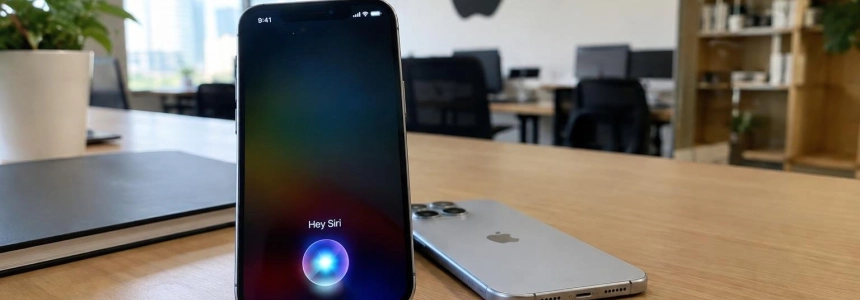
Apple wants Siri to move beyond executing one-off commands and be able to pursue goals for longer. According to Mark Gurman of Bloomberg, the company aims to turn the assistant into an agent capable of deciding what step comes next and continuing a task without the user having to initiate each action. Gurman considers it possible that this evolution will arrive next year.
The change would build on a roadmap that already includes new capabilities for Apple’s apps and, later, third-party services. It also follows the launch of Siri AI with iOS 27 and comments from CEO John Ternus, who described the current version as primarily request-based, but built on an architecture that leaves room for expansion.
From responding to commands to pursuing a goal
The difference Apple is proposing is not simply adding more commands. The idea behind an agent is that users can set an objective and let the system manage several successive steps, rather than requesting each action separately. Bloomberg describes this kind of behavior in Dots, Muse, and Grok: they can pursue goals, determine what needs to be done next, and continue without a new instruction for every step.
Gurman says Apple wants to take Siri in that direction. In his account, the assistant could move from responding to isolated requests to handling tasks that remain active. The company has not specified which features of this kind it will launch or how they will work in each case; the forecast of a more agent-like Siri next year comes from Gurman, not from an official timeline announced by Apple.
With Siri AI, we really have the kind of—the Siri we always wanted. It’s primarily request-based today, but as we talked about at WWDC, it’s built on a modern, orchestrator-driven architecture that gives us real room to expand capabilities over time. As far as agentic capabilities, we think these are promising tools for users. We just want to make sure that users are aware of what they’re getting access to. We want to make sure this is done in a way that protects security and privacy.
— John Ternus, Apple CEO
Ternus made those comments during Apple’s quarterly earnings call, according to 9to5Mac. He also said the company was working intensively on agent capabilities, but tied their rollout to ensuring users understand what they are accessing and protecting security and privacy. In another comment, he said Apple had “a lot more” to do with Siri AI.
First, more control over Apple’s apps
The roadmap Bloomberg attributes to Apple includes two major expansions. The first would let Siri control Apple’s own apps more precisely. Examples cited include rotating and cropping images in Photos, as well as organizing tabs in Safari. Bloomberg places these features in iOS 27.3.
The second expansion would cover third-party apps and, according to Gurman, would arrive later, in the spring. In that scenario, Siri could complete actions within other services, such as placing an order through Grubhub or booking a table on OpenTable. These are examples of what the integration would allow; they are not presented as features already available.
The distinction matters for understanding the scope of the plan. Control of Apple’s own apps would let Siri connect with tasks that currently depend on Apple interfaces, while access to third-party services would expand the kinds of tasks the assistant could complete. Neither of these two stages, on its own, confirms that Siri will handle prolonged tasks without supervision: that is the later direction Gurman says the company is pursuing.
The starting point: Siri AI in iOS 27
Apple announced Siri AI on September 14 and introduced it as a more capable and personal version, powered by the next generation of Apple Intelligence. The company said Siri AI would roll out in beta in English with iOS 27, iPadOS 27, macOS 27, watchOS 27, and visionOS 27. 9to5Mac later reported that the personalized Siri had arrived with iOS 27 and met the goals Apple had set out in 2024.
Apple’s announcement brought together capabilities across its systems and apps. In Photos, it described tools for adjusting an image’s perspective, expanding the frame, and improving the Clean Up feature. Safari would add automatic organization of tabs by topic, alerts about changes on websites—such as restocks or price drops—and the ability to create extensions from a description. In Mail and Messages, Smart Reply could use a personalized writing style; in Mail, suggestions could work with third-party apps.
Apple also introduced features for adding or modifying Calendar events through simple descriptions and creating complex automations in Shortcuts by describing what you want to do. In the Siri app, users could generate images by describing them, using Image Playground. These tools expand the available actions, although the announcement does not describe them as an agent that maintains goals and acts continuously.
The announced availability comes with conditions. Apple said Siri AI would debut in beta in English, with support for French, Japanese, Korean, Portuguese, and Spanish arriving the following month. It also said Siri AI would not initially be available in the European Union on iOS, iPadOS, and watchOS, or in China while the company worked on regulatory requirements. The company did not give a specific date in that announcement for lifting these restrictions.
Apple also specified that Apple Intelligence features in iOS 27 and other systems required compatible devices. The listed devices included iPhone 16 models or later, iPhone 15 Pro and iPhone 15 Pro Max, iPad mini with A17 Pro, iPad with M1 or later, Mac with M1 or later, and Apple Vision Pro. Compatibility for Siri AI and Apple Intelligence also depends on the language and the specific feature.
Apple adjusts internal work for iOS 28
The push to expand Siri coincides with a change to the iOS 28 development cycle that Bloomberg attributes to Apple. According to Gurman, during the M1 milestone, engineers spent six weeks on coding, exploration, and feature development, and two weeks integrating or consolidating the work. The usual allocation, according to 9to5Mac, was two stages of four weeks each.
Employees cited by Gurman welcomed the adjustment because it gave them more time to explore ideas before finalizing integration decisions. The change is not presented as a new Siri feature or as a guarantee that the system’s launch will be accelerated. It is, however, part of the context of a company that, according to Bloomberg, is trying to advance its artificial intelligence roadmap and respond to competitors that already offer more proactive interfaces.
9to5Mac links the process review to advances in agent-based coding tools in recent years, but this connection is presented as a likely explanation, not as a cause confirmed by Apple. The specific reported detail is the new allocation of weeks for the M1 milestone.
Privacy and the access model remain at stake
Ternus presented security and privacy as conditions Apple wants to preserve while developing agent features. Apple’s announcement about Siri AI also described a “privacy-first” architecture and said that some server-model-based features would be subject to daily usage limits. These limits could vary depending on the feature, the complexity of the request, system demand, and other factors.
Apple added that it would offer expanded access to certain capabilities for a fee in the future. The company did not specify the price or which features would be included. On the earnings call, Ternus mentioned intelligence as an opportunity for services growth; 9to5Mac linked that comment to the possibility of charging for expanded use, although Apple did not announce a fee for a more autonomous Siri at that time.
For now, the most concrete milestones are more detailed control of Apple’s own apps, planned for iOS 27.3, and the subsequent integration with third-party apps that Gurman places in the spring. The transformation of Siri into an agent that pursues goals over several steps remains Apple’s ambition and a possibility for next year, still without an official launch date.
Sources: The Verge, 9to5Mac, Apple Newsroom, 9to5Mac