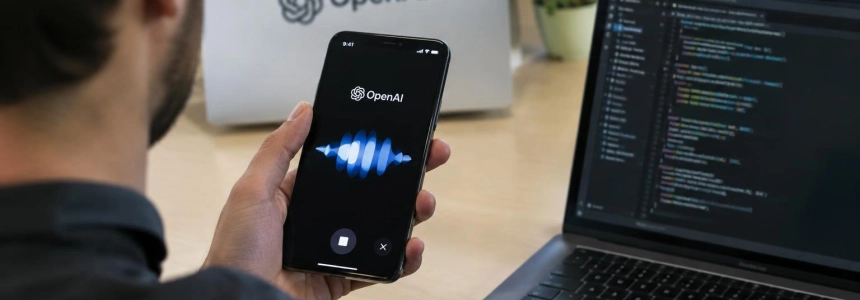
On December 11, 2026, ChatGPT will stop offering its Standard and Advanced voice modes. OpenAI wants to consolidate the experience in GPT-Live, the model that, according to the company, has already attracted nearly everyone who uses voice on the service. The change, announced in ChatGPT’s official notes and in a post on OpenAI Newsroom, will also bring an automatic transition for people still using the old options.
The consolidation will not immediately end all the features of Advanced mode. Live video and screen sharing will continue to rely on it because GPT-Live does not yet support them. OpenAI has not given a date for adding those capabilities to the new system.
One mode for talking to ChatGPT
The decision ends a menu with three options: Standard, Advanced, and GPT-Live. OpenAI intends to move the features that characterized the two previous modes to GPT-Live and avoid maintaining systems with partially overlapping capabilities. However, it has not detailed which specific features will move to the new model or what operational differences users will notice once the change is complete.
The company justifies the retirement by pointing to GPT-Live’s growing use. In its announcement, it said voice conversations have nearly doubled since its launch and that practically everyone who talks to ChatGPT is already using the new model. Multiplayer.it also reports this assessment. Punto Informatico describes adoption as widespread, without providing more precise figures.
The OpenAI Newsroom announcement was published on November 10. In the message, the company said: “We’re retiring Advanced and Standard voice from ChatGPT Voice on December 11, 2026. In July, we introduced GPT-Live, our latest voice model that combines natural conversation with frontier intelligence.”
We’re retiring Advanced and Standard voice from ChatGPT Voice on December 11, 2026. In July, we introduced GPT-Live, our latest voice model that combines natural conversation with frontier intelligence.
— OpenAI Newsroom (@OpenAINewsroom)
Both outlets place the end of Standard and Advanced on December 11, 2026. Punto Informatico specifies that user notifications began on November 10 and that, when the modes are retired, they will disappear from Settings > Voice. Anyone still using them will automatically switch to GPT-Live.
From turn-based voice to simultaneous dialogue
Punto Informatico describes the difference between the modes as a change in how the conversation is carried out. Standard converted the user’s voice into text, sent that content to a language model, and turned the generated response into audio. Advanced mode, which arrived in 2024, eliminated those intermediate steps to make exchanges faster and more natural.
Even so, with Advanced, the conversation still worked in turns: the assistant waited for the person to finish speaking before replying. GPT-Live introduces simultaneous dialogue using full-duplex technology. It can listen while speaking, accept interruptions, and receive corrections in real time. For more demanding questions, it can also draw on OpenAI’s most powerful text models without stopping the conversation, according to Punto Informatico.
There is a discrepancy in how the model’s arrival is dated. OpenAI Newsroom and Punto Informatico say GPT-Live was introduced in July; Multiplayer.it says it was introduced at the beginning of the year. Neither outlet provides further details to clarify the discrepancy.
Video and screen sharing left out
Advanced will not be fully retired while GPT-Live lacks its live video and screen-sharing features. OpenAI will keep the old mode for those tasks, but has not announced when they will be available in GPT-Live. For now, this dependency leaves an exception to the idea of bringing all voice features together in a single model.
Punto Informatico adds that previous conversations will remain in the history and can be resumed by text or with GPT-Live. It also notes that custom GPTs will retain the old voice mode until December 11. It is unclear how these features will be handled after that date.
Multiplayer.it presents the migration as a transfer of capabilities to GPT-Live, but notes that OpenAI has not listed the features it will integrate. Thus, there is a provisional answer about the future of screen sharing and video—they will remain in Advanced—while the subsequent fate of custom GPTs has yet to be clarified.
Criticism of its speed and depth
The change has also drawn criticism from users, according to Punto Informatico. The outlet reports complaints from people who prefer Standard because, in their view, it provides more detailed answers and connects better with written conversations. They fault GPT-Live for interrupting frequently, losing the thread, and giving less information than they need.
These objections matter especially to people who use voice to develop ideas, explore a topic, or reason through complex issues. Some paid subscribers, Punto Informatico adds, have threatened to cancel their plans. The outlet does not quantify how many people have voiced these complaints or how many have said they might unsubscribe.
OpenAI acknowledges that some users prefer the style of Standard and Advanced. According to Punto Informatico, the company is working to improve the depth of responses, conversational continuity, and GPT-Live’s personalization, drawing on what it has learned from previous models.
For now, the change has a set date for the two old modes, but not for moving video and screen sharing. GPT-Live will be the remaining voice option starting December 11; those two features will remain tied to Advanced until OpenAI explains how and when it will add them.
Sources: Multiplayer.it, Punto Informatico