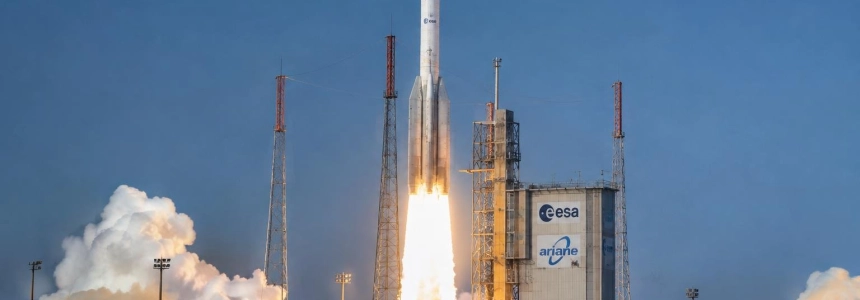
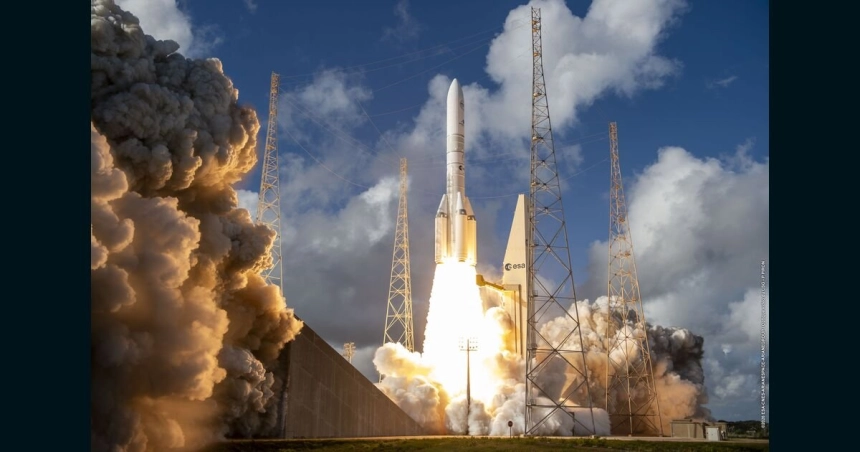
Ariane 6 placed 36 Amazon Leo satellites into orbit on November 24, on its tenth flight and after an issue with ground support systems forced the launch to be postponed by one day. Liftoff took place from Europe’s spaceport in Kourou, French Guiana, and deployment was completed about two hours later.
Mission VA271, also identified as VA271/LE-04, lifted off at 12:14 Central European Time, according to the European Space Agency (ESA). The agency gave the launch time as 08:14 local time in French Guiana and 11:14 GMT. Arianespace provided the launch service for Amazon.
With this flight, Ariane 6 delivered 136 satellites for the constellation, according to the ESA. Transport Topics also puts the number of Amazon satellites placed into orbit by Arianespace at 136; 20minutos gives that figure as the total launched for Leo. The US newspaper adds that those spacecraft represent more than a quarter of Amazon’s current fleet.
A flight lasting almost two hours
The launch was Ariane 6’s tenth mission and the fourth to use its four-booster configuration. The ESA describes it as the most powerful version of the rocket. For Amazon, it was the fourth launch Arianespace had carried out for its network, according to Transport Topics.
The flight sequence included booster separation just over two minutes after liftoff and fairing separation less than a minute later. Subsequently, the Vinci upper stage ignited twice before satellite deployment began.
| CET time | Time since liftoff | Milestone |
|---|---|---|
| 12:14 | 00:00:00 | Liftoff |
| 12:16 | 00:02:23 | Booster separation |
| 12:17 | 00:03:12 | Fairing separation |
| 12:21 | 00:07:45 | End of core stage burn |
| 12:21 | 00:07:51 | Core stage separation |
| 12:21 | 00:07:59 | First Vinci ignition |
| 12:31 | 00:17:51 | End of first Vinci burn |
| 13:20 | 01:06:52 | Second Vinci ignition |
| 13:21 | 01:07:10 | End of second Vinci burn |
| 13:53 | 01:39:29 | Start of satellite deployment |
The ESA recorded the start of satellite separation at 13:53 CET, one hour, 39 minutes and 29 seconds after liftoff. Transport Topics reported that Ariane 6 completed deployment of all the satellites about two hours after launch.
“With this mission, Ariane 6 has now delivered 136 satellites for Amazon Leo, demonstrating its ability to serve major institutional and commercial customers.”
— Géraldine Naja, ESA Director of Space Transportation
The boosters of the most powerful configuration
The flight used four P160C solid boosters. Each carries 14 tonnes more propellant than a P120C: together, the total propellant load reaches 156 tonnes. Each P160C is 14.5 metres long, one metre longer than the previous model.
According to the ESA, boosters based on the P160C can increase Ariane 6’s performance by between 10% and 15%, depending on the target low Earth orbit. The improvement amounts to around two additional tonnes of payload capacity in low Earth orbit. The boosters’ greater height does not change their connection to the central core or the overall height of the booster assembly.
Europropulsion, a joint venture equally owned by ArianeGroup and Avio, developed the P160C. The structure is manufactured in Italy, the engine nozzle in France, and the igniter in Norway; the boosters are loaded with propellant and prepared for Ariane 6 at Europe’s spaceport in French Guiana.
The ESA works with an industrial network spread across 13 European countries and identifies ArianeGroup as the prime contractor and design authority. The French space agency CNES manages spaceport operations. According to the ESA, the mission for Amazon strengthens Europe’s independent access to space.
Two setbacks before liftoff
The launch was initially scheduled for Monday, November 23, but was postponed because of an issue with the launcher’s ground support systems, according to 20minutos. The countdown was halted before the mobile launch tower was withdrawn and the rocket systems operations began. Liftoff had been scheduled for 12:09 Spanish mainland time.
The postponement came nine days after another setback: on November 15, a United Launch Alliance (ULA) Vulcan rocket lost the 40 Amazon satellites it was carrying. The vehicle lifted off from Cape Canaveral Space Force Station in Florida and lost communication about ten minutes after the start of the flight.
Initial findings from ULA’s investigation pointed to a first-stage performance issue that may have begun shortly after liftoff. The loss of power left the rocket, at the time of its two stages separating, at a lower altitude and speed than required to complete the mission. According to ULA, the six solid rocket boosters and second-stage engines worked properly, but could not make up for the first-stage problem.
The investigation was still ongoing, and the US Federal Aviation Administration (FAA) was to oversee it and approve the final findings and corrective actions proposed by ULA. Transport Topics reported that Vulcan remained grounded as the investigation proceeded. The lost flight was the first of the 38 Vulcan launches contracted by Amazon.
Amazon aims to expand a network that is not yet in service
Amazon is developing Leo to bring satellite internet to areas beyond the reach of existing networks. The company plans to deploy thousands of satellites connected to a network of antennas, fibre-optic cables, and ground-based internet connection points, with Starlink, the service backed by Elon Musk, as a rival.
Transport Topics notes that Amazon said in 2025 that it expected to begin internet service that same year and aimed to offer it in several countries by early 2026. However, the outlet reported that the company had not yet begun providing coverage amid obstacles to putting satellites into orbit.
Rocket availability has also affected the schedule. In June, the US Federal Communications Commission granted Amazon a waiver from the requirement to have half of its planned satellites in orbit by July 2026, after the company cited a shortage of launches, according to Transport Topics.
In September, Amazon added six new contracts for Ariane 6, bringing the total number of planned launches on the European rocket to 24. Arianespace, for its part, aims to increase the pace of Ariane 6 flights to reach 12 per year by around 2030, with the capacity to deliver up to 200 satellites annually, according to Transport Topics.
The success of VA271 adds 36 satellites to the network, while the outcome of the Vulcan investigation remains pending. Amazon still has to turn launches into coverage: Transport Topics reported that the service had not yet started.
Sources: Technology, ESA, Transport Topics