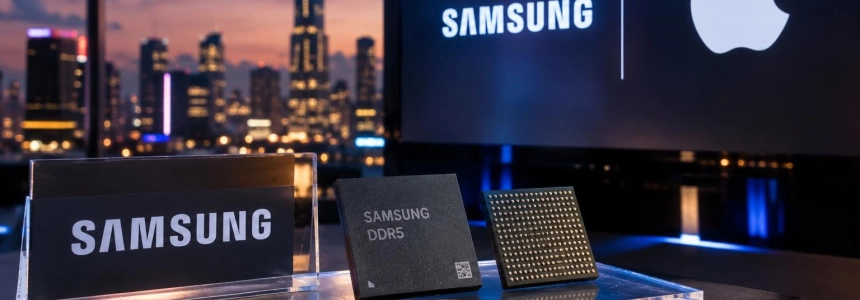
Apple and Samsung are negotiating a four- to five-year DRAM agreement that would begin in the first half of 2027. The contract would establish a minimum supply volume, while prices would be determined later according to market conditions, according to Maeil Business Newspaper.
The negotiations would mark an unusual change in the way Apple buys memory. The company usually prefers shorter contracts and pushes for price cuts at each renewal; now it is seeking to secure supply for several years in a market where chip shortages have worsened.
A minimum supply, with the price still open
Maeil Business Newspaper reported on November 17 that Samsung Electronics and Apple were finalizing the terms of the agreement. According to the newspaper, the planned duration would be four or five years from the first half of 2027, with a floor for the volume of DRAM Samsung would deliver.
However, this structure does not mean that Apple and Samsung have agreed on a fixed price for the entire contract. The cost would be determined later based on market conditions. Wccftech and Yahoo Finance also describe this arrangement: a commitment to a minimum quantity, but with prices that can be adjusted during the term of the agreement.
| Element | Reported terms |
|---|---|
| Duration | Four or five years |
| Planned start | First half of 2027 |
| Supply | Minimum DRAM volume |
| Price | Would be determined according to market conditions |
The exact quantities and financial value of the contract have not been made public, according to Yahoo Finance. Nor have the companies announced that a deal has been finalized: talks are ongoing, and signing depends on the negotiations being concluded.
A shift from Apple's usual strategy
Maeil describes Apple as a buyer that uses its scale to negotiate with suppliers and request price cuts at each renewal. The company has also tended to opt for short-term agreements. The South Korean newspaper notes that Apple was the only major technology company that had not yet signed a long-term DRAM supply agreement with Samsung.
A semiconductor industry representative described the negotiations as exceptional compared with the usual practice: “Given Apple’s usual practices, this LTA with Samsung is an unusually bold deal, unlike anything we’ve seen before,” the representative told Maeil Business Newspaper. The outlet does not identify the person who made the statement.
“Given Apple’s usual practices, this LTA with Samsung is an unusually bold deal, unlike anything we’ve seen before.”
— Semiconductor industry source cited by Maeil Business Newspaper
The initiative would not be an isolated one. Maeil reported that Apple had recently signed a long-term supply agreement with SK hynix on terms favorable to the supplier. MacRumors also refers to that deal, while Maeil's report places both agreements among a series of contracts that memory manufacturers are signing with major customers.
Data center demand leaves less room to spare
Maeil cites supply pressure as the main reason for the change. Amazon, Google, and other companies are trying to secure DRAM for their artificial intelligence data centers and, according to the newspaper, are willing to pay high prices to obtain it. As manufacturers allocate capacity to server products, including high-bandwidth memory, or HBM, mobile DRAM for consumer devices is becoming less available.
This imbalance affects components Apple needs for products such as the iPhone and MacBook. The agreement would give the company a minimum quantity committed for several years, although it would not shield it from price fluctuations: the reported formula leaves costs tied to the market.
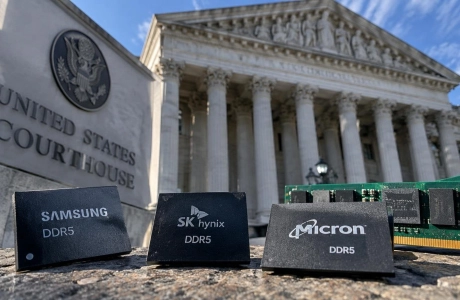
Maeil also explains that multiyear contracts have become widespread among memory manufacturers—Samsung Electronics, SK hynix, and Micron—and their major customers. Securing capacity in advance can reduce uncertainty about supply, but leaves buyers exposed to the prices in effect when the financial terms are set or revised.
Contracts could put pressure on product prices
The South Korean newspaper links the proliferation of these agreements to so-called chipflation: rising prices for electronic products when memory costs increase. In recent agreements, Maeil adds, minimum DRAM supply prices have been set at high levels, reflecting current market prices.
Some analysts cited by Maeil suggest that higher device prices could lead consumers to delay their purchases. If that happened, the effect could hurt memory semiconductor demand in the medium to long term. The newspaper presents this as a concern, not as an outcome that has already been observed.
For Samsung Electronics and SK hynix, contracts with Apple would provide predictability around large volumes of memory destined for phones and computers. Maeil argues that this consumer demand could help protect suppliers' profitability and reduce uncertainty in the medium term. It also notes that, unlike orders for AI data centers, Apple's supply covers consumer products, so its impact would be more limited if investment in artificial intelligence infrastructure slowed.
Negotiations are still pending finalization
The report comes from Maeil Business Newspaper and was also covered by MacRumors, Wccftech, and Yahoo Finance. The reports agree on the planned duration, the 2027 start, the minimum volume, and market-based pricing. However, they do not provide figures for deliveries or total cost, or a specific date for finalizing the contract.
For now, the next step depends on Samsung and Apple finishing negotiations and formalizing the agreement. Until then, the four- to five-year term and the reported conditions remain proposed terms, not a contract announced by the companies.
Sources: MacRumors, Wccftech, 매일경제, Yahoo Finance