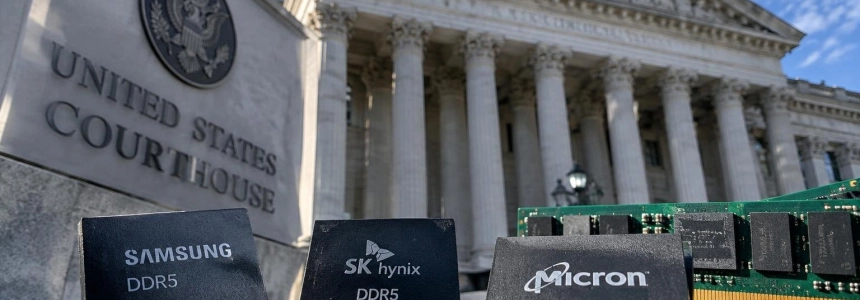
Federal judge Noël Wise on November 14 rejected a joint request by Samsung Electronics, SK hynix, and Micron to dismiss a class-action lawsuit alleging DRAM price-fixing. The case will proceed in the United States District Court for the Northern District of California, although the decision does not find the manufacturers guilty.
The action, filed in June by consumers and small businesses in the industry, claims that the three manufacturers cut production of memory for the general market while shifting more capacity to HBM, high-bandwidth memory used in artificial intelligence data centers. The plaintiffs allege that this shift restricted DRAM availability and contributed to higher prices.
What the plaintiffs allege about DRAM supply
The lawsuit was filed by 14 U.S. consumers and three small computer assembly and distribution companies, according to CHOSUNBIZ. It accuses Samsung, SK hynix, and Micron—which, according to the outlet, control nearly 90% of the global DRAM market—of deliberately reducing supply to drive up prices and earn profits the plaintiffs consider unjustified.
The allegations focus on shifting production from consumer DDR3 and DDR4 memory to HBM, a type of memory commonly used in AI data centers. Rock Paper Shotgun describes the lawsuit as challenging the coordinated withdrawal of consumer products and the shift to HBM; CHOSUNBIZ reports that the court considered both production cuts and plans to stop manufacturing DDR4.
Among the evidence cited by the court are announcements of DDR4 cuts between April and June of last year. It also considered that, since January of this year, the three companies allegedly adopted similar procedures for reviewing end-customer demand and order volumes. These factors formed part of the basis for Wise's decision that the allegations could proceed.
Judge rejects the “watching each other like hawks” explanation
The manufacturers argued that their decisions were independent responses to market conditions and to their competitors' actions. In their motion to dismiss, they also argued that the lawsuit repeated the ground covered by an earlier antitrust case filed in 2018, according to Tom’s Hardware. The defense cited a comparison by the late judge Richard Posner: «[C]ompetitors in concentrated markets watch each other like hawks».
Wise found that the allegations went beyond mutual monitoring among competitors. Her order, cited by Rock Paper Shotgun, says: «Their contentions are more akin to hawks flying in formation – an activity that hawks ordinarily do not do». The image of hawks flying in formation sums up why, in the judge's view, the allegations about parallel moves deserve to be examined in the proceedings.
“Their contentions are more akin to hawks flying in formation – an activity that hawks ordinarily do not do.”
— Noël Wise, judge of the United States District Court for the Northern District of California
Tom’s Guide reports a 500% price increase and says the judge considered the evidence presented by the plaintiffs highly plausible. The outlet also notes that the ruling described the changes as more structural than one leading company making a decision and others following suit. The figure and that assessment appear in Tom’s Guide’s coverage; the other cited publications do not provide the same detail.
The denial of the motion to dismiss opens the door for both sides to present further arguments and evidence, but it does not determine whether coordination occurred. Tom’s Hardware emphasizes that the decision is not a finding of guilt: Wise concluded there was enough evidence to allow the litigation to proceed. The court will have to decide later whether the allegations hold up.
Dates set for the next phase
The court ordered Samsung, SK hynix, and Micron to respond by December 7. The first case management conference is scheduled for January 12 of next year, according to CHOSUNBIZ. At this stage, the proceedings will continue, giving each side an opportunity to present its arguments before a decision on the merits.
The lawsuit is part of a longer history of allegations concerning memory prices. Hobby Consolas recalls that Samsung and Micron pleaded guilty in 2005 to participating in an «international conspiracy to fix prices in the DRAM market» and paid fines of between $185 million and $300 million. That precedent is part of the context, but it does not determine the outcome of the current case.
The same outlet says that the Chinese government investigated the three companies' activities between 2016 and 2018 over similar allegations, but was unable to prove them. The current defense also invokes a 2018 antitrust case, presenting it as a precedent for the allegations. In this lawsuit, Wise rejected the argument that this reference was sufficient to close the case before examining the new allegations.
The memory crisis remains unresolved
The case comes amid an ongoing memory shortage and rising prices, according to coverage by Rock Paper Shotgun and Hobby Consolas. The court's decision, however, does not mean the crisis will be resolved quickly. Rock Paper Shotgun estimates that it could last at least until 2028; the progress of the litigation does not guarantee increased supply or lower prices in the short term.
Tom’s Guide also links the memory debate to separate allegations concerning the GPU market and an alleged circular financing practice involving Nvidia. Its article attributes to leaks the claim that the company allegedly financed small neocloud companies so they would absorb GPUs that, according to that account, Nvidia had over-ordered from TSMC. It also says that Colette Kress, then Nvidia's CFO and acting head according to the article, allegedly questioned the practice. These claims are not part of the lawsuit against the DRAM manufacturers.
For Samsung, SK hynix, and Micron, the next firm deadline is to file their responses by December 7. The January 12 conference will mark the next announced milestone in the case; the central question—whether there was coordination to restrict supply and raise prices—remains to be addressed in the next stages of the court proceedings.
Sources: Tom's Guide, Rock Paper Shotgun, Hobby Consolas, Tom's Hardware, CHOSUNBIZ