Smartphone shipments in the United States fell 9% year over year in the third quarter of 2026, while Apple increased its share from 50% to 57%. Counterpoint Research says memory costs hit lower-priced Android phones hardest.
The market figure refers to shipments, not consumer sales. That distinction matters: the data describes how many phones reached the channel, while carrier and retailer sales offer another measure of demand. Counterpoint also recorded declines in those metrics, but not of the same magnitude.
Apple extends its lead as the market retreats
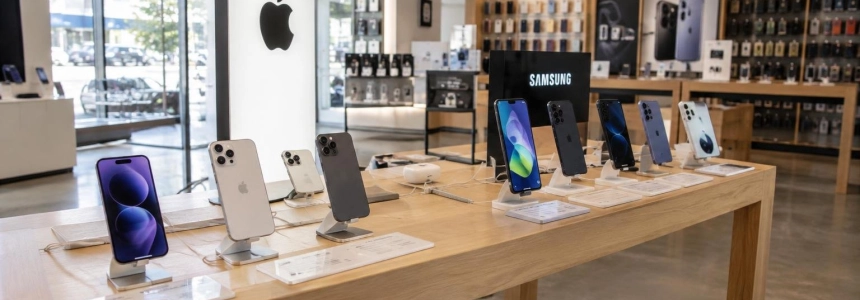
In Counterpoint's year-over-year comparison, Apple went from accounting for half of U.S. shipments in the third quarter of 2025 to 57% in the same period of 2026. The company was the only major manufacturer to maintain its shipment volume, according to the report cited by 9to5Mac. Thus, its share increase came in a shrinking market, not as a result of industry-wide growth.
Samsung also advanced, though more modestly: its share rose from 24% to 25% of shipments. iClarified links this result to a lineup that spans both flagship Galaxy S and Z models and lower-priced Galaxy A phones. Motorola fell four percentage points to 8%, while Google declined from 7% to 6% despite the launch of the Pixel 11.
| Brand | Share in Q3 2025 | Share in Q3 2026 | Year-over-year change |
|---|---|---|---|
| Apple | 50% | 57% | +7 points |
| Samsung | 24% | 25% | +1 point |
| Motorola | 12% | 8% | −4 points |
| 7% | 6% | −1 point |
The shares show relative winners and losers, but they are not enough to calculate the change in each brand's unit shipments: the overall market also shrank. Counterpoint reports that Apple avoided a drop in shipments among major brands and that Samsung gained share; Motorola and Google, meanwhile, lost share.
Memory costs squeeze budget Android phones
Rising memory costs particularly affect cheaper Android phones because their manufacturers have less room to absorb costs, according to Counterpoint analyst Emily Herbert, in information reported by iClarified. The options described in response to this pressure are to raise prices or reduce shipments. Either could make it harder to compete in the segment where price matters most.
The context helps explain why the decline was not evenly distributed. According to 9to5Mac, Counterpoint had observed during the year that Apple was better able to weather component shortages and cost increases than some competitors, which raised their phone prices several times. Apple generally kept iPhone prices stable for much of the year and postponed broader increases until the launch of the iPhone 18 Pro lineup in September.
This contrast does not prove that any manufacturer can replicate a particular pricing strategy. The data does point to an asymmetry between segments: low-cost models have less room to absorb more expensive components, while Apple maintained prices across much of its lineup during the period described. The observable result is a higher share for Apple, not a complete explanation of each company's internal decisions.
Sales channels also feel the contraction
Weakness is not limited to shipments in the United States. Smartphone sales at the country's three largest carriers fell 4% year over year in Q3, according to Counterpoint. In addition, the same analysis cited by iClarified puts U.S. retail sales in the second quarter 5% below the previous year. These are different indicators from different periods, but both show demand under pressure.
The difference between the 9% decline in shipments and the 4% drop in sales at major carriers means they cannot be treated as a single measure. Shipments can fall more sharply than sales recorded in a particular channel; the available figures do not break down the reasons for that gap here. Counterpoint also reports declines in retail sales and sales at the three largest carriers.
Less aggressive holiday promotions
Counterpoint expects memory costs to remain high and U.S. carriers to be more selective with promotions during the holiday season. The firm's analyst Maurice Klaehne expects carrier sales to remain weak in the fourth quarter, even though it is usually the strongest period of the year.
Memory cost pressures have been particularly noticeable in low-priced Android phones, and Counterpoint expects carriers to be more selective with their holiday promotions. Counterpoint expects a weak Q4; the final impact will depend on how costs and carrier offers evolve.
Sources: 9to5Mac, iClarified