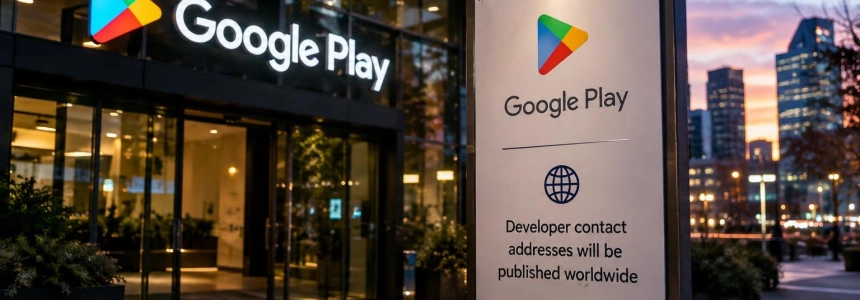
Google Play will start displaying the physical address and phone number of some developers worldwide on March 1, 2027. The measure affects those who declare themselves to be traders under European Union and United Kingdom rules; for individual accounts, the address could be the home where the apps are created.
The requirement stems from the application of the EU Digital Services Act, but the scope Google has chosen goes beyond what that regulation requires: the company will publish the details globally, even though the European obligation applies to consumers in the region. Apple, which is subject to the same rules, limits publication to the European Union and allows individual developers to provide a P.O. box if they can prove their connection to it.
What each account will have to declare
Google Play Console’s official help page states that all active developer accounts must indicate whether they are traders or non-traders under the laws of the European Economic Area (EEA) and the United Kingdom. The deadline is February 1, 2027, regardless of where the apps are distributed or which territories they target.
The declaration must reflect the account’s actual commercial activity and be kept up to date. Google warns that each developer is legally responsible for ensuring that their answer is truthful. The definition includes individuals and entities acting for purposes related to their business, trade, or profession; someone publishing as a hobby or without commercial activity probably does not fall into this category.
To assess status, Google lists as criteria the aim of earning income—for example, through paid apps, in-app purchases, or advertising—the volume or frequency of transactions, managing development as a business, and having a legal status that permits commercial activities. The list is not exhaustive.
TNW and Digital Trends describe regular income from ads or sales as evidence of commercial activity. Digital Trends notes that people who publish entirely non-commercial apps are probably not traders. Google, however, asks for a declaration for all active accounts, even if their apps are not distributed in Europe or the United Kingdom.
What will appear on Play Store listings
Starting March 1, 2027, users in any country will be able to see traders’ contact details. For an individual account, Google specifies that a phone number and address will be displayed. The payments profile must include a physical address: the company does not accept P.O. boxes for this field.
More details will be published for those who declare themselves to be traders. Google says the D-U-N-S number will appear in the “App support” section and that a link to each app’s terms of service will also be displayed if the developer has provided one.
Additional information will be added in the EEA and the United Kingdom: the developer’s or trader’s name will replace “Google” in the “Offered by” field on the listing, and a self-certification that the products or services comply with local laws will be displayed. Google will also ask traders to certify this commitment and provide a link to each app’s terms of service.
The schedule and scope are as follows:
| Date | Requirement or change | Who it affects |
|---|---|---|
| February 1, 2027 | Deadline to declare trader status | All active developer accounts |
| March 1, 2027 | Publication of contact details, D-U-N-S number, and link to terms if provided | Google Play users worldwide, for traders’ apps |
| March 1, 2027 | Trader’s name and self-certification on the listing | Users in the EEA and the United Kingdom |
The problem for people who work from home
The combination of global publication and a mandatory physical address leaves independent developers facing a choice: expose their home address or pay for a business address. The Verge reports that an independent developer told The Elec they were considering renting a private office solely to meet the requirement. Digital Trends also reports that some developers are considering renting office space to protect their personal information.
The Verge mentions using a registered agent or another service that provides a business address as an alternative. However, it is not possible to replace the address in a Google payments profile with a P.O. box. Google has not publicly explained, in the information cited by The Verge, why it prohibits this or why it will disclose the details worldwide; the outlet said it had asked the company for clarification.
The requirement does not mean that the home address of every person who uploads an app will automatically be published. It depends on the trader classification and the type of account. But Google considers regular or commercial remuneration relevant, and its official page lists ad revenue, in-app purchases, and paid apps as factors for assessing status.
Google also warns that declaring oneself a non-trader when the activity does qualify as commercial may have consequences. Play Console Help says that if it detects signs of commercial activity, it may ask the developer to confirm or update their status. If they do not respond within the specified deadline, their apps may be removed from Google Play.
The declaration is configured at two levels
Google separates the account-wide declaration from the confirmation for each app. To indicate overall status, the developer must sign in to Play Console and open “Manage account,” “Account details,” and “About you.” If they declare themselves to be a trader, they must also confirm this status for each app under “Monitor and improve,” “Policy and programs,” and “App content.”
The company distinguishes this process from developer identity verification. The trader declaration does not replace or repeat D-U-N-S verification: according to Google, the latter collects and verifies information about all developers. If an account has already provided a D-U-N-S number and declares itself to be a trader, that number will be displayed on the app listing.
Google says that failing to complete the declaration on time may trigger enforcement measures, including blocking updates or removing apps from the Play Store worldwide. The same warning applies if the company detects that an account declared itself a non-trader to avoid verification or self-certification: the help page lists global account suspension or termination as possible consequences.
Apple limits exposure to the EU
Apple applies the DSA trader requirements to those distributing apps in its store in the European Union. Its documentation says it verifies and publishes the address, phone number, and email address provided by the trader on the product page. Although it asks people who do not distribute in the EU to declare their status too, it publishes these details when the app is distributed in any of the Union’s 27 territories.
For individual developers, Apple accepts an address or a P.O. box, as well as a phone number and email address. If an alternative address such as a P.O. box is used, Apple requires documentation proving the connection to it, such as a receipt or invoice. The Verge adds that Apple displays the details only in the relevant European countries, not worldwide.
The difference in scope is central: European regulations require consumers to be able to identify and contact traders, but TNW and Digital Trends note that they do not require Google to show those details outside the region. Google, for its part, has chosen to let Play users anywhere in the world see the contact details of developers classified as traders.
A change separate from Android verification
Digital Trends emphasizes that the trader declaration is separate from Android’s broader developer verification initiative. According to the outlet, that policy aims to improve app security and make it harder for malicious operators to act anonymously. The Play Console requirement, by contrast, is tied to commercial status under European and British rules.
The decision comes as Google expands its tools for publishing apps: TNW recalls that the previous month the company announced that anyone could publish apps for free through AI Studio. It also mentions that in August a US judge ordered Google to stop making it difficult to install rival app stores.
The immediate deadline for developers is February 1, 2027: that is when the deadline to declare status expires. One month later, the global publication of details for those who declare themselves to be traders will begin.
Sources: TNW | Apps, Digital Trends, The Verge, Google Play Console Help, Apple Developer