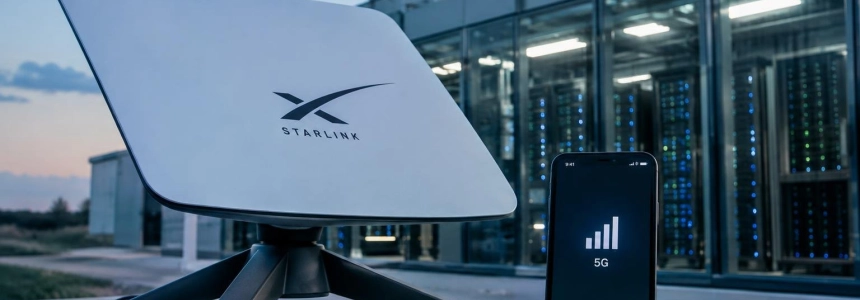
SpaceX agreed to buy 100% of Grain Management’s nationwide 800 MHz portfolio, spectrum the company wants to use to take Starlink Mobile beyond direct connections between satellites and phones. The deal, announced on October 8, is subject to approval by the U.S. Federal Communications Commission (FCC) and other customary closing conditions, according to Grain.
SpaceX’s goal is to enter the U.S. mobile phone market and compete with operators such as AT&T, Verizon, and T-Mobile. To do so, its satellites alone will not be enough: the company is also preparing a terrestrial 5G network. The Verge describes this combination as the next major challenge for Starlink Mobile’s plans.
800 MHz spectrum, a key part of the deal
Grain Management announced that SpaceX would acquire its entire nationwide 800 MHz spectrum portfolio. The firm had bought this set of frequencies from T-Mobile in August 2026 in exchange for cash and its own 600 MHz spectrum, according to the announcement Grain published through PR Newswire.
Low-band frequencies are relevant to the coverage plan SpaceX associates with the deal. Genbeta notes that 800 MHz bands can better penetrate obstacles such as walls and roofs, a limitation that has affected Starlink Mobile until now. The intention is for the service to connect phones both from space and through terrestrial infrastructure; Grain also presents the deal as support for direct-to-device satellite services, known as D2D.
Grain’s announcement frames the sale as part of the convergence between terrestrial and satellite networks. The firm says the use of its frequencies could expand consumer connectivity and continue a regulatory process that began in July 2026: the FCC order approving Grain’s acquisition of the spectrum established a competitive selection process and a conditional path for D2D deployment.
“For nearly twenty years, we have built Grain to see opportunity where others see complexity.”
— David Grain, founder and CEO of Grain Management
The deal has not yet closed. Grain said it requires FCC authorization, in addition to other customary conditions. Genbeta reports that Elon Musk considers the deal the last step needed to provide phone coverage nationwide, but that ambition does not mean the new network is ready to operate.
A satellite network that needs support on the ground
SpaceX has already deployed thousands of direct-to-phone connectivity satellites, according to The Verge. The next phase involves building a terrestrial cellular network capable of complementing that coverage. Genbeta adds that the company is authorized to deploy up to 15,000 second-generation satellites, although that approval does not mean the mobile service is ready to operate.
An agreement with Qualcomm provides one part of the terrestrial infrastructure. Qualcomm announced a deal with SpaceX on November 4 to supply equipment and technology for the future 5G network, according to Genbeta. The Verge specifies that Qualcomm’s cellular technology would be deployed at tens of thousands of 5G sites starting in 2027.
This timeline leaves a development period before Starlink Mobile can be presented as a large-scale alternative to traditional networks. Genbeta quotes John Hodulik of UBS, who considers the acquired frequencies compatible with current phones and does not expect major regulatory obstacles. He also warns that SpaceX will need time to develop its mobile business.
The deal shook telecom stocks
The prospect of SpaceX competing directly with U.S. operators had an immediate effect on the markets. On the morning of October 9, T-Mobile shares fell as much as 11%, while AT&T shares dropped 7.4%, according to Genbeta. The move came after the spectrum deal became public.
The industry’s reaction also reflects the scale of the bet SpaceX is making. The Verge reported that Tim Höttges, CEO of Deutsche Telekom, T-Mobile’s parent company, said he was taking SpaceX’s plans “super serious” and argued that carrying them out could cost Musk more than $200 billion.
For now, the deal with Grain does not make Starlink a mobile operator or activate a new nationwide network. If completed, the acquisition would give SpaceX a spectrum asset that the company wants to combine with its satellites and terrestrial cellular sites. The Qualcomm deal puts the planned start of terrestrial deployment in 2027, while the spectrum purchase is still awaiting FCC approval.
A possible Boost Mobile acquisition, still under discussion
The Verge adds that SpaceX is reportedly in talks to buy Boost Mobile, a possibility that could allow it to launch Starlink Mobile through that service. The outlet also cites another report saying the company could use 80,000 cellular sites in the United States to build its network. Neither option is described as a completed transaction in the details published about the Grain deal.
The strategy therefore has several fronts: acquiring spectrum, deploying 5G technology on the ground, and leveraging the existing satellite network. The next infrastructure milestone mentioned by SpaceX and its partners is the start of terrestrial deployment planned for 2027.
Sources: Genbeta, The Verge, Cision PR Newswire