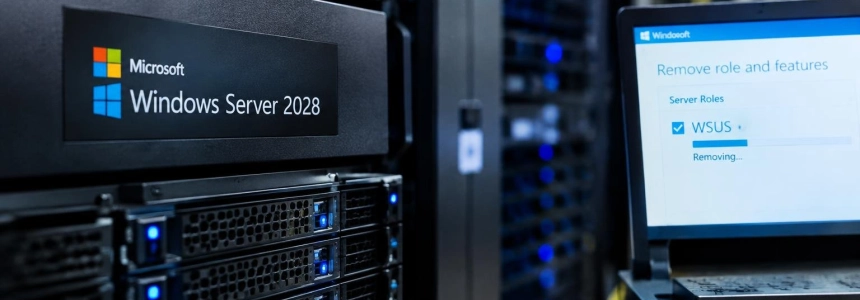
Windows Server 2028 will remove the WSUS server role, according to Microsoft documentation updated for the preview version. The change affects organizations that use Windows Server Update Services to centrally distribute updates across corporate networks, but it does not remove WSUS from earlier versions or interrupt support for those installations.
What is changing and what will continue to work
The removal applies only to Windows Server 2028: Microsoft Learn's page says that the removal does not change WSUS availability or support in earlier editions. Organizations will be able to continue using the role in those versions throughout each product's support lifecycle.
Microsoft explicitly includes Windows Server 2025 among the supported versions. It also says that WSUS servers installed on earlier versions can manage updates for both supported Windows clients and supported Windows servers, including those running Windows Server 2028. Therefore, the change does not mean that updates for that operating system will no longer be published through WSUS.
The practical difference is where the service is hosted: Windows Server 2028 will not be able to perform the WSUS server role, while an installation on an earlier version will remain covered by its support lifecycle. Microsoft does not announce a specific end-of-support date for WSUS on those versions in this documentation; it refers readers to each version's lifecycle duration.
WSUS —Windows Server Update Services— allows administrators to manage and distribute updates for Microsoft products from a centralized location. Microsoft introduced the service in 2005 under the name Software Update Services (SUS). It is especially relevant to corporate networks with many devices, where computers do not need to download each update separately from Microsoft's servers.
A removal following the 2024 deprecation
Microsoft had deprecated WSUS in September 2024, but clarified at the time that it would maintain the functionality and continue publishing updates through the channel. Deprecation meant that the product would no longer receive new features, not that it would disappear immediately: the role remained available and operational in the Windows Server versions that included it.
In that announcement, Microsoft's Nir Froimovici recommended moving to cloud tools to manage updates for client devices and servers.
“WSUS remains operational but is no longer investing in new features.”
— Nir Froimovici, Microsoft
Microsoft's recommendation cited Windows Autopatch and Microsoft Intune for managing client updates, and Azure Update Manager for servers. The updated documentation confirms that the role will be removed in Windows Server 2028, but does not present those tools as a universal replacement for every scenario. In particular, the company acknowledges that some organizations need to manage patches offline or under strict controls.
Patching in isolated networks still lacks a detailed answer
Microsoft says it recognizes the need to keep disconnected and highly controlled environments up to date and is working to support them. It adds that it will share more information as that work progresses. To learn about previews of patching technologies for disconnected servers, its documentation says that users can contact the Windows Server Technology Adoption Program (TAP) team.
This leaves an open question for companies that rely on WSUS precisely because their servers cannot use cloud management: Microsoft has not yet described a specific alternative here to the role in Windows Server 2028. The company also does not specify when a solution for these cases will be available. Its commitment to publish more details does not include a date.
Windows Server 2028 is still in preview
Microsoft announced Windows Server 2028 the week before BleepingComputer published its report, during the Ignite 2026 conference. The company opened access to the public preview and offers testing through the Windows Insider program for Windows Server; it also mentions the option to request early access through the Windows Server Technology Adoption Program.
Microsoft's documentation warns that Windows Server 2028 is still in preview and that removal plans may change before release. The appearance of a feature on the list of removed items also does not necessarily confirm that it is already absent from all current test builds. The announced removal describes the plan for the product, not an immediate change to Windows Server installations already in production.
The support lifecycle of earlier versions is the limit Microsoft does establish for WSUS: the role will remain available and supported for the period applicable to each version. The documentation explicitly mentions Windows Server 2025 and confirms that WSUS on those versions will be able to manage updates for Windows Server 2028. Companies do not need to remove WSUS from their current servers simply because the new version is coming.
WSUS is part of a broader list of changes
The removal of the update service coincides with other planned changes to Windows Server 2028. Microsoft also lists WINS, DirectAccess, and SMBv1 as removed, along with VBScript and the WMIC command-line utility. The documentation distinguishes these items from features that are deprecated but may still be included in the product.
The latter include BranchCache, the Windows Deployment Services (WDS) role, Windows PowerShell 5.1, and Windows Sockets Direct. Microsoft defines a deprecated feature as a component that is still distributed, can be used in production, and receives security and quality updates according to the product lifecycle, even though it is no longer actively developed. WSUS, by contrast, is listed in the section of features that Windows Server 2028 will remove.
The removal list also includes legacy BIOS boot, the Shielded VMs feature, and the .NET Framework 3.5 optional component. For Windows Server 2028 guest virtual machines, Microsoft requires Hyper-V Generation 2 virtual machines, which use UEFI. At the same time, the company notes that this requirement does not change support for Generation 1 virtual machines running earlier guest operating systems.
For WSUS administrators, the immediate takeaway is narrower than that broader list: the role is disappearing from the target operating system, not from earlier versions. Managing Windows Server 2028 updates through WSUS hosted on an earlier version will remain possible, while Microsoft prepares more information for environments that require disconnected patching.
Sources: BleepingComputer, Microsoft Learn, Microsoft Learn, Daily Windows Server News, Pro IT NW