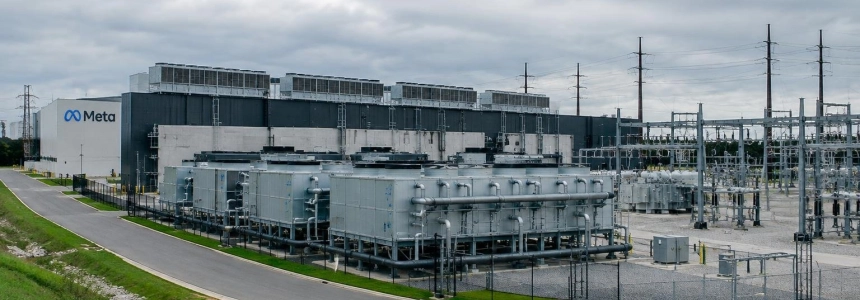
A data center can retain its buildings and connections even after the hardware that justified the investment is no longer competitive. This difference between a facility’s physical lifespan and the economic life of its servers and accelerators means that infrastructure can remain operational and still fail to generate enough revenue to recoup its cost.
This does not prove that all investments in artificial intelligence infrastructure will lose money. The question is more specific: who bears the renewal risk if equipment depreciates quickly, demand does not grow as expected, or service prices fall before the capital is paid back.
A building does not age at the same rate as an accelerator
A data center’s infrastructure brings together assets with different lifecycles. The land, structure, electrical connections, and part of the cooling system can remain in service for a long time. Servers, networks, and, above all, compute accelerators can lose value sooner: more efficient equipment becomes available, model requirements change, and workloads no longer fit the installed generation.
That is why talking about a data center’s “useful life” as if it were a single figure obscures the problem. Economic obsolescence arrives before failure for many technology assets: a server may still power on, but deliver less performance per unit of energy or cost too much to compete with newer alternatives.
Accounting seeks to spread the cost of assets over time through amortization. This rule helps organize the books, but it does not turn the investment into cash or guarantee that the equipment will retain its resale value. If capacity stops generating revenue before it has been fully amortized, the company may have to recognize losses or replace it while still bearing costs associated with the initial capital outlay.
The equation depends on utilization, energy, and revenue
An expensive cluster does not make money just by being installed: it needs work it can perform at a sufficient price. Occupancy matters, but it is not enough. If customers use capacity irregularly, the company may pay for a facility sized for peak demand and leave resources idle the rest of the time. Idle capacity also has a cost, even if it does not consume as much energy as an accelerator running at full load.
Electricity and cooling add to the initial investment. Maintenance, staff, connectivity, licenses, and financing also count. An AI service may appear profitable when looking only at inference costs, but its margin changes once infrastructure, periods of low utilization, and the upgrades needed to remain competitive are included.
The relationship between performance and consumption is decisive. A new generation of accelerators can perform more work using the same amount of energy, but buying it requires capital and may leave older equipment with a lower value. Greater efficiency does not automatically mean savings: if demand grows and capacity expands faster than usage, total spending may rise even if each operation is more efficient.
Pricing also affects the calculation. Some operators sell reserved capacity, others charge by usage, and still others bundle compute into broader services. Each model distributes demand risk differently: a stable contract can make financing easier, but entails commitments; usage-based pricing offers flexibility, though it leaves the operator more exposed to a downturn in activity.
From optimistic forecasts to idle capacity
Building ahead of demand can be rational if connecting a facility and securing power takes time. But a demand forecast is not a purchase guarantee. If several companies expand capacity based on similar expectations, available supply may outpace the customers willing to pay for it. Overcapacity puts pressure on prices and can make it difficult to recover investments made at higher costs.
The opposite risk also exists: sustained demand can leave little capacity available and delay projects that would have customers. The problem, then, is not to guess whether AI will grow, but to get the pace, type of hardware, and location of each investment right. A facility with suitable power, connectivity, and access to customers is not readily interchangeable with one located far from those resources.
Scale has two sides. Buying and operating infrastructure can spread certain costs across more workloads; at the same time, it multiplies the capital at risk if revenue does not keep pace. Growth does not fix a negative margin when each additional unit of capacity adds more costs than revenue. Expansion improves the books only if it brings efficiency, profitable demand, or both.
Who foots the bill
The risk may lie with the data center operator, the company buying servers, the cloud service provider, or a customer that signs capacity commitments. In practice, contracts determine who pays when actual usage falls short of forecasts, who finances an upgrade, and what happens if the installed technology no longer meets the customer’s needs.
Companies that rent capacity reduce the need to build their own facilities, but they do not eliminate the economic cost: it shows up in rates and contract terms. A consumption commitment can give the provider confidence to invest and give the customer access to resources, but it can also become an obligation that is difficult to justify if demand or the product architecture changes.
For a company training models or running services, it is worth distinguishing between strategic capacity and capacity that can be purchased on the market. Owning hardware can provide control over data, latency, and availability; renting it can avoid tying up capital and shift some maintenance responsibilities. The decision depends on expected usage, total cost, and the value of controlling the infrastructure.
Opportunity cost also matters. Capital allocated to a data center cannot be used at the same time to develop products, hire staff, or acquire capacity when needed. If the hardware is underutilized, it is not just the return on that purchase that suffers: the company loses other investment options.
What technical teams can do
Software architecture affects the amount and type of hardware required. Quantization, compression, batch processing, reuse of results, and choosing smaller models can reduce resources for certain tasks. These are not universal solutions: an optimization may affect quality, increase latency, or require engineering work that also has a cost.
Designing for multiple classes of accelerator can reduce dependence on a single platform, although it requires testing and maintenance. Portability does not mean that all equipment performs equally: libraries, available memory, and device features vary. Measuring the cost per useful task, rather than comparing only the price of a machine, helps determine which workloads should run in each environment.
Technical leads can monitor utilization by service, energy consumption, wait times, and cost per request. These data make it possible to identify reserved resources that go unused, jobs that could be scheduled during periods of lower demand, and models that deliver equivalent results with less compute. The metric must include result quality: making an answer cheaper when it is no longer useful does not improve the product.
Planning also benefits from reversible steps. Instead of immediately committing to an oversized facility, a company can combine contracted capacity, gradual purchases, and load testing. This strategy may be more expensive per unit at certain times, but it avoids taking on the cost of demand that has not yet materialized from the outset.
The investment can fail without the technology failing
AI can be useful while some facilities still fail to recoup their costs. Adoption of a technology does not guarantee that every operator, project, or hardware purchase will deliver an adequate return. The value of the service and the return on the asset are different questions: a product can attract users while its provider loses money because of capacity prices, customer acquisition costs, or the required infrastructure.
Older hardware may also find less demanding uses, demand may eventually fill capacity that is underutilized today, or the cost of operating equipment may fall. These possibilities can soften losses, but they depend on the equipment remaining useful, demand for it existing, and revenue covering its operating costs. They do not automatically turn a failed investment into a profitable one.
For boards of directors, the practical question is not whether data centers are “the future,” but which assumptions underpin each project: occupancy level, selling price, energy costs, upgrade schedule, and contract duration. An adverse scenario must fit within the budget, not appear for the first time once the capacity has already been built.
The clearest sign of a fragile investment would be a facility whose business depends on every factor going right at once: high utilization, firm prices, available power, and competitive equipment for long enough. If any one of those conditions fails, the building may remain powered on, but the capital used to build it may never come back.