ChatGPT could call contacts and send SMS from Android, according to permission strings found in version 1.2026.328 of its app. The references also point to music controls, reading what appears on screen, and tighter integration of Dots agents; OpenAI has not announced when these features might arrive.
The clues come from an analysis of the app's installation package, known as an APK teardown. Digital Trends attributes the discovery to Android Authority; GSMArena, TuttoAndroid, and TecnoAndroid also describe references to permissions and features that are not yet available. So what appears in the code points to work in progress, not tools users can activate now.
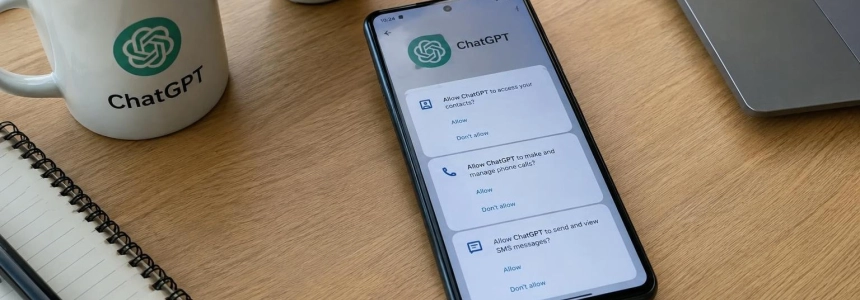
Permissions for contacts, calls, and messages
The strings found include requests to search contacts and check recent calls. Others describe the ability to place a call when the user asks and to read or send text messages. According to GSMArena, these actions would require the person to grant the relevant permissions first.
The difference from current use is clear: ChatGPT can already be set as the default digital assistant on Android, but GSMArena describes that experience as limited to voice conversations and text responses. TecnoAndroid notes that, so far, users cannot ask it to call someone or pause music that is playing. The new references suggest OpenAI is looking to expand these capabilities within Google's mobile operating system.
Call history access appears alongside the communication actions, but it is not clear what information would be shown or how it would be presented. The described features would be enabled through user permissions; none of the publications reports a rollout date.
Control music without opening another app
The code also suggests that ChatGPT could pause, resume, or skip tracks by accessing Android notifications. That permission would allow it to interact with an active media session without the assistant having to open the music app itself.
GSMArena and TecnoAndroid set a limit on this possibility: ChatGPT would not start a new song or automatically open a player. Digital Trends' description mentions pausing, resuming, or changing tracks; TuttoAndroid adds that the strings might allow it to locate media content and perhaps identify the artist and song. This last possibility is presented as a potential interpretation of the code, not as a confirmed feature.
The distinction matters for understanding the intended scope: the references do not describe an assistant capable of finding any song and playing it from scratch. Rather, they point to controls for music already playing on the phone, subject to notification access.
Questions about what's on screen
Another suggested feature would let ChatGPT use the screen as context for answering. Instead of capturing and uploading an image, the user could ask about what they are viewing and continue the conversation with related follow-up questions. Digital Trends says the «Use screen and app data» option would need to be enabled.
GSMArena adds that the assistant might check the screen again with each follow-up question. This suggests that visible content would be used as up-to-date context for the conversation, although the available references do not explain in more detail how access would work or what controls the user would have beyond that option.
The idea is similar to «Ask about screen», a Gemini feature mentioned by Digital Trends. TecnoAndroid and TuttoAndroid place these capabilities within the competition between ChatGPT and Google's assistant: Gemini already offers this type of feature on Android, while ChatGPT's integration is still more limited.
Dots could connect with Android
The analysis also found references to a dedicated Dots card. Digital Trends describes Dots as always-available AI agents, accessible from their own app or from ChatGPT on mobile, desktop, and the web. According to the publication, OpenAI introduced them in September 2026 and has been adding capabilities such as communication through iMessage and RCS, as well as integrations with Wallet and Health.
A permission request seems to indicate that users would need to grant notification access in Android settings and then return to the card to tap «Connect» or «Continue». GSMArena links this card to Dots, which can perform tasks without the user having to keep the app open. The final steps are not known, nor is it clear how the card would connect with the other features mentioned.
Two configuration references point to other possibilities, though these remain uncertain. allowedWhileLocked suggests that a Dot might be usable while the phone is locked, while useDotAsAssistant suggests that it could be set as the device's digital assistant. GSMArena and Digital Trends present both as clues in the code, not as confirmed options in the app.
An alternative to Gemini, still without a release date
The current integration explains the interest in these clues: although ChatGPT can already take the place of the default assistant, its Android features remain limited, according to GSMArena and TecnoAndroid. Adding calls, messages, media controls, and contextual screen access would bring it closer to tasks that the publications say Gemini can perform in Google's system.
TuttoAndroid believes these tools could make ChatGPT a more direct competitor to Gemini on Android. TecnoAndroid also suggests they could give some users a reason to change their default assistant. These are possible consequences of the described features, not a change that is already available or a decision announced by OpenAI.
For now, it is unclear when they might arrive or which features would make it through development. Digital Trends and GSMArena warn that it is also unknown whether all the possibilities will ultimately be released; the references are from version 1.2026.328 of the Android app. Until OpenAI announces a rollout, calls, SMS, and screen controls remain potential features.
Sources: Digital Trends, TecnoAndroid, TuttoAndroid, GSMArena