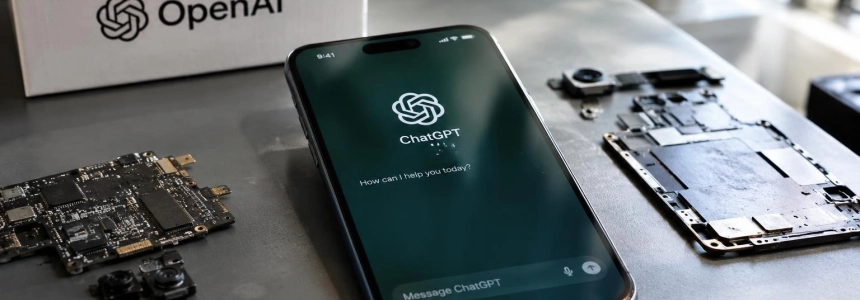
OpenAI is reportedly preparing a phone designed around ChatGPT and has reportedly commissioned FIH Mobile, a Foxconn subsidiary, to assemble it. Reports place the possible launch between late 2027 and 2028, although neither the device nor its industrial partners have been officially confirmed.
The project attributed to OpenAI aims to make AI the phone’s primary interface, rather than limiting it to an app. According to Elettronica Open Source, ChatGPT and agents could coordinate requests, apps, and services, so users would not have to open each app separately.
Foxconn could handle assembly, but not necessarily the entire design
Reports on the industrial arrangements still paint a tentative picture. Elettronica Open Source, citing Chinese newspaper Securities Times, says FIH Mobile has reportedly been commissioned to assemble the device. Business Today adds that Luxshare Precision, Lingyi iTech, and AAC Technologies could be involved in supplying components or other tasks.
This possible role for Foxconn changes earlier accounts of the production chain. Analyst Ming-Chi Kuo had identified Luxshare as a possible exclusive design and manufacturing partner; later reports suggest it could retain component work while FIH Mobile would handle assembly. The companies’ final responsibilities are not yet known.
OpenAI and Foxconn’s relationship would not begin with this phone: Business Today notes that the two announced a collaboration last year on equipment for AI data centers. In late October, Foxconn chairman Young Liu said they were discussing other joint projects, without revealing details. Neither company has publicly confirmed that those discussions include a smartphone.
The timeline and processor remain rumor
Published dates differ. Android Police points to units going on sale toward the end of 2027 and cites earlier reports that production would begin early that year. Elettronica Open Source and Business Today place the possible market arrival between 2027 and 2028. The distinction matters: starting production is not the same as having the product available, and no date is official so far.
A high-end configuration attributed to Kuo is also circulating: a MediaTek Dimensity 9600 made using a 2 nm process, two AI processing units, LPDDR6 memory, and UFS 5.0 storage. Business Today describes changes to the chip’s production forecasts: mass production was first said to be planned for 2028, then reportedly brought forward to the first half of 2027. There is no confirmed spec sheet, and those components could change.
For OpenAI, a processor capable of running AI tasks locally could help reduce reliance on remote services, but sources do not detail which features would run on the device and which would require a connection. Elettronica Open Source notes that local performance, power consumption, and battery life will be key constraints; it also mentions microphones, sensors, and permissions as central parts of the experience. In a phone designed to listen and act on requests, these decisions affect both its usefulness and the control users retain.
The operating system is a strategic decision
An assistant that coordinates apps would need consistent access to their features and services. That is the implicit promise of the proposal described by Elettronica Open Source: ask for a task and let ChatGPT connect the steps, instead of switching between apps. For developers, the practical implications would depend on how OpenAI enables this integration: it is not known whether adapting existing apps would be enough or whether specific interfaces for its agents would be required.
Android Police outlines two still-hypothetical options: an Android-derived version or an entirely new operating system. The first could make it easier to access familiar apps; the second would give OpenAI more room to build an experience centered on its agents, but would also require it to establish its own ecosystem. The choice of operating system will determine how much work developers would need to bring their services to the phone and how much control OpenAI would have over apps.
That barrier to entry also affects companies considering developing for the device. If the phone simply reorganizes access to existing apps, the challenge could be enabling agents to use them; if it introduces another platform, companies would also need to assess its reach and the effort required to maintain an additional integration. These are scenarios, not announced decisions: OpenAI has not explained how the software would work.
Privacy and battery life versus the convenience of an agent
The idea of a phone maintaining context across tasks makes permissions and data management more important. Elettronica Open Source cites pKVM, for isolating sensitive environments, and online hashing, for checking data integrity, as possible measures.
The product would have to strike a specific balance: greater access to apps, sensors, and services can make an agent more useful, but it also requires explaining what information it uses and what actions it performs. Battery life matters for another reason: if AI tasks depend on local computing, performance and power consumption could come into conflict. The promised experience will depend on how permissions, battery life, and continuity between operations are handled.
OpenAI would also have to persuade users who can already access ChatGPT through the Android and iPhone apps. Android Police questions whether that access is enough to motivate a switch to a new ecosystem and notes that the company has talked about selling more smartphones than Samsung. The ambition is high, but that does not prove demand exists or clarify how that goal would be achieved.
For now, the most concrete news is industrial: FIH Mobile has reportedly been commissioned to assemble the phone, while other companies could supply components. Until OpenAI confirms the phone, the decisions that will determine whether it is a conventional mobile with ChatGPT at its center or a different platform for software agents remain open.
Sources: Elettronica Open Source, Android Police, Business Today