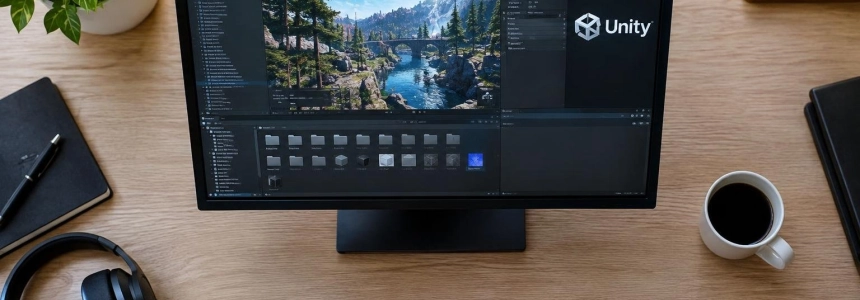
Silver Lake and the Public Investment Fund of Saudi Arabia (PIF) have reportedly held talks to buy Unity for around $25 billion, according to an exclusive report by Reuters cited by several outlets. The deal is not finalized: Unity is working with an investment bank to evaluate its options, and the proposal, including its terms, could change.
The potential acquisition would come just months after Silver Lake and PIF took part in the purchase of Electronic Arts (EA), alongside Affinity Partners. That deal was completed in August 2026 for around $55 billion. Unity, developer of the game engine of the same name, is now the new target attributed to the consortium.
Reuters based its report on people familiar with the talks. InvenGlobal, citing two people with knowledge of the matter, says Silver Lake and PIF approached Unity in recent weeks. The sources spoke on condition of anonymity because the talks are confidential. Unity declined to comment; Silver Lake and PIF did not immediately respond to Reuters' requests.
A valuation predating the latest results
The roughly $25 billion figure under discussion is not final. According to sources cited by InvenGlobal, the valuation was proposed before Unity published its third-quarter results, which raised its market capitalization to around $21.5 billion. Eurogamer also cautions that the figure should be treated as indicative: the results could push the valuation higher, while broader economic changes could put downward pressure on it.
Unity published its figures on November 5. For the three months ended September 30, it reported revenue of $622 million, compared with $471 million in the same period of 2025. Strategic revenue reached $597 million, a 59% year-over-year increase. The company also posted GAAP net income of $122 million, compared with a loss of $127 million a year earlier: its first profitable quarter under those accounting principles since going public.
Growth was not uniform. Grow Solutions revenue reached $457 million, up 44% from the third quarter of 2025. Unity attributed the increase to growth in Unity Ads, driven by Vector, which rose 126% year over year and 40% compared with the previous quarter. The company said growth in its ad network partially offset declines in ironSource Ads.
Create Solutions generated $165 million, up 8% year over year. Unity linked the improvement to higher subscription revenue, partially offset by declines in cloud and hosting services following the realignment of its portfolio in 2025. In the breakdown of strategic revenue, Grow contributed $431.5 million and Create $165.1 million; the total was $596.6 million, compared with $374.9 million a year earlier.
The company also reported adjusted EBITDA of $257 million, with a 41% margin, compared with $109 million and a 23% margin in the comparable quarter. Free cash flow was $220 million, and cash, cash equivalents, and restricted cash totaled $2.651 billion at the end of the quarter. For the fourth quarter of 2026, Unity forecasts strategic revenue of between $683 million and $691 million and adjusted EBITDA of between $290 million and $295 million; these are company forecasts, not results already achieved.
The financial history also includes changes to the advertising business. Unity reported that its ironSource Ads network was shut down during the second quarter of 2026 and that it sold the Supersonic publishing business on August 4. Non-strategic revenue, which mainly includes those activities, fell 73% year over year to $25.5 million in the third quarter.
Silver Lake is already a Unity shareholder
The investment firm would not be coming in from the outside. Rock Paper Shotgun and InvenGlobal put Silver Lake's stake in Unity at around 8%. InvenGlobal says the firm invested up to $400 million in the company in 2017. Eurogamer also puts the stake at approximately 8% and cites the $400 million investment.
In addition, Egon Durban, Silver Lake's co-CEO and managing director, sits on Unity's board of directors, according to Rock Paper Shotgun and Eurogamer. This connection could be relevant in acquisition talks: Rock Paper Shotgun argues that Durban would probably have to recuse himself from the negotiations. None of the sources confirms what steps have been taken in this regard.
The EA deal is the closest precedent, although it is not known whether a potential Unity purchase would have the same structure. The EA acquisition was a leveraged buyout, according to Eurogamer and InvenGlobal; this type of deal places debt on the acquired company. Eurogamer emphasizes that the terms of a potential Unity purchase have not been confirmed and that it could be a private acquisition with a different structure.
The consequences for EA have fueled concern about the new approach. Rock Paper Shotgun reports that EA laid off around 400 people to cut costs, closed BioWare, and canceled a project related to The Sims codenamed Project Lotus. Eurogamer also notes the closure of BioWare, the studio behind Mass Effect and Dragon Age.
80 Level links the studio's closure to EA's acquisition by Silver Lake, Affinity Partners, and PIF, and quotes BioWare co-founder Greg Zeschuk. The outlet attributes the closure to the new owners' lack of experience making games:
“these people have ever made a game, like, never really sat and made one, like, from start to finish, even a small thing, they just don’t know how it works.”
— Greg Zeschuk, BioWare co-founder
Rock Paper Shotgun attributes BioWare's closure and the cancellation of Project Lotus to post-acquisition cuts. Eurogamer offers another perspective on the studio: it says that, according to previous reports, EA decided not to fund Star Wars Battlefront 3 and Mass Effect 5 at the same time and chose to support only the former. None of these precedents confirms what might happen to Unity's teams or projects if an acquisition were to go ahead.
The debate over Unity's structure and future
The possibility of a leveraged buyout concerns Rock Paper Shotgun because of its potential impact on Unity staff, although the outlet presents this scenario as a hypothesis. Eurogamer also distinguishes the Unity proposal from the EA deal: there is no confirmation that the purchase would involve debt or replicate its terms. So far, no specific terms have been made public.
80 Level adds a regulatory concern: it believes the rapid acquisition of major industry companies by investors linked to PIF could attract the attention of antitrust authorities if the deal goes ahead. This is a possibility raised by the outlet, not an announced investigation or regulatory review.
Unity enters these talks following other episodes that have shaped its relationship with the development community. Eurogamer recalls the 2024 controversy over the runtime fee, a charge the company tried to apply to every sale of a game made with its engine and quickly withdrew after a strong public backlash. It also mentions recent agreements with Google for AI game-creation platforms, Google PlayGround and Unity Spark. According to Eurogamer, Spark's website features a game called Space Corridor.
The economic landscape surrounding AI also adds uncertainty to the valuation. Eurogamer notes that growth in the AI-powered Vector advertising platform helped Unity achieve GAAP profitability, but warns that a recent downturn in the generative AI sector could make investors more cautious about companies using the technology. The outlet does not rule out the possibility that this setback is temporary.
For now, what is clear is that Unity is evaluating its options with the help of an investment bank and that no definitive agreement has been reached. The roughly $25 billion proposal was discussed before the November 5 results; Reuters has not confirmed the terms or structure of any potential deal. InvenGlobal reported that Unity shares closed nearly 15% higher on the day the results were published and rose again following the Reuters report.
Sources: 80lv, Rock Paper Shotgun, Eurogamer.net, InvenGlobal, Unity Software Inc. / Business Wire via FT