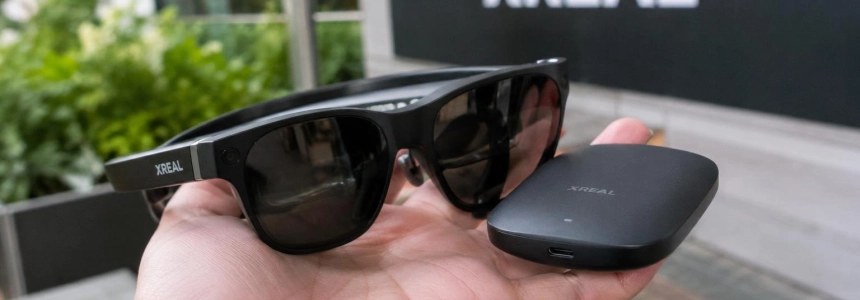
The Xreal Aura weigh 95 grams and bring Android XR to glasses connected by cable to a puck that houses the processor and battery. Reviews from Tom’s Hardware, Tom’s Guide, 9to5Google, WIRED, and TechRadar agree that the form factor makes the experience lighter than a bulky headset; the debate is whether the controls and apps justify carrying another device.
- Developer: Xreal and Google
- Platform: Android XR
Xreal developed Aura together with Google. The glasses feature displays, cameras for hand and spatial tracking, and electrochromic dimming lenses. The puck, connected via USB-C, provides computing power and battery life; it also serves as a touch surface for moving the cursor. According to 9to5Google, it also includes a fingerprint reader.
The concept goes beyond projecting a phone or laptop screen. Android XR lets users open apps in floating windows, interact with them using gestures, and use Gemini with voice commands. The cameras also enable mixed-reality experiences, although the 70-degree field of view leaves part of the real environment visible.
Lightweight design versus a wired system
The low weight is one of the most frequently praised features. 9to5Google compares the glasses’ 95 grams with virtual reality headsets and notes that they feel easier to put on and wear for longer. TechRadar also finds them comfortable, especially at home, in the office, or while traveling. WIRED says they drew stares when worn outdoors, although Tom’s Guide notes they don’t look out of place alongside other display glasses.
Comfort, however, does not eliminate the design trade-offs. The cable connects the glasses to the puck, which must be stored or attached with the included clip. WIRED describes the accessory as one more thing to charge, while TechRadar finds the combination of puck, cable, and keyboard awkward when trying to work. Published battery-life estimates also vary: Tom’s Guide estimates around three hours of continuous use, compared with the four to five hours reported by WIRED and TechRadar.
There are also differences in the physical experience. Tom’s Guide noticed warmth where the glasses rest on the eyebrows, but did not find it uncomfortable; WIRED says the glasses heat up after a few minutes and left marks on the bridge of its nose. TechRadar, for its part, lists the puck’s heat among its drawbacks. Battery life and heat therefore depend on what each review measured or experienced.
Image, audio, and apps
The displays and audio receive favorable reviews. WIRED highlights the 1920 × 1200-pixel resolution per eye and Bose-tuned speakers; Tom’s Guide also thinks they sound better than those on other glasses it has tested. TechRadar praises the image’s sharpness and color. The field of view, however, limits immersion: according to 9to5Google, dark elements can look strange when there are light sources in the environment.
The format is more compelling for movies and video than as a general computer replacement. 9to5Google sees potential in downloading content for offline viewing and combining screen mirroring with other windows. Tom’s Guide tried games such as Demeo and highlighted the connection to Steam Deck and Switch 2. TechRadar also tried the puzzle game Cubism, where it found that hand tracking could feel immersive.
The reviews are less positive about the catalog and interface. 9to5Google puts the number of 150 experiences Xreal is promoting for launch at around that figure, but warns that many apps are still mobile versions and some do not adapt well to gestures. In its tests, Spotify ran as a web version, and notifications appeared on top of whatever was on screen. Tom’s Guide, by contrast, liked the initial setup and found the gestures fluid and intuitive.
Controls divide the reviews
Hand tracking is the main point of disagreement. WIRED says some pinches were not registered and it had to repeat gestures to open apps or change videos. 9to5Google also encountered occasional glitches, particularly when returning to the home screen, although it notes that the top button offers a shortcut. TechRadar says it sometimes struggled to select targets, but was also impressed by the precision when manipulating pieces in Cubism.
The puck provides a physical alternative, but it does not fully convince either. WIRED found its touchpad imprecise; TechRadar considers it a useful way to regain control when gestures fail. TechRadar links the lack of eye tracking to less precise navigation. 9to5Google also describes occasional problems with gestures, though it does not attribute them to the lack of eye tracking. Tom’s Guide, by contrast, describes the gesture controls as smooth and natural to use.
How useful the glasses are for work also depends on the user. WIRED wrote part of its review using the glasses and a virtual screen, but eventually returned to its desktop computer to rest its eyes. 9to5Google wrote its article using Docs and several open windows, although it questions whether that setup is better than working on a laptop. TechRadar considers connecting a computer to expand the desktop an appealing work scenario.
High price, mixed verdict
Published prices are not consistent: Tom’s Hardware says the price starts at $1,099, while Tom’s Guide and 9to5Google cite $1,299 and $1,279, respectively. TechRadar puts the base model at $1,099 and the higher-end configuration at $1,299. That difference matters because cost is one of the main reservations: Tom’s Hardware sees it as a barrier, while 9to5Google considers the higher price reasonable given that it includes the puck and cameras.
The reviews agree that Aura makes Android XR easier to live with than a bulky headset and works especially well for consuming content or expanding another device’s screen. Opinions diverge when evaluating the rest: TechRadar considers it a particularly successful Android XR experience; WIRED gives it a 6 out of 10 and focuses on the controls; 9to5Google doubts that productivity and gaming justify the form factor for many users. The weight is clear; how much the puck, cable, and interface are worth remains a question each review answers differently.
Sources: Tom's Hardware, Tom's Guide, 9to5Google, WIRED, TechRadar