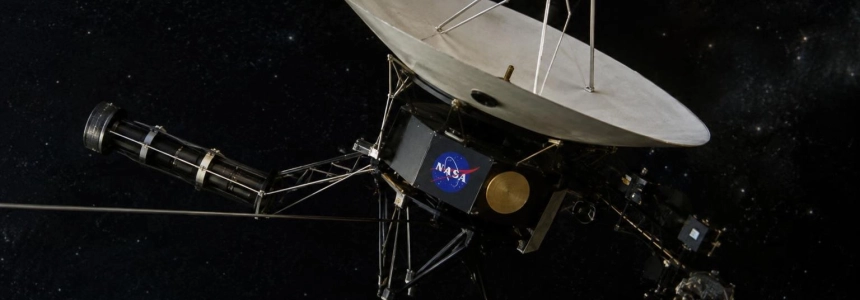
Voyager 1 reached a distance of one light-day from Earth on November 18, but did so without transmitting scientific or engineering data: NASA detected that the probe had stopped sending it four days earlier. The spacecraft is still emitting a radio signal, enough to confirm that it is still communicating and has reached this milestone, although the signal does not contain the information mission teams need.
The malfunction coincides with an unprecedented record: no human-made object had ever been that far away. NASA confirmed the milestone using the carrier signal and trajectory calculations. Engineers have not yet determined the cause of the problem, although the lack of data points to the onboard computer that collects it and prepares it for transmission to Earth.
A signal arrives; the data do not
The mission team detected the problem on November 14, when an antenna belonging to NASA’s Deep Space Network in Canberra, Australia, managed to pick up the spacecraft’s carrier signal, but not the scientific and engineering data it normally transmits. The carrier signal usually accompanies that information; in this case, it continued on its own.
The carrier signal’s continued arrival is useful: it indicates that Voyager 1’s attitude control computer is keeping the antenna pointed toward Earth and that the transmission system is working. The failure appears to lie elsewhere. According to NASA, the lack of data suggests a problem with the computer responsible for gathering information from the various subsystems, including the science instruments, and converting it into the right format for transmission.
The diagnosis will not be quick. The signal takes 24 hours to travel from Earth to the probe and another 24 hours to return. Each instruction therefore requires waiting around two days for a response. NASA warns that figuring out what happened could take weeks or longer.
The current interruption follows another brief outage in October, when the mission lost all contact with the spacecraft for approximately 48 hours. Voyager 1 resumed communication on its own and, according to NASA, operated normally until November 14. Engineers are checking whether the two incidents are related, but have not yet established a connection.
The record was confirmed from Madrid
The milestone occurred on November 18, 2026. A light-day is the distance light travels in 24 hours: about 25.9 billion kilometers, or 16.1 billion miles. NASA places the exact moment at 2:16 a.m. Pacific Time and 5:16 a.m. Eastern Time in the United States.
The signal that made it possible to verify the milestone reached Earth about 24 hours later. A 70-meter antenna in Robledo de Chavela, Madrid, received the transmission. Nicola Fox, associate administrator of NASA’s Science Mission Directorate, explained during a panel at the Jet Propulsion Laboratory (JPL) that the carrier signal had reached the Madrid complex.
The spacecraft’s distance is calculated using trajectory models based on measurements accumulated over many years. The probe is moving away at a constant speed and following a known trajectory; according to NASA, the malfunction cannot change when it crosses that distance. The mission was able to confirm the record despite not receiving the scientific and engineering data.
| Date | Milestone or incident |
|---|---|
| November 14, 2026 | Voyager 1 stops sending scientific and engineering data. |
| November 18, 2026 | Reaches a distance of one light-day from Earth. |
| November 19, 2026 | The received signal makes it possible to confirm the record. |
The milestone comes after more than 49 years of travel. NASA launched Voyager 1 in September 1977. Both Voyager probes were launched in 1977 to study the outer planets. They were the third and fourth spacecraft to visit Jupiter and Saturn, and the first to send high-resolution images of those worlds and their moons. Voyager 2 also studied Uranus and Neptune.
A computer with a history of problems and an aging spacecraft
This is not the first time Voyager 1 has maintained a carrier signal while ceasing to send data. NASA recalls a similar episode in 2023: the control team received the signal, but not the information. That problem was caused by one of the onboard computers, and the experience of resolving it is helping guide the current investigation.
The Register adds that the earlier malfunction was traced to a defective chip and that engineers prepared a software update to work around the damaged component. According to the publication, the spacecraft returned to operation, and NASA announced its recovery in June 2024. NASA has not confirmed that the current failure has the same cause.
The problems are part of a broader history of wear and tear. In recent years, engineers have dealt with computer failures and blockages in the thrusters that keep the antennas pointed toward Earth. In October, contact was interrupted for about 48 hours; now, the latest loss of data has occurred while the spacecraft retains the ability to emit its signal.
Available power is also declining. The Voyagers do not use solar panels: each carries three radioisotope thermoelectric generators, which produce electricity from the heat released by the decay of plutonium-238. As the radioactive material gradually runs out, both probes lose about four watts of power each year.
Saving power without losing science
The mission has had to turn off instruments to reduce power consumption. Each probe launched with ten science instruments; some cameras were no longer used after the exploration of the outer planets was complete, and other equipment has been switched off because of limited power. Engineers are also looking for ways to reduce consumption without giving up more instruments, by making use of redundant systems installed on the spacecraft.
Those responsible for a recent intervention called it “Big Bang.” In September, after months of preparation, engineers simultaneously switched off three devices on Voyager 1 and activated three equivalent, lower-power devices. They had carried out a similar operation on Voyager 2 about six weeks earlier.
The maneuver carried an additional risk: the devices that were switched off helped maintain the temperature inside the spacecraft. Heat generated by some components can help keep others at a suitable temperature. Reducing power consumption without disturbing that thermal balance therefore required sending instructions from Earth, with no way to intervene physically if anything went wrong.
NASA estimates that the savings will provide enough power to keep the science instruments that remain active switched on at least until the summer of 2027, when the probes will mark 50 years since their launch. The latest measures could allow both to continue communicating with Earth for another three or four years, until 2029 or 2030. That does not guarantee they will be able to continue doing science throughout that period: the time will come to decide whether to switch off the last instruments to preserve communications.
“One day in the future, when it can no longer communicate with Earth, Voyager 1 will become humanity’s silent ambassador to the stars.”
— Suzanne Dodd, Voyager project director at JPL
Both probes entered interstellar space: Voyager 1 did so in 2012 and Voyager 2 in 2018. Both continue to measure changes in the Sun’s magnetic field at great distances. NASA expects engineering problems that cannot be resolved will eventually bring both missions to an end, but says it will do everything possible to keep them operational and collecting science for as long as possible.
When they stop transmitting, the spacecraft will continue moving away from Earth. They carry golden records, made of gold-plated copper, containing images and sounds from our planet. In the meantime, engineers must figure out why Voyager 1 is still emitting a signal but no longer returning the data that have accompanied its journey.
Sources: Technology, Technology, Computer Hoy, NASA Science, NASA, Live Science, theregister