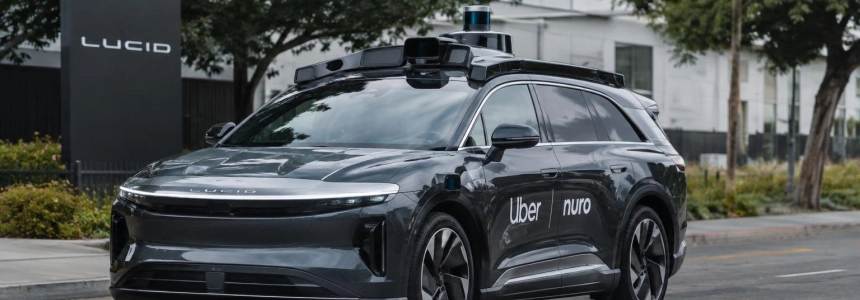
Uber, Nuro, and Lucid are already testing their driverless robotaxis on public roads in the San Francisco Bay Area. The initial phase covers Palo Alto, Mountain View, Los Altos, and Sunnyvale; the companies expect to offer rides to their employees soon and launch the service to the public in the first quarter of 2027.
The change comes after nearly a year of supervised testing. Until now, a safety operator rode in the Gravity vehicles and could intervene; in this phase, the tests are being conducted with no one behind the wheel. The next announced step is rides for employees, before users can request the vehicles through the Uber app.
Four cities for the new phase
The initial trials are taking place in Palo Alto, Mountain View, Los Altos, and Sunnyvale, on the peninsula and in the South Bay. Nuro expects to extend testing to other cities in the area next year. San Francisco is not among the locations named for this phase.
Nuro has been testing the Lucid Gravity on public roads in the Bay Area and Houston since December 2025, with a safety driver on board. CNET and other outlets describe the tests as continuous or “round-the-clock.” The operator's removal, therefore, does not mark the start of road testing, but rather the transition to driving without human backup inside the vehicle.
The fleet numbers more than 100 SUVs, according to The Verge, which puts the number of Gravity vehicles delivered by Lucid for the program at over 100. The outlet compares this figure with the 75 engineering vehicles that, according to its reporting, were in circulation at the beginning of the year. Engadget also reports a fleet of 100 vehicles, although it says it is unclear how many will take part in the initial rollout.
Before moving to public roads without a driver, Nuro tested the system on a closed track in Las Vegas, according to The Verge and Electrek. Electrek mentions trials involving encounters with pedestrians and right-of-way situations, as well as large-scale simulations. Nuro's public announcement does not detail the specific tests conducted on that track.
An electric Gravity with sensors and the Nuro system
The vehicle is a modified version of the Lucid Gravity, an electric SUV. The Nuro Driver autonomous driving system is combined with high-resolution cameras, lidar sensors, and radar. The Verge describes the system as Level 4 and adds that the sensors include solid-state lidar; the information Nuro published for the announcement does not list those specifications.
The roof features, according to The Verge and Car and Driver, a light-up structure or “halo” with LED lights. It helps passengers identify the car and, according to The Verge, can display the user's initials and pickup status. Car and Driver adds that the cabin includes an interface designed by Uber, while Transport Topics mentions a tablet and a dashboard screen that show the route and what the vehicle detects on the road.
The Gravity can carry up to six passengers, according to CNET, which compares that capacity with the four seats available on Waymo and Zoox rides. It also highlights the legroom and luggage space. The vehicle thus combines Lucid's electric SUV platform with Nuro's autonomous system and the ride experience Uber plans to integrate into its platform.
The commercial timeline shifts to 2027
The companies announced the partnership in July 2025. CNET dates the program's first announcement to that month, while The Verge and Electrek say the initial forecast pointed to late 2026 or “later next year,” according to the wording used at the time. The date now announced is the first quarter of 2027 for the Bay Area; Houston would follow later that same year.
Lucid expects to begin manufacturing the first vehicles built specifically for the commercial fleet “in the coming weeks,” according to CNET and Transport Topics. The Verge reports that the company began building preproduction models in October to advance safety approvals. Those preparation vehicles are not the same as production units intended for commercial service.
Uber has committed to deploying around 35,000 Lucid vehicles with Nuro Driver in the coming years, across “dozens” of cities, according to CNET. Electrek explains that the commitment increased from 20,000 vehicles and that the fleet could include future Lucid midsize models in addition to the Gravity. Car and Driver puts the commitment at at least 35,000 vehicles and says Uber will own and operate them alongside fleet partners.
The expansion is not limited to California. The companies expect Houston to be the second market in 2027, and Uber has proposed bringing the service to dozens of global markets in the years that follow. The company will design the in-cabin experience and provide passenger controls, according to Engadget; rides will be accessed through the Uber app.
“Removing the safety operator from behind the wheel is an important milestone in our partnership with Nuro and Lucid, and a testament to all three partners’ focus on executing against our shared roadmap.”
— Samarth Kejriwal, Uber's global head of autonomous mobility
Permits and competition in California
The driver's removal is supported by regulatory permits obtained in California. CNET reports that Nuro received a permit from the California Department of Motor Vehicles in April to test without a driver, and a permit from the California Public Utilities Commission in May to conduct passenger-carrying pilot tests with a safety driver. Car and Driver also mentions two permits issued this year, although it does not give the same dates.
Electrek describes the driverless testing permit as an authorization that the DMV extended to the Lucid Gravity, and the commission's permit as one that allows tests with passengers when a safety operator is present. The authorizations apply to different stages: testing without a driver is not the same as already operating a commercial service.
Electrek says Nuro is one of six companies authorized to test driverless vehicles on California roads. According to the DMV list that the outlet says was updated on November 5, the others are AutoMo, Tensor, Waymo, WeRide, and Zoox. Tesla does not appear on that list: Electrek says its Tesla Robotaxi LLC entity only has a permit to test with a driver and does not have a deployment permit.
The development puts Uber and its partners up against companies already operating or testing robotaxis in the same region. Transport Topics notes that Waymo and Zoox are providing driverless rides, while Motional and Avride, other Uber partners, still have operators who can take control. Waymo already offers paid rides in parts of the Bay Area, including the peninsula and the South Bay, according to Electrek and Transport Topics.
A rollout under scrutiny
The announcement comes at a time of increased attention to autonomous vehicle safety. CNET reports that the California DMV banned Waymo robotaxis from state highways the previous week following several high-profile incidents, and that the company paused its highway rides. Transport Topics adds that Waymo temporarily suspended service in the area on November 23, citing weather conditions.
CNET also notes that the U.S. National Highway Traffic Safety Administration has opened investigations into other autonomous driving companies, including Zoox and Tesla. This is the context in which Nuro, Uber, and Lucid are moving from supervised testing to driving without a safety operator inside the vehicle.
For Uber, the partnership is part of a strategy based on integrating third-party technology into its platform instead of building its own self-driving car. Transport Topics says the company has signed agreements with more than a dozen robotaxi companies and sees its role as connecting passengers with human drivers and autonomous vehicles. CNET lists Waymo, Zoox, Avride, Wayve, and May Mobility among its partners.
The timeline and fleet size will be two concrete measures of what comes next: employee rides will precede the public launch, planned for the first three months of 2027 in the Bay Area. Lucid is expected to begin manufacturing the commercial vehicles in the coming weeks, while driverless testing expands beyond the initial four cities.
Sources: CNET, Engadget, The Verge, Nuro, Car and Driver, Electrek, Transport Topics