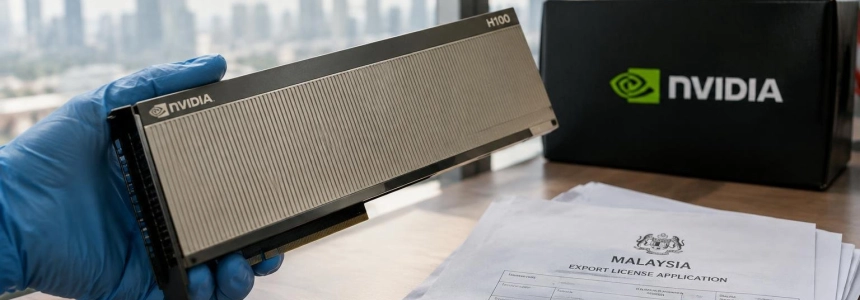
A $480 million loan intended to buy Nvidia GPUs for a data center in Malaysia has been frozen under new U.S. licensing rules. The facility was to serve ByteDance; the episode shows how restrictions can stall project financing even before they affect operations.
The loan case, reported by DIGITIMES, is part of a data center expansion that requires major investment and available computing capacity. DealStreetAsia describes the regulatory change as a test for that model: having a completed building, power, and a customer does not guarantee that the customer can use the installed chips.
The rule covers remote use, not just shipments
The U.S. Department of Commerce issued an interim final rule restricting remote access to certain advanced AI chips. According to DealStreetAsia, operators must obtain a license if they offer, above a specified threshold, computing capacity based on those chips to companies headquartered in China, Macau, or other restricted markets. The requirement applies even if the hardware remains in Southeast Asia.
The distinction matters for the model that had attracted demand to the region. Until now, Chinese companies could primarily use rented capacity on advanced Nvidia GPUs located in Southeast Asia, an alternative when U.S. restrictions made it difficult to buy those chips and take them to China. The new rule introduces a condition on who can access that capacity from outside the country where the equipment is installed.
It also changes controls on shipments: a U.S. license is required to export covered chips to Malaysia, Singapore, Thailand, Indonesia, and Brazil. The requirement does not in itself mean that all projects in those countries will be halted: the restriction described depends on the chips covered, the destination, and, in the case of remote access, the customer and applicable threshold.
| Scope | What the rule requires, according to DealStreetAsia |
|---|---|
| Remote access to computing capacity | A license to offer capacity using certain advanced chips, above a threshold, to companies headquartered in China, Macau, or other restricted markets. |
| Shipment of covered chips | A license to export them to Malaysia, Singapore, Thailand, Indonesia, and Brazil. |
The first effect may show up in debt
The freeze on the loan for the Malaysian data center is the first concrete financial effect highlighted by DIGITIMES. For banks, the change is not just a compliance issue: the ability to sell computing capacity to expected customers can affect the revenue an operator uses to pay its debt. DealStreetAsia warns that the first sign of stress could be a loan that does not close, rather than a data center shutting down its servers.
“The first sign of stress may be a loan that doesn’t close, rather than a data centre that shuts down,”
— Bob Chua, founder of NTRY.AI
The exposure is evident in DayOne’s financing terms. In October, the company expanded bank financing for its Johor data centers to about $7.2 billion, according to DealStreetAsia. The agreement, disclosed in documentation for its U.S. IPO, requires a debt service coverage ratio of at least 1.2 times: for every dollar of debt payments, the borrower must have $1.20 in project revenue and designated reserves.
That margin is not guaranteed additional revenue; it is a condition that must be maintained even after certain dividends. If a customer starts paying later than expected, the operator could continue servicing its debt and still lack the cushion required to pay some dividends. Thus, a delay in licensing or commercial launch can affect shareholders without the facility ceasing to operate.
The scale of the bets explains why lenders and investors are watching chip access alongside construction. DayOne raised $4.5 billion in new capital for its expansion in 2026, while KKR and Singtel agreed to pay $5.1 billion for the remaining 82% of ST Telemedia Global Data Centres, according to DealStreetAsia. These are separate deals, but both depend on installed capacity generating revenue.
The risk runs through customers and GPU prices
Operators may try to replace customers who lose access or change the hardware in their data centers. But these options do not guarantee that demand will remain at the same level or that expected rates will be maintained. Bob Chua told DealStreetAsia that some Chinese companies might move workloads to their home country and adapt their models to domestic chips; others might remain in Southeast Asia and switch hardware.
The risk, therefore, is not limited to a binary ban. If customers leave faster than operators can find replacements, some GPU clusters in Malaysia or Singapore could be underused while new chip deliveries slow. Chua said he would first watch GPU rental rates: a decline would indicate that data centers need to lower prices to fill their servers, even if they sell a similar amount of computing capacity.
That adjustment would have consequences for cash flows. Debt payments do not automatically fall when rental prices drop, and lower profitability can delay profit distributions. For a company financing facilities with loans and equity, the question is whether it can replace affected customers without reducing the revenue on which the project was designed.
For developers, the specific change is that hardware location alone is not enough to determine whether a workload can run: the customer company’s headquarters and whether the service requires a U.S. license also matter. For companies purchasing computing capacity, the change could affect regional capacity availability and the choice between keeping workloads in Southeast Asian data centers, migrating them, or using other chips. The rule described does not support the conclusion that all these alternatives are available to every customer.
Distance from China does not insulate projects
DealStreetAsia compares the current exposure with that of Chinese solar panel manufacturers that built factories in Malaysia, Vietnam, Thailand, and Cambodia to serve markets such as the United States. In 2025, Washington imposed high tariffs on solar imports from those four countries. The comparison does not mean that data centers will face the same treatment, but it does show that operating outside China does not eliminate the impact of U.S. trade decisions.
Immediate pressure is concentrated on financing and the demand each project can legally serve. The $480 million Malaysian loan has already been frozen; for the rest of the industry, the indicators Chua suggests watching are GPU rental rates and operators’ ability to replace customers who lose access.
Sources: DIGITIMES, DealStreetAsia