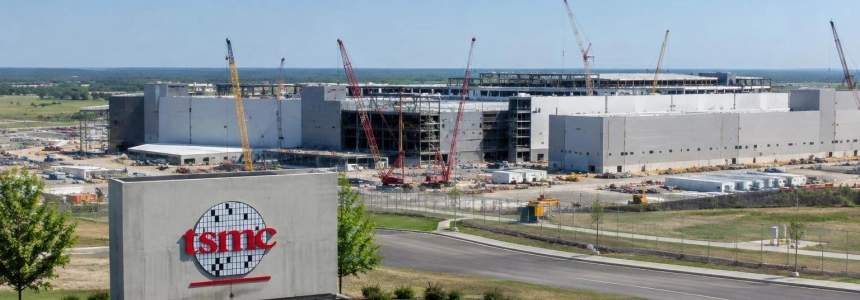
TSMC is considering investing $22.6 billion in a new advanced semiconductor factory in Brazos County, Texas. The project, still contingent on tax incentives and an assessment of the site, is expected to begin construction in 2027 and manufacture 2 nm chips or later processes starting in 2031.
The initiative appears in an application submitted by TSMC Arizona Corporation, the Taiwanese company's Phoenix-based subsidiary, under the state's Jobs, Energy, Technology and Innovation (JETI) program. According to eeNews Europe, the details became public on November 23. The proposal identifies 2 nm logic circuits or more advanced technologies as the planned output, for artificial intelligence and high-performance computing applications.
A phased investment, subject to conditions
The documents describe a five-year construction period that would begin in 2027. Of the approximately $22.6 billion planned, $14 billion would go toward machinery and equipment, and about $8.6 billion toward buildings and property improvements, according to figures reported by eeNews Europe. Tom’s Hardware notes that the application includes a mask shop within the factory and that most of the equipment budget would be allocated to 2030.
The production schedule puts the arrival of 2 nm or more advanced chips in 2031. Tom’s Hardware contrasts that timeline with the start of volume production of 2 nm chips in Taiwan, which it places six years earlier. The Texas investment, therefore, would not mean that TSMC immediately manufactures its most advanced processes there: the rollout depends on the project going ahead and construction and equipment installation proceeding.
| Item | Stated estimate |
|---|---|
| Total investment | About $22.6 billion |
| Construction | Expected to begin in 2027; five years according to eeNews Europe |
| Buildings and improvements | About $8.6 billion |
| Machinery and equipment | $14 billion |
| Advanced production | 2 nm or more advanced chips from 2031 |
| Direct employment | 2,099 permanent jobs according to eeNews Europe; up to 2,099 in the proposal described by KBTX |
Published construction completion dates differ: Hardware Upgrade cites documents pointing to 2031 or 2032, while eeNews Europe describes five years of construction starting in 2027. The site and the startup schedule are also subject to TSMC's assessment.
The application does not commit TSMC to building or buying the land, Tom’s Hardware warns. The Texas Comptroller's office, responsible for managing the state's public revenue, has recommended approving the tax application, but the school district and governor still need to weigh in. KBTX reports that College Station ISD will hold a public hearing on December 10 and that its trustees could vote that day.
A site spanning more than 3,200 acres
The proposal concerns a site of just over 3,200 acres—around 13 square kilometers—in southern Brazos County. KBTX places the area in Precinct 1, north of Koppe Bridge Road and west of I&GN Road; the school district describes a reinvestment zone of about 3,232 acres. The site covers nearly five square miles and, according to KBTX's comparison, about two-thirds of the Texas A&M campus in College Station.
The land is under contract, but county records indicate that it has not been purchased. KBTX also notes that the agreements cited in the application are nonbinding. Tom Johnson, president and CEO of Greater Brazos Partnership, told the station that part of the site would serve as a buffer zone and that the company would want to maintain a distance of 1,000 feet from residential areas.
According to documentation cited by Hardware Upgrade, Brazos was selected because of its proximity to Texas A&M University and the potential to hire people with engineering training, as well as its closeness to Bryan and College Station and the availability of an airport. KBTX adds that the regional partnership has been working with TSMC for about four or five months and that, according to Johnson, the site beat out more than 20 locations considered in Texas and other states.
The company, however, is keeping Arizona as an alternative. The application mentions the possibility of acquiring and developing another site there, alongside existing production infrastructure and a supplier network. According to Hardware Upgrade, that option could also benefit from training programs and relationships with local authorities.
Expected employment and economic impact
The impact analysis associated with the application estimates 2,099 permanent direct jobs, with hiring beginning in 2028, according to eeNews Europe. KBTX puts the expected average salary at $133,000 a year. Hardware Upgrade also reports an estimate of around 7,400 indirect jobs; another regional assessment reported by KBTX estimates 7,160 jobs across the county at the peak of activity in 2033.
The indirect job figures come from estimates with different sources: KBTX attributes its figures to a Greater Brazos Partnership analysis focused on one factory. That analysis also estimates $1.7 billion in annual economic activity and around $1.4 billion in new state revenue over ten years. These are projections, not outcomes guaranteed by a decision to build.
Johnson suggested that the first facility could be the start of a larger expansion. In an interview with KBTX, he said the project could become the first of five or six factories, or more, if TSMC decides to expand in the region. In another interview cited by the station, he estimated that such an expansion could exceed 10,000 jobs. The current proposal, by contrast, covers at least one factory; no commitment has been announced for additional facilities.
“We beat out over 20 sites across the country and in Texas to win this facility.”
— Tom Johnson, president and CEO of Greater Brazos Partnership
Local hiring would depend in part on transferring expertise from Taiwan. Johnson said workers could come from that country because the technology would be new to the local workforce, and estimated that more than 75% of the jobs could eventually go to Texas A&M graduates and other Texas residents. According to him, the transfer of skills could take between five and ten years.
Water, electricity and roads
The arrival of a factory of this size would also create demands for utilities and infrastructure. Johnson told KBTX that the partnership is in the final stages of negotiations to secure water from outside the county, which would be piped into local systems, with the company contributing financially to construction of the pipelines. The partnership expects TSMC to recycle more than 90% of the water it uses and the additional supply to help expand the capacity available to residents.
Those expectations are not the same as an independent impact assessment. KBTX says it has not independently verified the water-recycling projections or potential reductions in electricity rates. Johnson said the plant would add capacity to the power grid and that the commercial sector would bear a significant share of the costs; he also said the partnership is working with the governor's office and ERCOT on electrical infrastructure.
Traffic will be affected in the short term while roads are being built, Johnson acknowledged. According to KBTX, he said the company wants to contribute to road construction costs from the outset during the initial phases. A road over the Brazos River, connecting to Highway 50, has been raised as a long-term possibility, not as infrastructure that has already been approved.
The partnership also anticipates increased demand for flights and a possible expansion of the airport and connections from College Station. Johnson mentioned potential routes to Taiwan, Phoenix and Houston, but did not announce any confirmed services. On housing, he said the region would need more supply, especially homes priced between $200,000 and $350,000, and that discussions are underway with developers.
The tax incentive and pending decisions
Tax incentives are central to the location decision. TSMC has applied for a limit on school property taxes through the JETI program. Hardware Upgrade reports that the company has tied approval of the benefit to its decision to bring the planned investment, advanced capacity and jobs to the state. Tom’s Hardware puts the proposed school tax reduction at around $354 million.
KBTX provides more detail on the calculation: a report by the Texas Comptroller estimates a $354 million reduction in school property taxes over 20 years, compared with around $405 million in school operating taxes that the project would generate over that period. The publication notes that these are projections and that the state would replace the revenue College Station ISD would forgo. Johnson did not describe the terms of a final incentive agreement.
The next local milestone is the College Station ISD public hearing, scheduled for 5:00 p.m. on December 10 in the district boardroom at 1812 Welsh Ave. Trustees could vote on the proposal at that meeting. KBTX reports that Governor Greg Abbott has until December 24 to decide and an additional week to notify the parties; if the district or governor rejects the application, the agreement will not proceed.
Meanwhile, TSMC is preparing another stage of its U.S. expansion: the opening of a new phase of Fab 21 in Arizona is scheduled for December 4, preceded by an event for industry partners and suppliers on the 3rd. The first phase produces N4 chips; the second is expected to move to N3 in the second half of 2027. The third is under construction, and its structural completion ceremony took place in May, according to Hardware Upgrade.
The Brazos plan would therefore be TSMC's second U.S. campus dedicated to advanced chips and its first outside Arizona, if it receives the necessary approvals and the company confirms the investment. The application must be considered by College Station ISD trustees and the governor; production of 2 nm chips is not expected before 2031.
Sources: Hardware Upgrade, Tom's Hardware, eeNews Europe, https://www.kbtx.com, https://www.kbtx.com