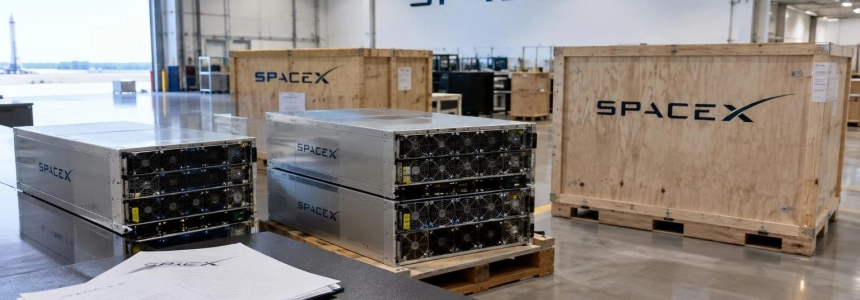
SpaceX will finance about $44 billion in GPUs and related equipment through a transaction led by Apollo and Goldman Sachs. The November 20 announcement raises the amount from the binding commitment of approximately $40 billion the company reported in October, and puts the expected start of the leases in the first half of 2027.
The transaction has two aspects that should be distinguished. Apollo and Goldman Sachs announced the pricing of approximately $44 billion in senior and subordinated notes to finance the purchase; TechCrunch reported a binding commitment of nearly $40 billion in October. The new announcement describes the amount as priced and expanded, not as a second, separate transaction.
| Announcement | Amount | Status described | Timeline |
|---|---|---|---|
| TechCrunch, October 26 | Approximately $40 billion | Binding commitment, subject to closing conditions | Expected to close before year-end; leases from the first half of 2027 |
| Apollo and Goldman Sachs, November 20 | Approximately $44 billion | Senior and subordinated notes priced; oversubscribed and upsized transaction | Leases would begin as equipment is delivered during the first half of 2027 |
A GPU purchase financed through leases
The structure described by TechCrunch separates initial ownership of the hardware from SpaceX’s use of it: an entity managed by Apollo would purchase the GPUs and server equipment, then lease them to the company. The contracts would run for approximately five to five and a quarter years, with each term beginning when its corresponding batch of equipment is delivered. Apollo and Goldman Sachs, for their part, describe financing through senior and subordinated notes to fund the purchase.
The delivery-based schedule matters for payments: lease payments would begin with each delivery, not necessarily all at once. Apollo expects the hardware to arrive in the first half of 2027. The package will include Nvidia’s next-generation Vera Rubin chips and equipment associated with the deployment of SpaceX’s ground-based computing infrastructure.
The transaction was oversubscribed and upsized after strong investor demand, according to Apollo and Goldman Sachs. In addition to funds and affiliates managed by the two firms, anchor investors included funds and accounts managed by BlackRock and Goldman Sachs Asset Management, along with capital accounts advised by KKR. The structure therefore combines large-scale financing with commitments from several managers, although the announcement does not specify the amounts contributed by each.
Spending accompanies a larger computing push
The deal comes as SpaceX accelerates the expansion of its AI infrastructure alongside its Starlink and launch businesses. TechCrunch reported that SpaceX’s AI segment, which includes the Grok chatbot, the Cursor coding tool, and its cloud computing business, generated $7.6 billion of total revenue of $14.6 billion in the third quarter. According to the publication, the segment exceeded investor expectations and generated more revenue than Starlink and space launches combined.
The expansion is also reflected in physical investment. SpaceX’s capital expenditures approached $20 billion, up from $6.9 billion a year earlier, according to TechCrunch. On an October 20 earnings call, CFO Bret Johnsen said the company expected to spend between $35 billion and $40 billion in the fourth quarter. Those figures help explain why the company is seeking to finance some of its GPU investment through a dedicated structure, rather than cover the entire investment with traditional debt.
“This lease diversifies our funding sources and addresses a notable portion of the funding required to deliver on our growth plans”
— Bret Johnsen, SpaceX CFO
Johnsen also said, according to TechCrunch, that SpaceX is seeing payback periods of less than a year on its AI infrastructure as it expands capacity. The claim helps explain the economic appeal the company sees in the expansion, but it does not guarantee that every facility or GPU batch will achieve that timeframe: the announcement does not break down costs, utilization, or revenue per piece of equipment.

Flexible financing, long-term obligations
Leasing provides a way to obtain computing capacity without SpaceX having to purchase all the hardware directly with its own funds. TechCrunch presents it as a way to diversify funding sources and reduce reliance on traditional debt markets. For a company that also has revenue from Starlink and launches, this mix of businesses is relevant in a market where investors, according to the publication, have grown more cautious about high capital spending and the limited profits of some AI infrastructure operators.
The trade-off is clear: SpaceX takes on multiyear lease commitments in exchange for access to high-cost equipment. The five- to five-and-a-quarter-year contracts described by TechCrunch mean the financing is not simply a purchase deferred without further consequences; it ties future payments to the batches received. Published information does not specify rates, guarantees, exit terms, or how risks would be allocated if demand for computing changed.
For cloud GPU providers, the deal also highlights differences in scale and financial profile. Elon Musk argued on X, according to TechCrunch, that debt markets were closing to companies that depend exclusively on AI data centers, without other significant revenue sources. In the same publication, he predicted that more than 200 neocloud companies would face heavy attrition and consolidation. This is Musk’s assessment, not an outcome demonstrated by the SpaceX deal.
The transaction gives SpaceX a way to add Nvidia Vera Rubin hardware in large quantities and stagger the start of payments according to deliveries. For companies that rent GPUs, the contrast TechCrunch draws is that SpaceX can rely on revenue from other businesses, while specialized providers depend more directly on selling computing capacity. The financing alone does not reveal what share of the GPUs will go to Grok, Cursor, or the cloud, or how they will be allocated among those services.
What remains to be measured
The November announcement confirms the pricing of an expanded transaction, but does not detail SpaceX’s final cost or the financial performance of each batch. Nor does it identify specific delivery dates beyond the first half of 2027. The timeline matters: leases will begin when the equipment arrives, while the company is projecting a major computing expansion and very high capital spending.
The bet combines next-generation technology with multiyear obligations and demand for computing that SpaceX expects to monetize through its AI services. Initial deliveries are expected in 2027; the associated equipment leases will begin from that point.
Sources: Apollo Global Management, Inc., TechCrunch