SpaceX plans to build a supercomputing center near the port of Brownsville, Texas, powered by a natural gas plant with an initial capacity of around 750 megawatts. The planned investment for the first phases amounts to about $24 billion, and the project has already entered the local debate over energy and water consumption, emissions, and the tax benefits it could receive.
The initiative places a computing facility alongside its own source of electricity, on land that Brownsville removed from its municipal boundaries in August and that later became part of Starbase. The Texas Tribune puts the initial investment at $24 billion; TecnoAndroid describes it as just over 20 billion euros. These figures are not expressed in the same currency, but both point to a large-scale project.
A complex near the port, not the launch pad
The site covers 444.45 acres, or about 180 hectares, according to The Texas Tribune, and lies east of Brownsville, between Boca Chica Boulevard and the port. KRGV places the site near the Port of Brownsville and notes that it is within Starbase's boundaries following its deannexation from the city. The area is close to SpaceX's Texas facilities, although it is not the Starship launch pad.
The air permit application reviewed by The 956 Report calls the location “Boca Chica Facility,” but places it alongside Boca Chica Boulevard, in the port's industrial corridor. Its coordinates are 25.957265 north and -97.369633 west, about 13 miles west of the Starship launch pad. The filing describes the power plant; it does not explicitly mention a data center.
The application was submitted to the Texas Commission on Environmental Quality (TCEQ) on September 8, 2026 by Trinity Consultants on behalf of Space Exploration Technologies Corp. It includes a $900 fee and requests authorization under the state's standard permit for electric generating units. The filing identifies Nicholas Engebretson as a senior engineer at SpaceX and the company's representative.
Two turbine configurations and a difference in capacity
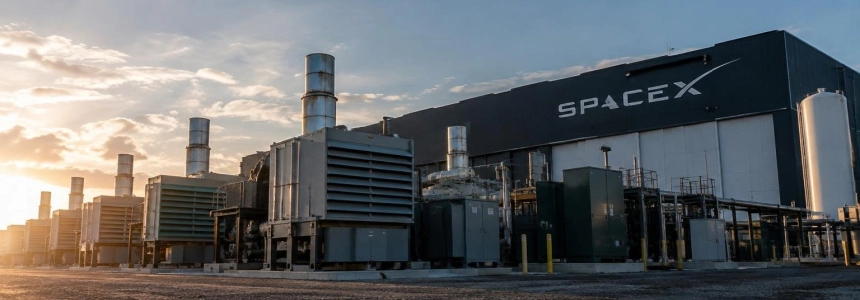
The application describes an initial configuration of 35 natural gas turbines, classified as temporary, and a final installation of eight GE Vernova 7E turbines. The 956 Report estimates the combined rated capacity of the 35 initial units at about 748 MW. TecnoAndroid rounds the project to 750 MW, while the final configuration specified in the filing would total about 708 MW.
| Configuration | Equipment described | Capacity indicated |
|---|---|---|
| Initial, temporary | 6 GE Vernova TM2500 (Plus) Gen 6; 2 GE Vernova TM2500 (+G4) Gen 8; 9 Mitsubishi FT8; 18 Solar SMT-130 | About 748 MW total |
| Final | 8 GE Vernova 7E | 88.56 MW each; about 708 MW combined |
The initial units have rated capacities of 25.4 to 27.4 MW for the GE Vernova models, 27.1 MW for the Mitsubishi FT8 units, and 16.48 MW for the Solar SMT-130 units. The eight final units are listed at 88.56 MW each. The filing says the temporary turbines will operate while the permanent ones are installed, with the latter entering service as the former are retired. It does not set a schedule: both the start of construction and the start of operations are listed as “TBD”.
The 956 Report notes that the turbines are used or refurbished, not newly manufactured equipment. The document adds that manufacturer performance guarantees are generally unavailable and that SpaceX did not purchase the units directly from their manufacturers. According to the filing, the emissions estimates are based on process engineering knowledge.
The deannexation that put the site outside Brownsville
The site's municipal history is central to the controversy. During the summer, SpaceX asked Brownsville to remove it from the city's boundaries. In exchange, it offered to contribute up to $220 million to water and wastewater projects. Commissioners approved the deannexation in August; the site subsequently became part of Starbase.
The move drew criticism from residents and environmental activists, who feared it would facilitate further SpaceX expansion in the area. It also sparked speculation that the company was preparing a data center and wanted to avoid a city moratorium. The Texas Tribune reported that those suspicions gained traction when Brownsville approved a 90-day pause on new data center applications, which took effect the week before its November 10 publication.
By removing the parcel from Brownsville, the project fell outside the jurisdiction of that moratorium. The newspaper reported that if the site had remained within the city limits, SpaceX would probably have had to look elsewhere. Brownsville defended its decision, saying it was based on the circumstances at the time, including the location, municipal services, and potential long-term benefits.
The city said the $220 million would fund water infrastructure needed to support future growth. It also said it would independently review any subsequent deannexation request and takes concerns about data center development, water resources, and electricity consumption into account.
Permits, emissions, and questions about operations
The application sets annual limits for several pollutants under the initial configuration. The filing puts nitrogen oxide emissions at 248.86 tons, just 1.14 tons below the federal threshold of 250 tons per year that triggers a more rigorous PSD review under the U.S. Clean Air Act for this type of facility.
| Pollutant | Proposed annual limit |
|---|---|
| Nitrogen oxides (NOx) | 248.86 tons |
| Particulate matter (PM, PM10 and PM2.5) | 242.11 tons |
| Sulfur dioxide | 205.62 tons |
| Carbon monoxide | 204.77 tons |
| Volatile organic compounds | 105.54 tons |
| Ammonia | 499.76 tons |
| Formaldehyde | 8.07 tons |
The NOx limits depend on controls keeping emissions between 1.75 and 1.9 parts per million, according to the filing. The 956 Report calculated that applying the standard permit limit of 0.14 pounds per megawatt-hour to all 35 turbines running at full capacity would result in potential emissions of about 458 tons per year. The document provides for a proportional reduction in the capacity factor if NOx emissions exceed the declared amount; in practice, this would mean operating less.
The calculation of the limits is based on routine operation, not on startups and shutdowns, when hourly NOx emissions can be about 13 times higher. The application allows 50 startups or shutdowns per turbine per year, up to 1,750 events for the 35 units, and argues that these episodes are covered because the turbines will not operate at full load for every hour of the year.
The 956 Report also warns that, although the plant would remain below the stated PSD threshold, SpaceX's tables mark “No” for the federal Title V operating permit threshold for several pollutants. According to the outlet, this means that the permit will be required, and its process usually includes public notice and a comment period. The turbines' standard permit application does not appear to offer the same process; the public notice section is blank.
The filing does not estimate carbon dioxide emissions or address water consumption. Using standard emission factors from the Environmental Protection Agency, The 956 Report calculated that the turbines could emit about 4.3 million tons of CO2 per year at full load. The same outlet estimated gas consumption of about 197 million cubic feet per day under those conditions; both figures are the outlet's calculations, not values declared by SpaceX in the filing.
Protests, jobs, and a December vote
The South Texas Environmental Justice Network announced a protest against the project. Its objections include potential deterioration in air quality, water use, and the effect on residents' electricity bills. The concerns add to opposition to new data centers that The Texas Tribune describes in communities across Texas, where worries about energy demand and water scarcity are also significant.
Other residents see the facility as a source of jobs. Janie Melendez, a Brownsville resident and teacher, said: “There are a lot of people who need jobs in our community, and SpaceX has contributed to those jobs.” She also noted that the value of her home had tripled since SpaceX arrived and that she tries to find a balance. Melendez had served on the executive committee of the Republican Party of Texas, although she said her politics do not determine her views on SpaceX and data centers.
“There’s a lot of people that need jobs in our community and SpaceX has contributed to those jobs.”
— Janie Melendez, Brownsville resident and teacher
The next local decision has a date and time: Starbase commissioners will consider a property tax exemption and a related economic development agreement at 7:00 p.m. on December 9, at Starbase City Hall. According to KRGV, the public will be able to attend and speak. The Texas Tribune had reported that a public hearing would be held in December to consider tax incentives, without specifying the date at the time.
At the state level, Governor Greg Abbott ordered electric grid operators in August to pause data center connection requests until they are audited. He also asked the TCEQ to stop issuing permits for data centers, although critics say some applications have continued to move forward. An on-site power plant could allow SpaceX to supply electricity to its facility without connecting to the state grid.
Governor-elect Gina Hinojosa, meanwhile, said she would impose a ban on all data center approvals until the state legislature passed laws to protect Texans. SpaceX did not respond to The Texas Tribune's questions about the project and has not publicly explained what equipment or facilities the power plant will supply with electricity. The environmental application still lists the start of construction and operations as dates to be determined.
Sources: TecnoAndroid, The Texas Tribune, KRGV, The956Report