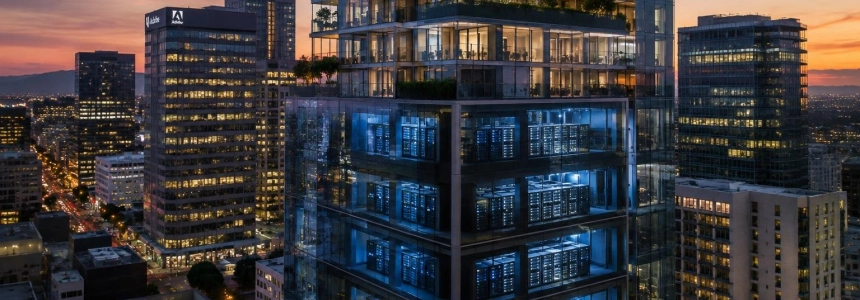
A proposal for downtown San José combines an 11-story data center with a 28-story residential tower and an expansion of a science museum. This is not a warehouse isolated in the countryside: it is a computing facility embedded in an urban development, a sign that some developers are exploring vertical buildings to bring computing capacity closer to where demand is concentrated.
Going vertical does not mean the industry is abandoning large outlying complexes. Tom’s Hardware describes developers proposing urban towers of 11 to 13 stories, despite the renovations needed to adapt the floors and the strain on the power grid. In San José, the proposals cited by KQED show how this idea could take shape: data center buildings alongside homes, not just standalone campuses.
The cloud already occupies urban areas
The familiar image of isolated data centers does not match the distribution found by a study from NYU Tandon School of Engineering. The team examined 4,283 commercial data centers in the continental United States and calculated that 97.5% are within metropolitan or micropolitan statistical areas, which include urban centers and their surroundings.
The remaining 2.5% are not necessarily far from a city either: on average, those facilities are 8.5 miles from the urban boundary. The figure requires a caveat: the study includes operational facilities as well as planned projects, those under construction, and sites set aside for development. In addition, its definition of “city” covers broader economic areas than densely built-up centers.
The concentration is evident in major markets. Washington-Arlington-Alexandria has 610 facilities, 14.2% of the U.S. total; Chicago has 241 and Dallas-Fort Worth, 192. New York and Phoenix join those three areas to make up the five regions that account for nearly a third of the data centers analyzed.
So the novelty of vertical projects is not that computing is reaching cities for the first time. It is that some developers want to insert buildings specifically designed for data centers into downtown areas and combine them with other uses, such as housing. This approach brings the debate over digital infrastructure directly to streets where land, energy, and quality of life are already contested.
What San José is proposing
The downtown projects covered by KQED present several ways to stack uses: a data center alongside a residential tower, another combined with apartment blocks, and a third proposal that offers a choice between a residential-only building and one with a data center on the ground floor.
| Location | Proposal described |
|---|---|
| 180 Park Ave. | 11-story data center alongside a 28-story residential tower and an expansion of The Tech Interactive. |
| 300 S. First St. | Seven-story data center alongside three 30-story towers with 1,164 apartments. |
| 323 Terraine St. | Option for a residential-only building or one with a seven-story data center beneath 345 homes. |
The city is also reviewing standalone proposals in the north and south, with substations, water tanks, and generator yards visible from the street. A project on Orchard Parkway calls for two four-story buildings totaling 630,000 square feet on 22 acres, as well as three water tanks, its own substation, and a PG&E switching station. On West Trimble Boulevard, another project would remove 224 trees to build a facility with 21 generators and a private substation.
The volume of applications is adding pressure to the planning process. San José is reviewing 11 other data center projects; the municipal list cited by KQED contains eight applications under review and three approved projects. Several of the largest are capped at 99 megawatts, just below the state threshold of 100 megawatts that triggers stricter oversight, according to the explanation reported by KQED.
The advantage of existing infrastructure
Location depends on more than finding an available building or site. The NYU study identifies local power capacity as the strongest predictor of where data centers are built: these facilities keep servers running continuously and need a large, stable supply of electricity.
Networks built for earlier industries also matter. NYU found that coal-fired power plants closed near cities can attract new data centers because they retain lines and connections capable of transmitting electricity. In cities that overlap with areas designated as “Energy Communities” under a 2022 federal policy, data centers under development are twice as likely to appear as in cities without that designation.
This pattern links digital expansion to infrastructure inherited from fossil fuels. The Energy Communities policy sought to direct clean energy investment to regions affected by coal plant closures; the study suggests that the digital economy can take root in some of those same places. It does not, by itself, determine whether each project will use clean energy: according to NYU, the carbon footprint depends on how electricity is generated on the local grid.
The availability of information technology workers and high-speed internet also helps explain the concentration. By contrast, local water scarcity appears to have less influence on location, even though data centers consume large amounts of water for cooling. This distinction matters to the urban debate: energy appears to be a more direct factor in siting, while water remains a local impact concern.
The cost of bringing computing closer
A downtown building can place capacity near demand, but it does not eliminate a data center’s physical requirements. San José’s proposals include dedicated power and water infrastructure, as well as backup generators. Tom’s Hardware notes that converting floors in buildings for this use requires major renovations and that growth can strain the power grid.
In the city, the debate is no longer limited to building design. San José is working on environmental standards, and its city committee voted to have staff incorporate community benefits and study whether some tax revenue can be reinvested near each facility. Ideas raised include parks, job training, affordable housing, residential solar power, and clean energy programs.
The proposal responds to a specific dispute: projects can generate tax revenue, but their neighbors bear the burden of generators, water tanks, and new infrastructure. Mayor Matt Mahan put it this way:
“But revenue cannot be a permission slip to ignore quality of life or harm the environment. A project that creates economic value while shifting environmental or other costs to nearby families is not a good deal.”
— Matt Mahan, mayor of San José
There is also disagreement over when the rules should take effect. Residents and organizations called for new applications to be put on hold until the standards are approved; city officials responded that special permits take more than six months and that projects need environmental impact reports. According to KQED, the city expects any proposal submitted at that time to reach a hearing no earlier than February or March, and says a new center would need at least a year to go through the process.
What changes for businesses and planners
For companies developing computing capacity, towers open up a siting option in places where land and urban infrastructure are already in use. But the model depends on local agreements covering electricity, water, generators, and land use. In San José, PG&E committed to investing $2.6 billion in South Bay infrastructure between 2026 and 2035, as part of a partnership that secured power supply for ten major projects.
The city estimated that each data center could generate between $3.4 million and $6.8 million a year in utility and property taxes. This potential revenue helps explain the appeal to the city, though it does not resolve how benefits are distributed relative to impacts concentrated in nearby neighborhoods. The discussion of community reinvestment is specifically intended to set terms for that exchange.
For teams planning infrastructure and operations, the practical consequence is that location may depend on municipal decisions and available grid capacity, as well as computing demand. The NYU study emphasizes that existing infrastructure shapes where construction takes place; the San José case shows that local acceptance and zoning rules can also determine a project’s timeline and form.
The scale of neighborhood opposition helps explain why these agreements have become part of project design. KQED cites a Gallup poll according to which seven in ten Americans oppose building data centers for artificial intelligence in their area; nearly half express strong opposition, while about a quarter support them.
The question left open by the vertical model is not just how many servers fit in a tower. San José still has to decide what environmental standards to apply and whether to tie revenue from these developments to benefits for the neighborhoods that host them. The final form of its buildings will also depend on how that negotiation is resolved.
Sources: Tom's Hardware, NYU Tandon School of Engineering, KQED