Samsung Electronics promoted 131 executives in its 2027 reshuffle, but recognition focused on those who developed HBM memory and expanded its production. The overall cut in promotions coincided with a clear bet on semiconductors: more than half of the promotions went to the Device Solutions division, while the consumer and mobile device division reduced its promotions after two consecutive quarters of operating losses.
The decision links the rise of artificial intelligence memory to who gains influence within the company. It is not just a matter of rewarding the design of new chips: Samsung also recognized those responsible for processes and manufacturing yields, indicating that turning technical advances into stable production is central to its strategy.
Fewer promotions, concentrated in semiconductors
This year's 131 promotions were 30 fewer than the 161 in the previous year, a decline of 18.6%, according to Seoul Economic Daily. The group included 39 executive vice presidents, 78 vice presidents, two fellows and 12 masters. Yonhap also reported the total and noted that more than half of those promoted belonged to Device Solutions, the division that manages the semiconductor business.
The contrast becomes clear when comparing the two major business areas. Device Solutions went from 69 promotions to 70, despite the overall cut; Device Experience, which includes consumer and mobile products, fell from 92 to 61. Seoul Economic Daily puts the decline at 31 promotions, or 33.7%. The company explained the criteria with the phrase “rewards go where results are”.
“rewards go where results are”
— Samsung
The gap reflects differing results, not just an abstract preference for chips. Yonhap reports that Device Experience recorded operating losses in the second and third quarters amid rising component costs. Seoul Economic Daily adds that the division faces the risk of ending the year with its first annual operating loss.
HBM: design, yields and volume manufacturing
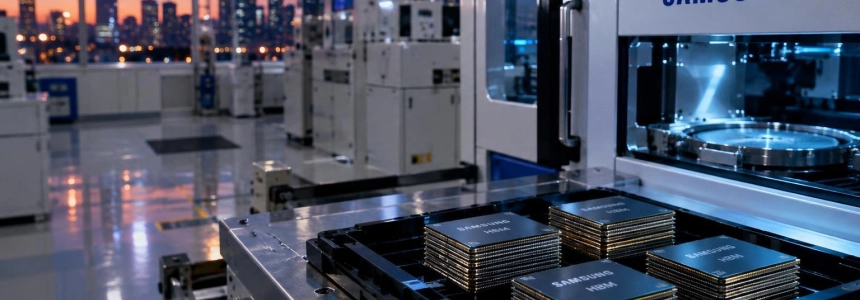
In memory, Samsung promoted Ha Kyung-soo, head of DRAM design, to executive vice president. Seoul Economic Daily credits him with developing HBM4, sixth-generation HBM memory that the outlet describes as the world's first of its kind. Korea JoongAng Daily specifies that his contribution involved circuit design and the mass production and supply of HBM4.
Park Tae-hoon's promotion highlights another part of the chain: improving DRAM processes and manufacturing yields to prepare HBM4 for mass production. Park Jin-pyo was recognized for developing next-generation customized HBM and diversifying the product lineup. Taken together, the appointments cover the design, manufacturing and customization of memory, not just one stage of the product.
Kim Myung-oh, who is associated with DRAM product development and competitiveness, was also promoted, according to Seoul Economic Daily. Korea JoongAng Daily also mentions Jang Se-jeong for his work on SSD units for AI servers. The promotion of these people broadens the focus beyond HBM: the group is also pursuing memory and storage for AI systems.
The signal for the organization is clear: AI demand is increasing the strategic value of memory, but Samsung ties that value to being able to manufacture it at good yields and in volume. The company did not report figures for capacity, deliveries or supply shares in these reports; the promotions therefore show internal priorities, not how much chip supply will increase.
Foundry and the battle to turn interest into orders
The reshuffle also rewarded those responsible for foundry, the chip manufacturing business for customers. Song Tae-joong was promoted to executive vice president for his role in securing orders, while Ryu Hyo-kyum received the same rank for developing intellectual property for high-speed interfaces and expanding design infrastructure, according to Seoul Economic Daily.
Korea JoongAng Daily adds Lee Ho, associated with performance and manufacturing-yield improvements in 4- and 5-nanometer processes, and Lee Ki-jo, who helped secure projects from global AI companies. This combines commercial, process and design capabilities. The challenge implied by these appointments is to sustain customer acquisition and technical execution: the outlet itself describes restoring foundry competitiveness as an ongoing challenge.
This emphasis broadens the scope of the shift toward AI. Samsung is rewarding both the memory that supports these systems and the ability to manufacture chips for customers and provide them with design tools. For companies that contract manufacturing or develop hardware with advanced memory, the reshuffle indicates where Samsung is concentrating talent and attention; it does not, by itself, guarantee availability, timelines or commercial terms.
A new division of responsibilities
The promotions follow changes at the top of the semiconductor business. Korea JoongAng Daily reports that Samsung appointed three new presidents in Device Solutions: Hwang Sang-joon, who will lead the memory business; Cho Sang-yeun, head of System LSI; and Lee Jong-myeong, the division's chief technology officer.
The company is keeping its two-CEO structure, with Jun Young-hyun and Roh Tae-moon, but both are stepping down from concurrent roles in their respective areas in favor of their successors. According to Korea JoongAng Daily, the new arrangement leaves Jun focused on developing foundry and Roh on future growth areas such as robotics. Mid-level appointments reinforce this specialization, although the reorganization of positions and responsibilities still had to be completed and announced.
The bet on the future is not limited to chips. Samsung promoted Koo Dong-han and Hyung Seung-yong, who are associated with the development of humanoid robots and motion and control technologies. It also promoted Matthieu Apotheker, head of management support at Device Experience, for his work on new businesses and mergers and acquisitions, according to Seoul Economic Daily. Robotics thus joins memory, foundry and AI as another area to which the company is assigning management talent.
The cost of betting on businesses that are already performing
Cutting promotions in the consumer area while increasing them in semiconductors makes the focus on results more visible, but also concentrates recognition and internal opportunities in the areas that are currently delivering stronger figures. Seoul Economic Daily notes that the number of new vice presidents at Samsung rose from 33 to 40. Device Solutions went from 69 promotions to 70, while Device Experience lost 31 promotions.
The reshuffle also saw a record 11 women promoted, according to Seoul Economic Daily and Korea JoongAng Daily. They include Lee Yoon-kyong, promoted to executive vice president after leading an AI data platform for the company, and Chang Chae-myung, who is associated with memory investment strategy. These appointments connect the technology push with data infrastructure and capacity planning, although the reports do not detail specific changes to budgets or production.
For Samsung, the balance lies in capitalizing on the AI memory boom without neglecting areas experiencing losses or businesses still seeking to regain competitiveness. The promotion of HBM, foundry and robotics specialists makes clear which capabilities it wants to strengthen; the decline in promotions at Device Experience shows the organizational cost of that prioritization. The next reshuffle of positions will need to translate these changes in rank into concrete responsibilities.
}Sources: Yonhap News Agency, Seoul Economic Daily, koreajoongangdaily